
Running Commentary 6/22/2026
Hello,
I managed to lose a draft on Sunday night, and had to re-write a lot of this, which is why it’s a few days late. My apologies.
Anyway...
Playing...
Warframe
A new update’s out with a new quest following up on “Jade Shadows” and continuing Stalker’s story. I’ve played the quest itself, so far. Gameplay-wise, there’s not a whole lot to it. Story-wise, It’s not quite as good as “Jade Shadows” but it provides some nice final(?) resolution to Stalker’s story for now, and it brings his story into the story of Wally, which means another loose plot thread has been woven into the main narrative of the game. While Stalker gets a happy ending, Wally did manage, it seems, to get rid of Hunhow, who’d proven to be quite a powerful ally in his odd way, and right in the lead-up to our return to Tau. So we have a wrapping-up and a leading-in all at once, which perhaps leaves this particular quest feeling a little hollow on its own, but that I’m confident is working in the larger whole once we’re looking back on it.
Before we get to Sirius and Orion in the new update, I’ll get my thoughts on Follie out there: Follie is a good study in the distinction between utility and usefulness. There are a lot of things Follie can do, but I don’t find many of those things broadly helpful in playing Warframe, at least the way I play it. It’s not that her functions are useless, but they’re mostly very situational. She’s most similar to Vauban in how she plays, with her crowd-control 4 being less powerful, and her bag of tricks to throw out being more versatile, offering not just area hazards for enemies but also various little boosts, including some for specific mission types like excavator power cells or life support modules. Her powerset seems focused on snatching victory from the jaws of defeat, in this way, and while I get what was gone for there, I’m having difficulty picturing when I’d think Follie would be an obvious choice to play. Because, for all she can do, Follie can’t heal herself, which I think is very important when considering what to bring to a truly difficult mission. And in an easier mission you really won’t need those emergency item summons. So that leaves Follie as a ‘frame you play if she just clicks with you, and she doesn’t with me.
Anyway, I’ll play more of the new update and, in a couple weeks, it’s TennoCon, so I’ll give my thoughts on what’s shown there.
Eating...
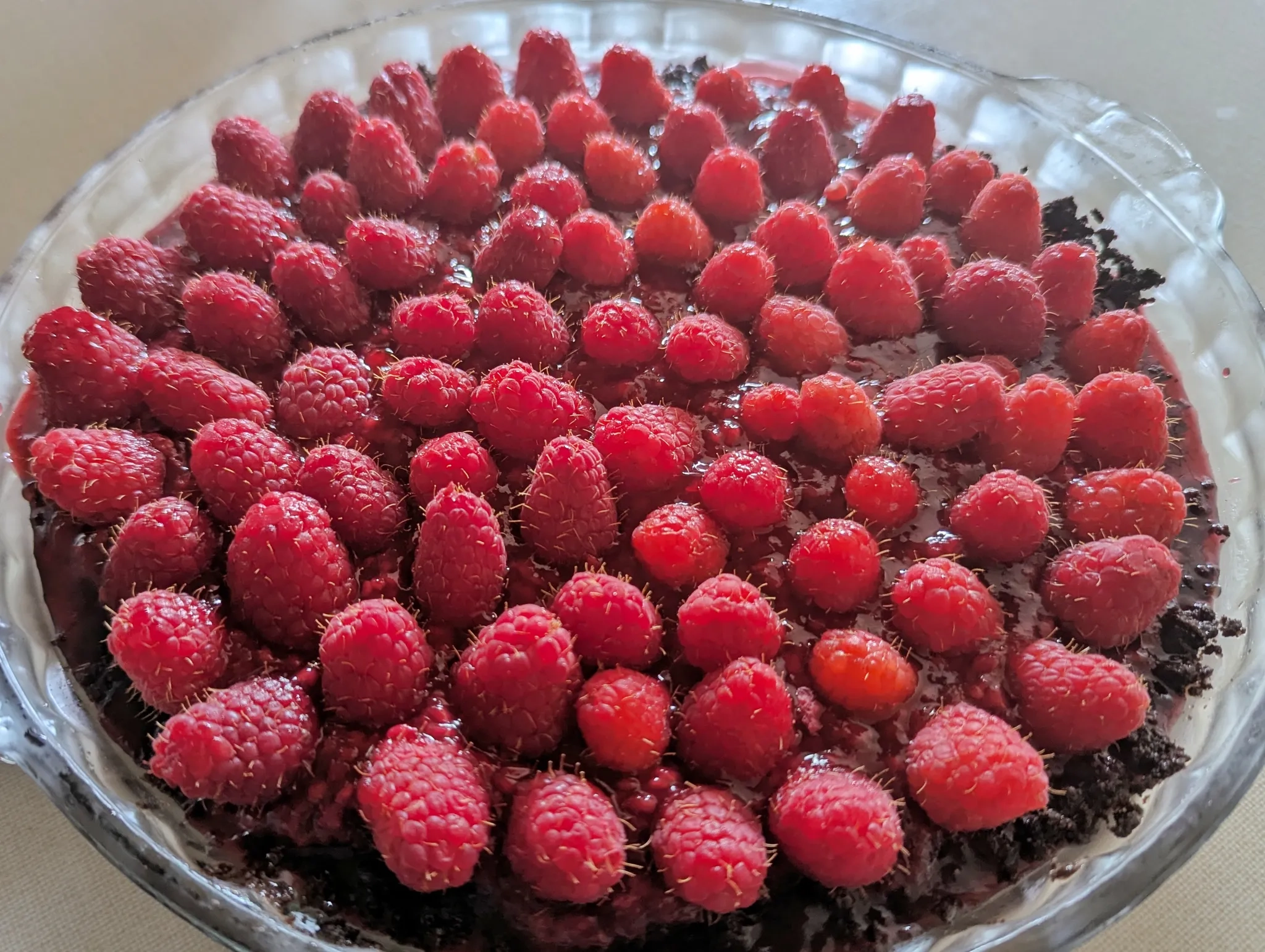
Chocolate-Raspberry Pie
It’s berry season, which means I finally got a chance to try this out. The recipe comes from Cook’s Illustrated and I didn’t really change much about it when I made it, except as I record it I will say that, if you don’t have fresh raspberries, you could leave them out and it would still be quite good.
Ingredients
- 16 Oreo cookies, pulverized to fine crumbs
- 1 TBSP sugar
- 4 TBSP butter, melted and cooled
- ⅓ cup heavy cream
- 4 oz. milk chocolate, chopped
- ¼ tsp salt
- 2 TBSP water
- 2½ TBSP gelatin
- 1¼ lb (4 cups) frozen raspberries
- ½ cup sugar
- ¼ tsp salt
- 2 tsp lemon juice
- 1 tsp vanilla
- 12 oz fresh raspberries
Procedure
- Mix first block of ingredients together, drizzling butter into cookie crumbs, and press into a 9-inch pie plate; use the bottom of a dry measuring cup to press the crumbs into a compacted crust.
- Bake the crust for 15 minutes at 325 °F, then allow to cool for 30 minutes.
- Combine second block of ingredients in a double boiler, melting the chocolate into the cream to form a smooth ganache.
- Pour ganache into crust and refrigerate for 30-60 minutes.
- Whisk together water and gelatin and let sit at least five minutes; this will form a rubbery substance.
- In a large saucepan, cook together frozen raspberries, sugar, salt over medium-high heat until boiling. Reduce to medium low and cook, stir, until mixture is reduced to 2 cups.
- Off heat, add lemon juice, vanilla, and hydrated gelatin, stirring until gelatin dissolves.
- Add mixture to crust; If you’d like, top this with fresh raspberries arranged tip-up.
- Refrigerate, covered, for at least 4 hours or overnight.
- Serve with whipped cream.
Bird of the Week
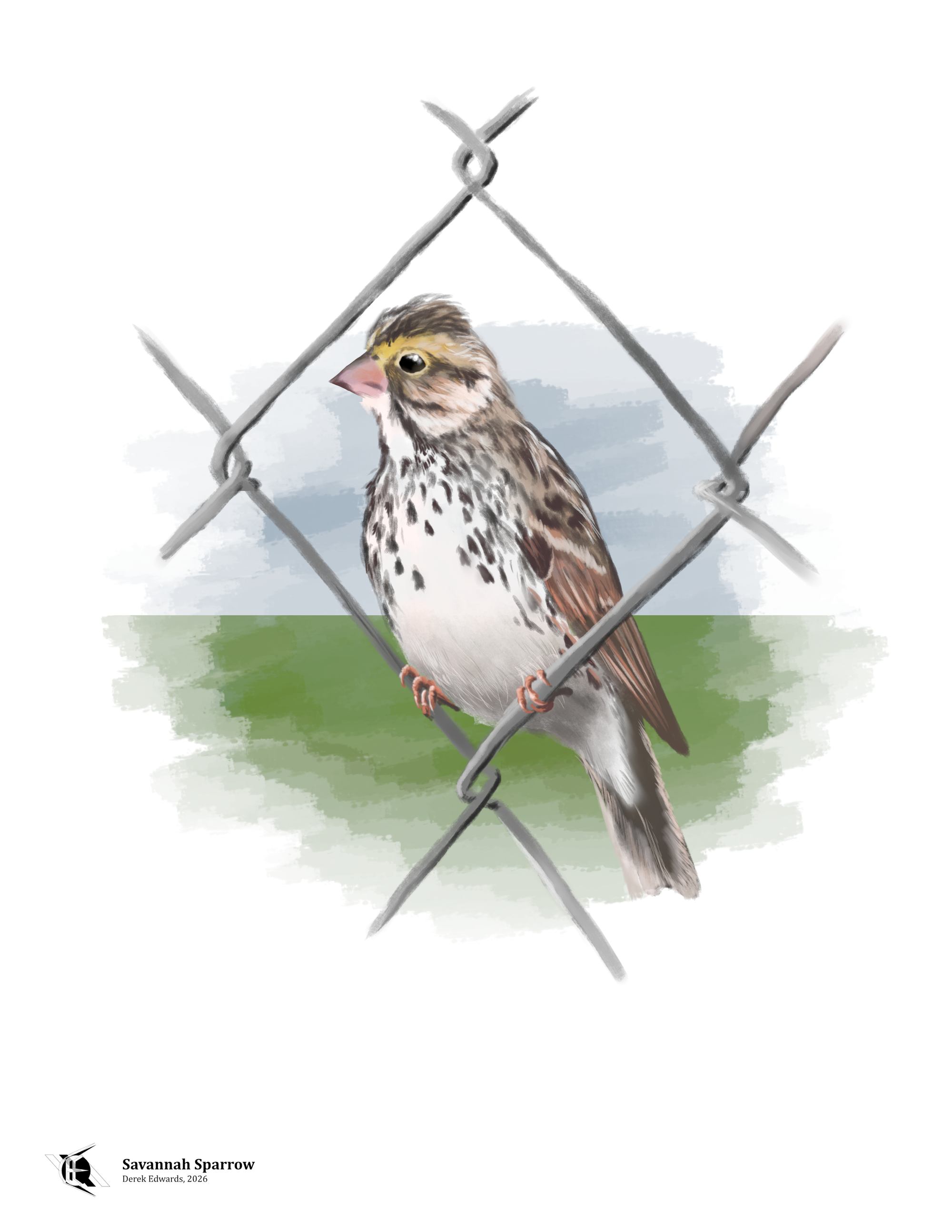
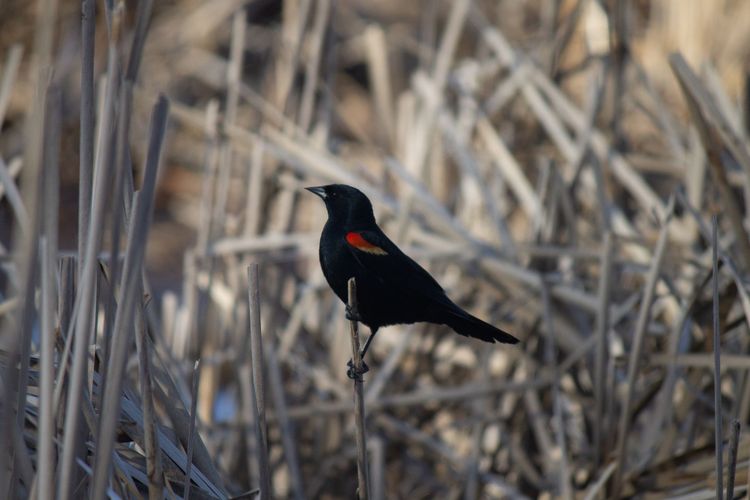
I’ve mentioned this before, but it bears repeating: it is as important to listen to birds as it is to look at them. There’s a reason that when I go out in search of birds I say I’m “birding,” not “birdwatching.” It’s because “birding” is a bit quicker to say. But even still, it works out because “watching” is only half the task. Many birds sing, and that’s the easiest way to find them, and it can be a good way to identify them, especially if they aren’t too visually distinctive, like this week’s bird, the Savannah Sparrow.
I first found a Savannah sparrow sitting on a chain‑link fence surrounding an airfield. Back when I featured the horned lark, I mentioned how the clear expanses around airports make for some surprisingly good bird habitat for open‑country species. The Savannah Sparrow was the 150th species added to my life list. I’m not sure what my 100th was; when I first sat down to actually work out my list, the total came to just over 140 species. At time of writing my list stands at 207 (including three species — the yellow rail, the American bittern, and the least bittern — that I’ve only heard). It might have made sense for one to draw my 200th, the Forster’s Tern, which I first saw this year, but I have little to say about another larid. I’ll do another someday, but for now let’s look at my first noted milestone bird.
A savanna is a type of landscape characterized by open fields dotted with the occasional tree or grove. The Savannah sparrow is indeed a bird of open country, but it is not named after the savanna, at least not directly. Alexander Wilson, in his great birding tour of the early United States, noted an unusual sparrow near Savannah, Georgia, a city so named because it sits on the Savannah River, which in turn is either named for the Spanish word for flatlands from which the English “savanna” was derived (the Spaniards called the river the Río Dulce, or “sweet river”), or from the name used for the “southerners” among Algonquian Native Americans, which is more commonly anglicized as “Shawnee.”1 In any event, the Savannah sparrow is found in savanna‑type settings: meadows, farm fields, marshes, and wide grasslands. Their range is extensive; at some point in the year you can expect to find Savannah Sparrows anywhere in North America that isn’t covered by trees. Small and striped brown, the Savannah sparrow can be difficult to spot or to take notice of. Visually, the best thing to look for is the bit of yellow above their eyes, but this can vary based on subspecies. When I go looking for them, I’m really going listening.
When I presented the Bay‑breasted Warbler I spoke a bit on the subject of computerized aids in ID’ing birds by sound; now I want to talk about an older method: mnemonics. Birders have long tried to hear words or phrases in the songs of birds, words being easier to remember than odd little tunes. Thus the yellow warbler is said to sing “sweet, sweet, sweet, I’m so sweet!”, the barred owl is said to ask “who cooks for you?”, and the tufted titmouse is said to be calling “Peter, Peter, Peter.” These are some of the common shared devices, but there are lots of others unique to a given birder—things that only make sense to them. I have one of these for the song of the Savannah Sparrow: to me, the ones I’ve heard in person and the ones I’ve heard in recordings taken in Michigan, all seem to be calling the name of the CEO of the company I work for in my day job. It’s not so exact that I think anyone else could hear it besides me and my coworkers (and not all of them hear it either), but it’s something I can reliably hear and remember, so it works as a mnemonic device for me. Whatever odd thing helps you remember what a bird sounds like, go for it.
Recordings I’ve heard of Savannah Sparrows from elsewhere don’t sound quite the same. This shows the limits of my own mnemonic’s usefulness, but it also shows something about the birds themselves: they’re quite local, as individuals if not as a species. There are more than a dozen subspecies, such as the Ipswich sparrows of coastal Nova Scotia (which winter in the dunes of the northeastern US, and are named for Ipswich, MA) or the thick-billed sparrows of California. This has arisen from the birds’ noted preference and ability to return to exactly the same small area year after year to nest. Savannah sparrows are some of the best‑studied of migrant songbirds, and our knowledge of these birds has been useful to our understanding of bird migration more broadly. How Savannah Sparrows are able to find their home fields each spring has been of particular interest. They’ve been found to possess interconnected senses for Earth’s magnetic field and polarized starlight that help them find their way precisely without the aid of the maps we would need to undertake the same journey unaided; these abilities are thought to be typical among migrant birds.2
To science, the Savannah sparrow is Passerculus sandwichensis. The genus name is Latin for “little sparrow,” which is pretty straightforward. The species name is a little less obvious. Alexander Wilson had called it Fringilla savanna (“Savannah finch”), but he was not actually the first scientist to describe this species. Johann Friedrich Gmelin, as part of his work cataloguing New World species for updated editions of his mentor Linnaeus’s Systema Naturae, included a bird found in Alaska, which Latham had called the “Sandwich Bunting” after the Sandwich Sound. Once it was determined that the two were the same bird, the older name took precedence. Sandwichensis usually is given to Hawai’ian species, referring to Cook’s name of Sandwich Islands for the Pacific chain, but that’s the only state in which Savannah sparrows are not found.3
- Neuffer, Claude & Irene Neuffer. “Names in South Carolina Vols. XIX-XXIV, 1972-1977 - Names in South Carolina Vol. XXII, Winter 1975, Page 21 - Names of South Carolina - UofSC Digital Collections,” n.d. https://digital.tcl.sc.edu/digital/collection/nsctest/id/854/rec/3.
- Able, K, and M Able. “The Flexible Migratory Orientation System of the Savannah Sparrow (Passerculus Sandwichensis).” Journal of Experimental Biology 199, no. 1 (January 1, 1996): 3–8. https://doi.org/10.1242/jeb.199.1.3.
- Jobling, J. A. (editor). The Key to Scientific Names in Birds of the World (S. M. Billerman et al. editors), Cornell Laboratory of Ornithology, Ithaca.
Curation Links
After the Tragic Lindbergh Kidnapping, Artist Isamu Noguchi Designed the First Baby Monitor | Roger Catlin, Smithsonian
“It sits like a dark, faceless plastic mask, more like a prototype for a Star Wars film. Eight inches high and made of black Bakelite, Isamu Noguchi’s Radio Nurse is not only a modern design that fits in with his monumental stone sculptures for which he is known, but the 1937 artwork is also the first working baby monitor.”
Stones In Coffee: An Ill-Advised Investigation | James Hoffman
[VIDEO] Like many agricultural products, there’s a chance that coffee beans might have a few stray pebbles in the mix, that you need to sort out before you grind the beans. But what would happen if you put a stone through a grinder? Which would win? James Hoffman investigates. (24 minutes)
Eat More Deer | Yasmin Tayag, The Atlantic
“Wherever deer are overabundant, they are at best a nuisance and at worst a plague. They trample gardens, destroy farmland, carry ticks that spread Lyme disease, and disrupt forest ecosystems, allowing invasive species to spread. They are involved in tens of thousands of car crashes each year in New York and New Jersey, where state wildlife departments have encouraged hunters to harvest more deer. In especially populated regions, wildlife agencies hire sharpshooters to cull the animals. Last year, New Hampshire legislators expanded the deer-hunting season in an attempt to keep the population under control. By the looks of the forest floor, which was pitted with hoof marks and scattered with marble-shaped droppings, that effort was falling short.
Over the past decade, some states have proposed a simple, if controversial, strategy for bringing deer under control: Couldn’t people like me—who don’t hunt but aren’t opposed to it—eat more venison?”
Inheritance | Palmer Holton, The American Scholar
[FICTION] “My mother was the caretaker of the Moybridge family’s idiot son, George, for most of my life. I believe she would have gladly died in service to this cause—the constant looking after, the chauffeuring of his bent body around town, the perpetual soothing of him—if she hadn’t shattered her pelvis tumbling down the front steps of her own home one sunny afternoon.”
See the full archive of curations on Notion

Member Commentary