
Running Commentary 6/15/2026
Hello,
I’m back. I hadn’t really planned to take a month-and-a-half off, but I did wind up doing that. Nothing major happened; I was doing a lot of birding in my spare time in May, and I’ve been doing a lot of reading, and I’ve had family visiting, and I just haven’t had the time for a few weeks. But I do still have things to write and birds to draw, so now that the spring migration is past I should be able to get back to regular Monday postings.
Speaking of birds, since I last wrote here I’ve passed 200 on my Life List. The 200th was the Forster’s tern that I found on the western shore of Lake Erie; I’m up to 207 now.
Forster's Tern, my 200th bird
Anyway...
Watching...
The Mandalorian and Grogu
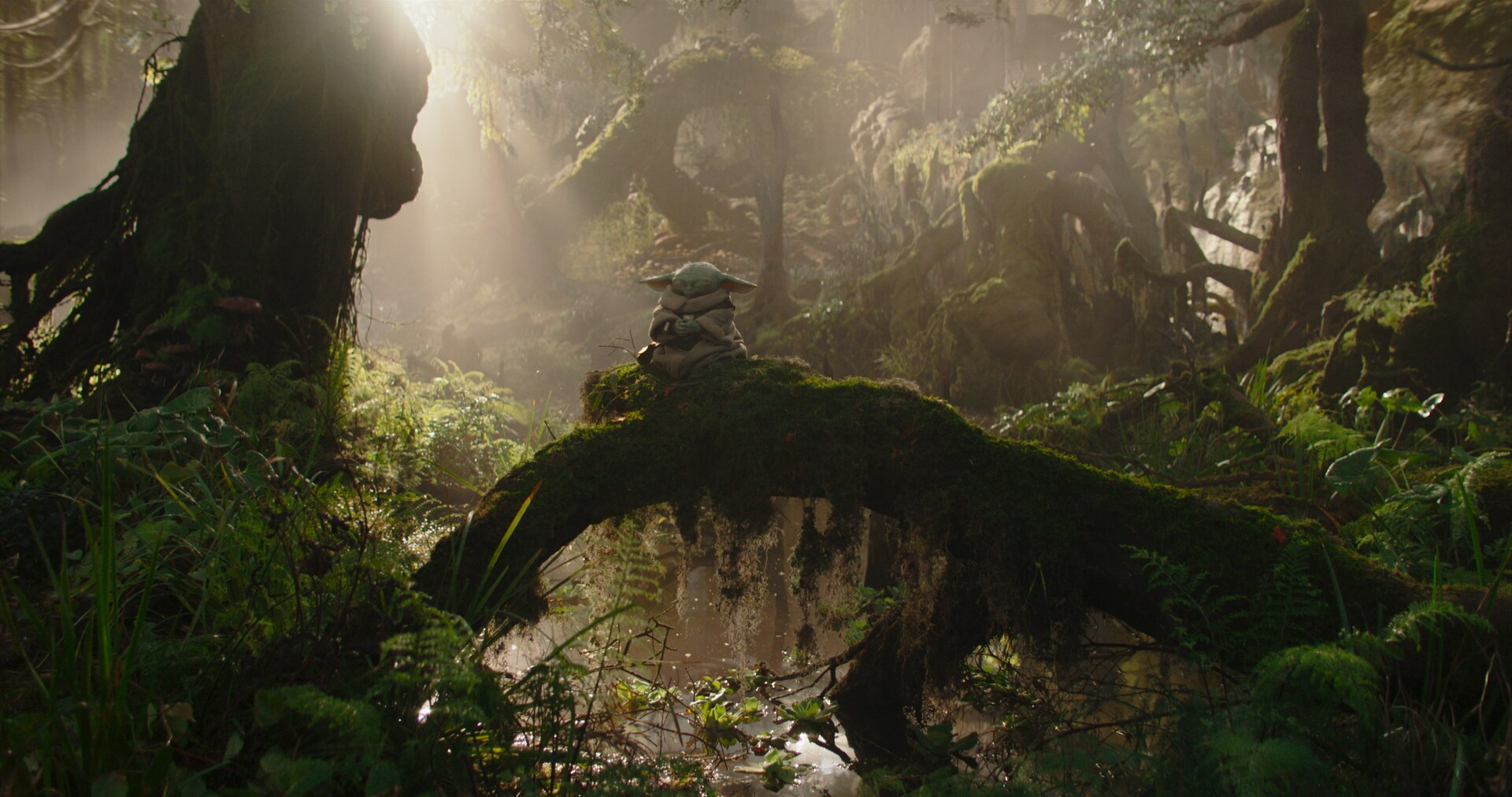
I started this newsletter, if you’ll remember, because I wanted to give my immediate thoughts on episodes of The Mandalorian. And now a big motivator to get posting again is to give my immediate thoughts on The Mandalorian and Grogu, which I saw not on opening day overall but on opening night for a local one-screen theater I like to patronize because they have good ticket prices.
- Star Wars returns to theaters — if not to the theatrical dominance — with The Mandalorian and Grogu. The title is awkward but fitting, as there are several sequences wherein Grogu is the protagonist being followed. If one liked the show, one will like this film, which comes from the same creative team.
- Jon Favreau has said that this film was a reworking of storylines meant for the television show. One can kind of pick up on this while watching. Specifically, the film divides cleanly into the section before the capture of Jannu Coin and the section after. In the show, these two halves could easily be two different arcs, with other storylines placed in between, even.
- The strength of this film is the action scenes. There are a lot of spectacular one‑on‑one fights, some good space dogfights, but not a lightsaber to be seen, a first for a Star Wars theatrical release. The plot of the film is pretty straightforwardly in service of the action scenes. I’d compare this movie to an entry in Mission: Impossible or James Bond. It even has an stand-alone action‑sequence opener before the film proper starts. The film is more or less what I had expected the show to be before I saw it. It’s very entertaining, if not perhaps the most deep or touching entry in the franchise. I really enjoyed it.
- I don’t want to dwell much on the business side of the things I review, but I will say it doesn’t bode well for the future of Star Wars — at least in theaters — that this film is not making money. This is a solidly good film that offers people pretty much exactly what they want from a Star Wars movie, barring a lightsaber duel. If this isn’t doing well I wonder if any Star Wars would. It could be that Disney+ subscribers are just waiting for the movie, which is, of course, a follow-up to a Disney+ series, to hit streaming; I’ve heard as much from a few of my friends. I suppose the gap between theatrical and home‑viewing experiences has narrowed quite a bit, so this attitude makes more sense than I’m sure filmmakers would like it to.
- Add Sigourney Weaver, Jeremy Allen White, and Martin Scorcese to The List.
Jonny Coyne is already one of The List, due to his brief appearance in The Mandalorian Season 3. I will say, having an actor named Coyne play a character named Coin, whose identity is meant to be a secret, is a bit of an unforced error.
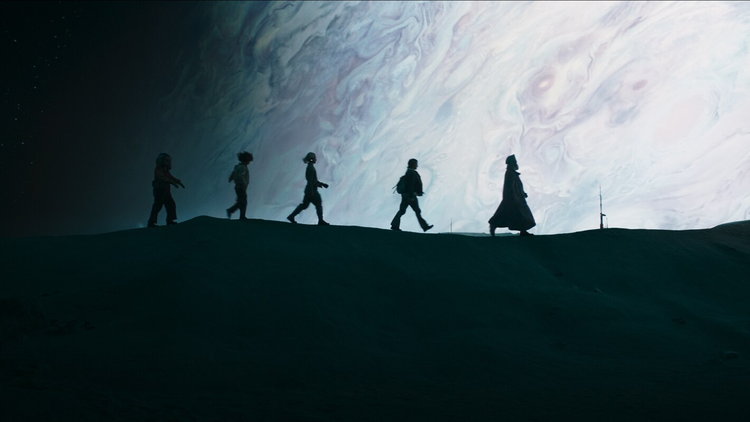
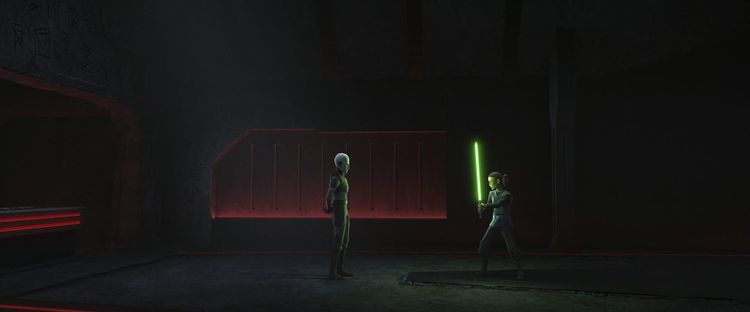
Maul: Shadow Lord
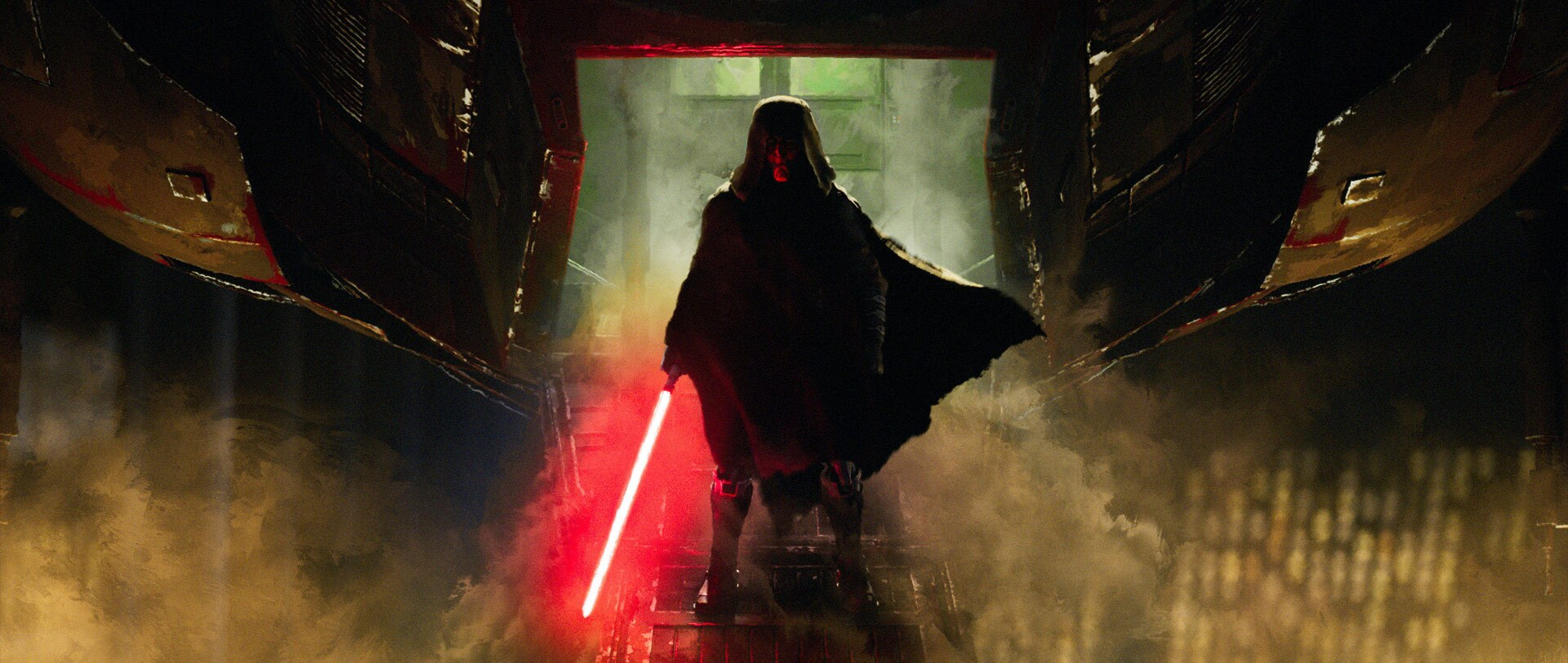
- The show takes place between Episodes III and IV, specifically around the same time frame as The Bad Batch, as evidenced by the use of Clone Wars–era materiel and TK‑troopers. The setting is the world of Janix and its large capital city.
- When Maul was brought back in The Clone Wars, I thought that was a bit of a stupid thing to do, and it’s a little silly how he’s brought back and how he was meant to have survived being cut in half with no medical aid. But I will say that once he was back, he became a really intriguing character. A former Sith, someone who knows all of Sidious’s secrets, a deadly adversary for whatever protagonist you want to have. Someone who is always very close to losing, who’s always on his back foot, trying to find an angle to get his life back on track even as he’s left without a clear idea in his own mind of what his life ought to be. Maul is a dangerous man with mainly immediate goals, which makes him an interesting contrast to characters like Sidious, who have a lot more control and can plan a lot further ahead. Maul is the sudden snarl in a plan.
- The cops in this story are interesting. I will say that there's a lot here that was also in Andor surrounding Syril Karn; Two-Boots is more or less a robotic version of Syril, and goes through about the same arc. It's certainly bold to invite that kind of comparison. I think it works, especially given that this show, too, deals with various responses to the rise of the Empire. Of course, we get a lot less of Two-Boots than we got of Syril.
- The Jedi survivors in this show were done pretty well. Eeko-Dio Daki was little bit of a generic Jedi Master, but I think this is intentional. Devon Izara is widely speculated to be an move toward realizing George Lucas’s vision of Darth Talon without necessarily using that name (which makes good sense, to me, since the Darth Talon of Legends came along a century after the Clone Wars anyway). I’d rather make the comparison to Reva Sevander in terms of being a fallen Jedi who turns to the dark side in response to the Purge. Obi-Wan Kenobi did have an interesting idea there, that I think got bungled by making Reva such a cipher for most of the show, so I’m glad to see this idea tried out again.
- Add Dennis Haysbert and Wagner Moura to The List.
- The action sequences in this show are consistently well‑shot (or whatever that's called in animation) and choreographed. I can’t help but compare this to action scenes from the live‑action shows. It’s a pity that Star Wars makers and fans alike seem to feel that animation is only meant for children’s stories, and that proper tentpole shows need to be live-action. Of course, the animated projects often get coded into the children’s media space. I’m not sure what I’d call this show. It's pretty grim with a very dark protagonist, if it is meant to be a kid's show. I guess this sits with Clone Wars Season 7 as being for established Star Wars fans.
- For ten episodes of television, I don’t feel that a whole lot happened in this show. I guess it’s not badly paced, but the season could have been tightened up quite a bit, especially in the second half, without losing much. I don’t think it dragged, but just looking back I’m not sure there are ten episodes’ worth of story. Probably this is mainly down to the show not really being episodic—it’s one long story chopped up.
- I’m excited for a second season.
Bird of the Week
During the reign of the Emperor Trajan, at the time of the 2nd Censor, there lived a man named Decimus Junius Juvenalis, a satirist who wrote at length about the sorry state of Rome. Today, the era in which Juvenal lived is remembered as the Pax Romana, a period of unprecedented peace and prosperity and the general high point of the ancient Roman era. But even still, there were enough things to complain about to prompt Juvenal to write sixteen poems decrying all the things wrong in Rome. The longest of these was his Satire VI, which railed against a rather broad swath of Roman society: women. Addressed to a young man, “Posthumus,” the poem warns against marrying, because there are no women any longer in Rome who would be a worthy wife. Juvenal has many unkind things to say about various Roman women of note: Eppia, who left her senator husband for a gladiator; Messalina Valeria, wife to the Emperor Claudius, who reportedly would work as a harlot under an assumed name; Consennia, who supposedly bought her husband’s love with a large dowry; Bibula, whom he says gets away with affairs because she is beautiful, for now.
This eloquent tirade has endured to the present day because it is actually one of the more useful sources of Roman attitudes toward women, and because it is the source of a few common turns of phrase. For instance, “Who watches the watchmen?” In the original context meaning that wives might be able to sneak out at night even if locked indoors, since they’d be able to seduce the guards. And then there’s another line, earlier on, that’s relevant for my purposes here:
“Nullane de tantis gregibus tibi digna videtur?” sit formonsa,decens, dives, fecunda, vetustospartibus disponat avos, intactoomni crinibus effusis bellum dirimente Sabina,rara avis in terris nigroque simillima cygno, quis feret uxorem cui constant omnia?
‘Isn’t there a single one worthy of you, in all that vast flock?’ Let her be lovely, gracious, rich, and fertile; let her exhibit her Ancestors’ faces round her porticos; be more virginal than the Sabine women, with tangled hair, who ended war with Rome; A rare bird on this earth, in the very likeness of a black swan; Who could stand a wife who embodied all of that? 1
—Juvenal, Satire VI, lines 161–164
Here, Juvenal says that even if you were to find a decent woman to marry — a woman as good and pure as the fabled Sabine women who had defended the founding Romans (whom they had been abducted by to be wives) from their own enraged families, which I suppose is a form of faithfulness to one’s husband, albeit not in the typical sense — even if you found such a remarkable woman, you shouldn’t marry her either, because she’ll be conceited. Toward women, toward the emperor, toward nearly everything, Juvenal holds a comically bitter pessimism, one that many of his readers have pushed back against through the centuries.
But there was one thing he said that they would accept as a given for a long while: he compared the rarity of that hypothetical decent woman to that of a black swan—that is to say, women are as uniformly unfaithful as swans are uniformly white. Everyone in the West “knew” that swans were white… until the 17th century, when Dutch sailors found something in that famous land of strange creatures: the Black Swan.
The first rumors of black swans come to Europe from Antonie Caen, a sailor aboard the Banda, who reported “two stately birds as large as swans, which had orange yellow bills and were almost half a yard long”2 seen as the ship passed Bernier Island. At least, it’s commonly attested that Caen was the first European to see black swans, although that quote doesn’t mention it the birds being black, gets the color of the beak wrong, and, unless there’s some other length that might be called a “yard,” gets its length wrong. I haven’t been able to find Caen’s original account of the voyage. What I can say with certainty is that just a bit later, another Dutch explorer, Willem de Vlamingh, while searching for survivors of a wrecked expedition, found large numbers of black swans up a river near the future site of Perth, and gave the river the name Swarte Swaane Drift—the Black Swan River.3 Today Perth sits on the banks of what came to be called simply the Swan River.
It’s unclear to me how much of a splash this made in Europe at the time. At the turn of the 18th century there were so many new things being learned about the world that I could imagine one bird getting lost in the shuffle, but it certainly kicks the legs out from under Juvenal’s metaphor that there are, in fact, black swans; they aren’t even rare, they just exist somewhere beyond his imagined world. It’s a reminder that the world is always larger than we know; faithful women and black swans both existed beyond his experience.
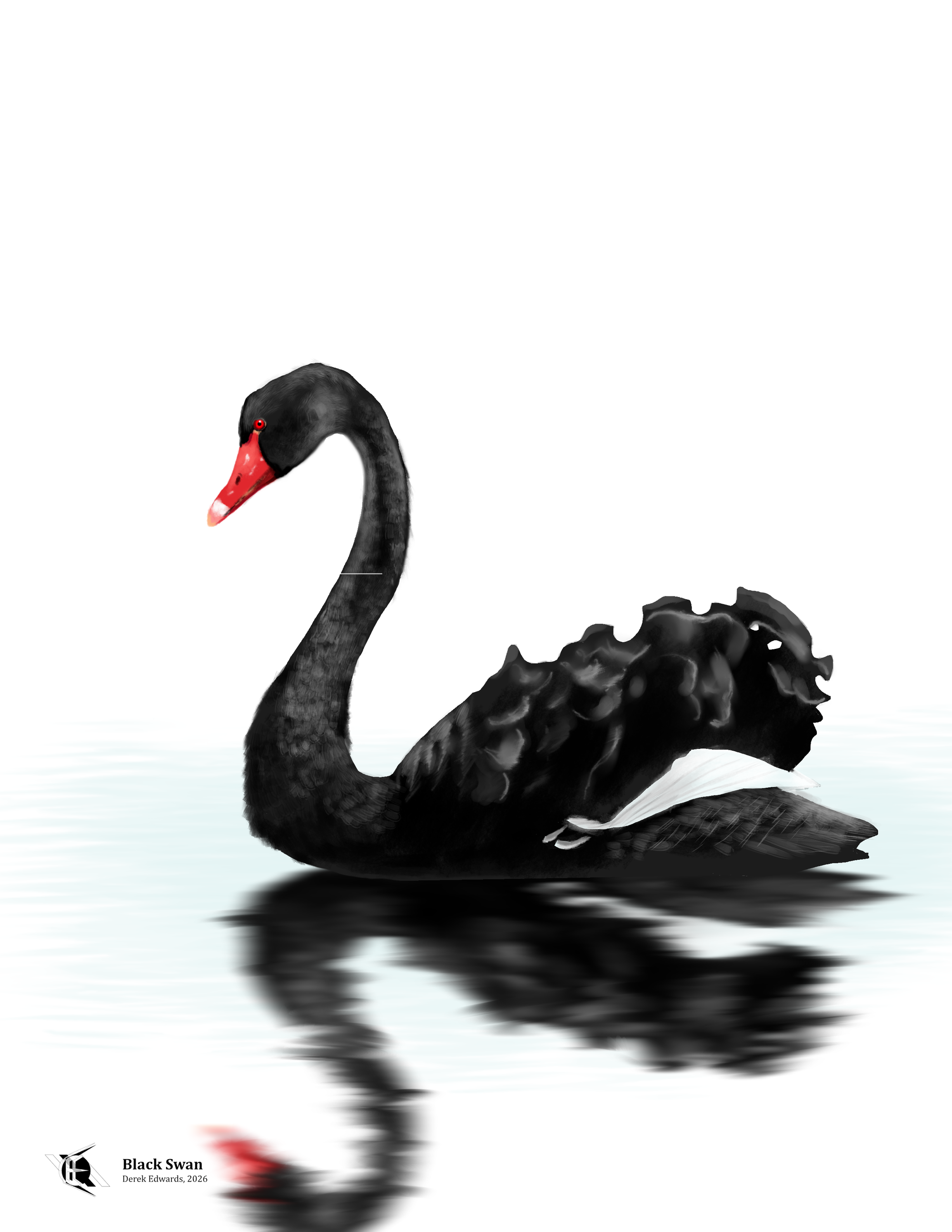
So what of the birds themselves? “Black swan” about sums them up. If you’re in the white‑swan‑aware world, black swans are going to be pretty striking, plumage aside. They’re very heavy waterfowl, pretty strictly seen in shallow water or else flying. They eat aquatic plants. They form lifetime mating pairs. The only really remarkable thing about them is that they are the opposite color to all other swans — at least in body, people often overlook the black‑necked swan of South America.
That distinctiveness has led the black swan to serve as a symbol of colony‑yet‑difference in Australia in its relationship to Britain. The mute swan has a long association with the British crown, and so when the British settled in Australia, the local swan was a natural choice for an emblem of the state while still being visibly uniquely Australian. It’s much like how the bald eagle works simultaneously as a distinctly American emblem and a callback to the Roman aquila. The state of Western Australia, where the Swan River flows, features the black swan on its flag and state seal.
Of course, before the Dutch or British, the black swan was already well‑known by the Aboriginal nations. I’ve found mention of the folklore of several regional nations featuring the same general story: long ago, the swans were white, but they were attacked—the attackers vary, either eagles, or resentful birds, or a fearsome water‑spirit called a bunyip—and left with their feathers torn out and their backs bloodied. At this point crows came to their aid, giving them a new coat made from their own black feathers. Now, all that remains of the swan’s original white is its wings, which were folded up and thus spared from being torn away.4,5,6 I find it interesting that even in the oldest stories of black swans there’s the idea that swans ought to be white. Perhaps the first people to come to Australia so long ago were also surprised by the reality of a black swan.
To science, the Black Swan is Cygnus atratus. Cygnus is the Latin for “swan,” and today is applied both to the genus of true swans and to a constellation said to resemble a swan in flight. The species name comes from the Latin for “clothed in mourning.”7 The Romans wore dark togas when mourning the dead, a practice that endures through much of the West, where black clothes are traditionally worn at funerals and by the family of the dead for some appropriate time afterward.8
- Juvenal, trans. A.S. Kline. “Satire VI,” https://www.poetryintranslation.com/PITBR/Latin/JuvenalSatires6.php#anchor_Toc282858859.
- DACC. “Vereenigde Oostindische Compagnie (VOC) and Australia.” Dutch Australia Cultural Centre, October 18, 2023. https://dutchaustralianculturalcentre.com.au/archive/dutch-busineses/aviation-and-shipping/vereenigde-oostindische-compagnie-voc-and-australia-1/.
- Whittell, Hubert Massey. The Literature of Australian Birds: A History and a Bibliography of Australian Ornithology. Martino Pub, 1993. p. 7
- Latimore, Jack. “The Parable of the Black Swan: How Tasma Walton Got Caught in a Native Title Scrap.” The Age, July 14, 2023. https://www.theage.com.au/national/victoria/the-parable-of-the-black-swan-how-tasma-walton-got-caught-in-a-native-title-scrap-20230712-p5dnpb.html.
- None. “The Story of the Black Swan - Guunyu.” Sydneyswans.Com.Au, August 18, 2020. https://www.sydneyswans.com.au/news/797686/the-story-of-the-black-swan-guunyu.
- Anzsog. “A First Peoples Approach to Public Policy: The Lesson of the Black Swan.” ANZSOG, January 3, 2026. https://anzsog.edu.au/news-media/a-first-peoples-approach-to-public-policy-the-lesson-of-the-black-swan.
- Jobling, J. A. (editor). The Key to Scientific Names in Birds of the World (S. M. Billerman et al. editors), Cornell Laboratory of Ornithology, Ithaca.
- Boschetto, Nick. “The Evolution of Mourning Wear.” The Journal of Antiques and Collectibles, October 4, 2022. https://journalofantiques.com/digital-publications/joac-magazine/features/the-evolution-of-mourning-wear/.
Curation Links
Dirty Birds | Corey Arnold & Laurel Braitman, The California Sunday Magazine
“We’re used to seeing our national bird as a valiant hero in nature documentaries plucking salmon from pristine streams, on the back of every dollar bill in our wallets, or on pretty much every federal seal — from the NSA and the CIA to the office of the president. But in Dutch, especially in winter when it’s harder for them to catch fish, you can see eagles for what they really are: hardy, scrappy scavengers.”
I Found It: The Best Free Restaurant Bread in America | Caity Weaver, The Atlantic
An engaging travelogue moreso than a straightforward, down-the-list review. Also touches on the way we now so prize rough, rustic bread in an age that has perfected and commodified the soft white bread that had been pursued for centuries.
The House Is a Work of Art | Andrew Deming, Aeon
"Frank Lloyd Wright exalted the individual and made ordinary life beautiful. But his life was marked by scandal and grief.”
Wireworks | Sheri Singerling, Clarkesworld
[FICTION] “Calista glared at her father, and as she did, she spied something behind the rage. It was small and hidden, almost imperceptible, but once she caught wind of it, she knew what it really was. His own grief, shrouded in all manner of guises. His obsession with work wasn’t a relentless pursuit for wealth. It was a coping mechanism, first with her mother’s sickness and refusal for treatment, and now with her passing. His iron grip on Calista’s life, his habit of being controlling, demanding, distant, it was him being afraid of losing her, as he’d lost her mother. He was wounded and raw. He’d buffered himself against future blows and, in the process, had become inert.
The wireworks would save him, just as they had saved Calista.”
See the full archive of curations on Notion

Member Commentary