
Running Commentary 6/29/2026
Hello,
It’s hard to find szechuan peppercorns where I live. I went looking today, hoping to find something for a recipe I wanted to try, but I couldn’t find any in multiple stores. I had to substitute in some stir-fry sauce that had it in it, which probably didn’t get it quite right but I think it got close enough that I could tell the dish was okay but not worth the effort of getting it quite right, ingredients-wise.
Anyway...here’s a different recipe:
Eating...
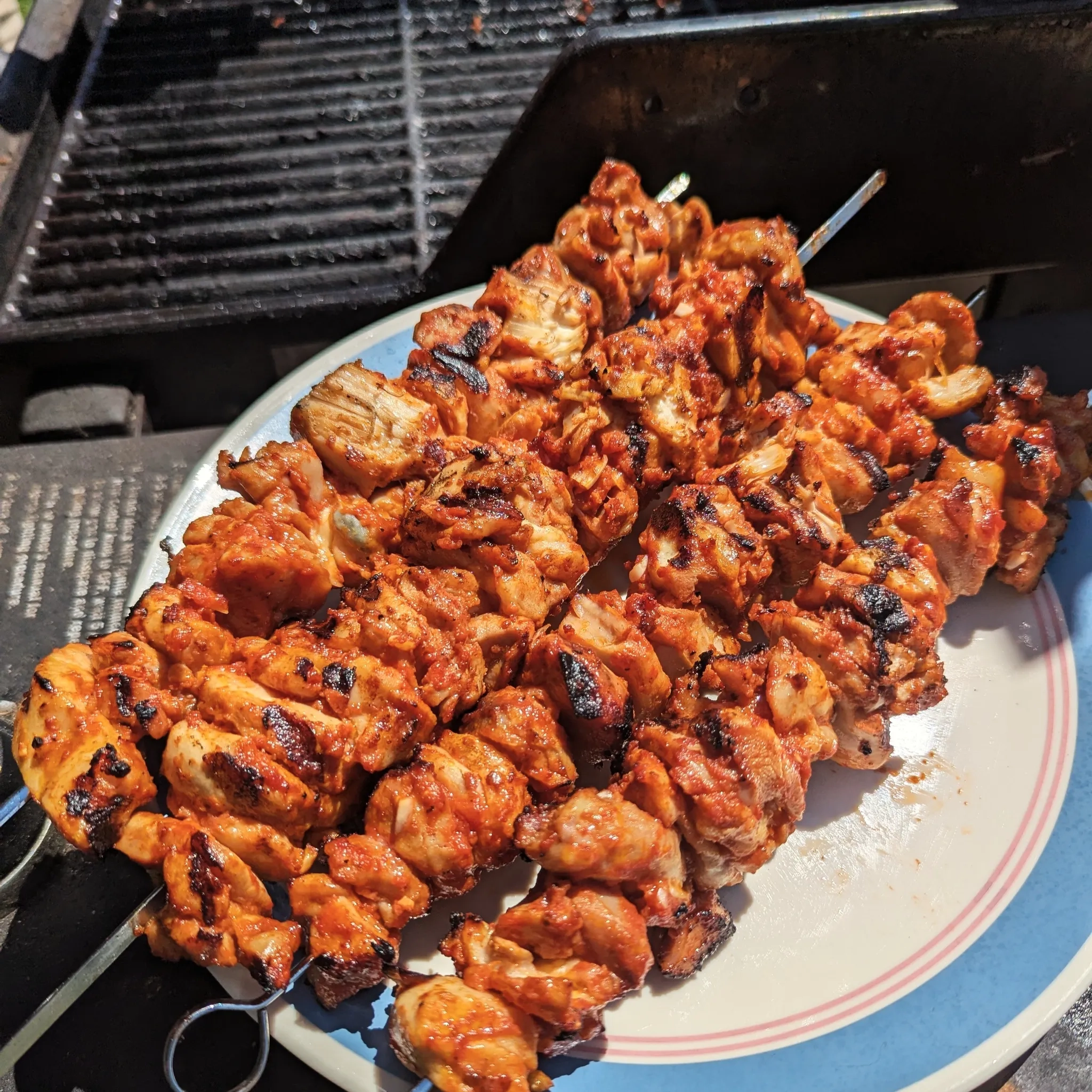
It’s summer, which means it’s grilling season. There’s a lot of things that can be done with chicken, but I really think grilled chicken might be the ultimate form of chicken-as-chicken, if that makes any sense. It tastes good without covering the chicken up. This is my favorite grilled chicken recipe. The original recipe was for chicken kebabs, but I’ve found the same marinade and general grilling method works for flattened chicken thighs, which take less prep work.
Ingredients
- 4x chicken thighs, bones removed and either cut into 2-inch chunks or pounded flat
- 3 oz. tomato paste
- 3 TBSP olive oil
- 2 TBSP fish sauce
- 2 TBSP garlic, minced
- 1½ tsp sugar
- 1 tsp kosher salt
- ½ tsp pepper
- ½ tsp red pepper flake
- ½ tsp chili powder
Procedure
- Combine all ingredients and let chicken marinate for at least 1 hour.
- If chicken is cut into chunks, skewer on 12-inch metal skewers.
- Heat grill with all burners on high for 15 minutes.
- Leave half of burners on high, grill chicken over these, turning and flipping as needed, until outside is moderately charred.
- Move chicken off direct heat and grill covered, as needed, until the meat reads 175℉.
- Allow chicken to rest for 5 minutes before serving.
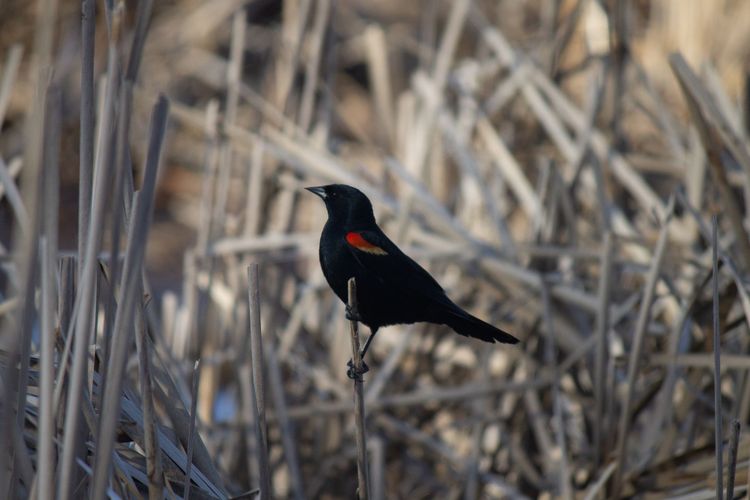
Bird of the Week
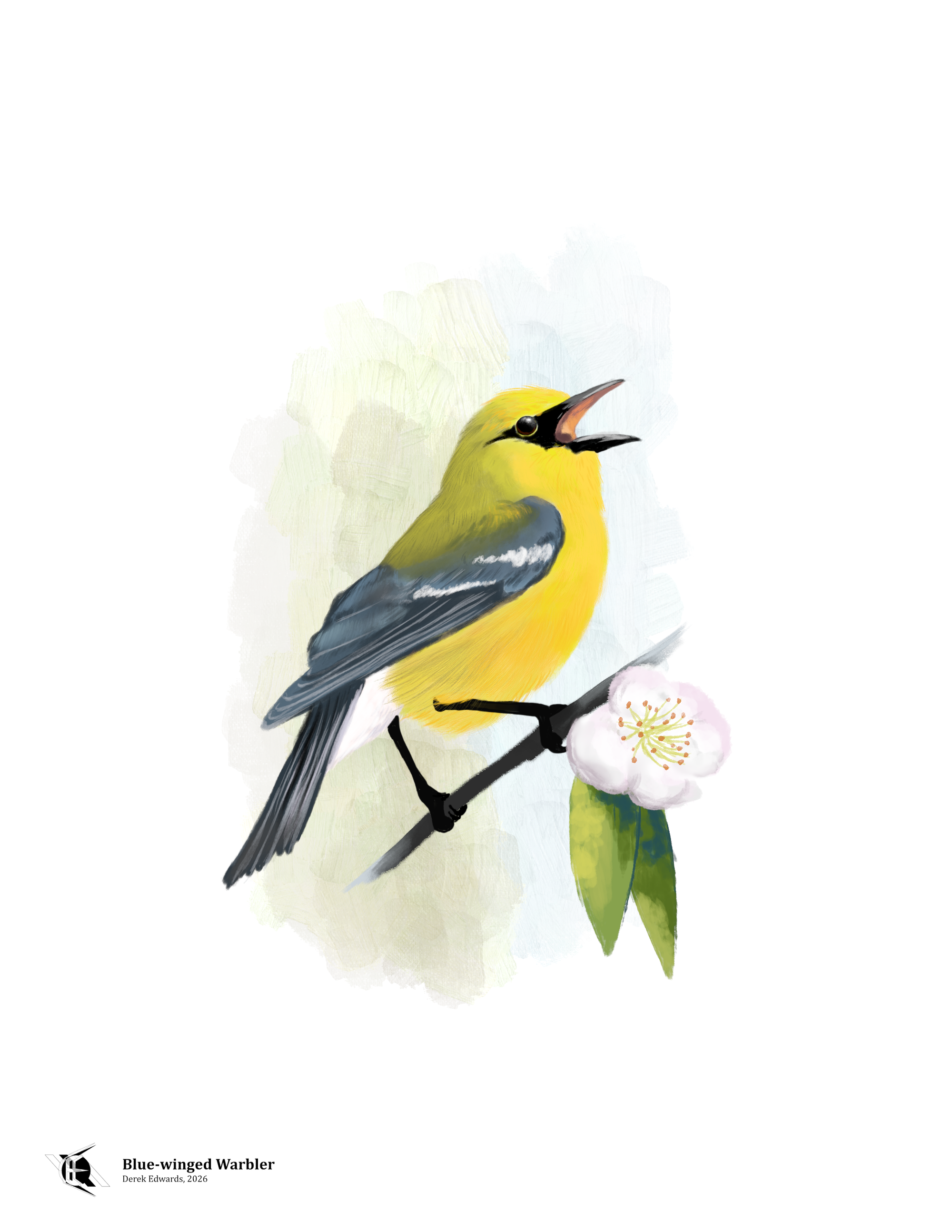
A lot of the time, birds are described as living in certain habitats. Sedge wrens, for instance, live in marshy fields, and toucans live in the rainforests of South America. But there are certain birds that are best said to live not in a particular place, but between places. Gulls are a familiar example, with most species found neither out at sea nor well inland, but on the shore dividing the two. Some birds get even more specific, such that they won’t move more than a matter of yards from the edge of one biome to the other. The Blue‑winged Warbler is one such bird.
Once, there were no blue‑winged warblers in Michigan, or at least those encountered there were rarities. It was a bird of the Ozarks and the oak savannas of western Kentucky and Tennessee.1 Then as now, it nested and lived in the shrubby growth where the woods give way to open country. It lives in a thin marginal habitat between the two classic biomes of forest and field, not really belonging to either. In the natural state of eastern North America, such forest edges were relatively rare, and the blue‑winged warbler remained relatively confined. But the arrival of Europeans, and their thorough clearing of the eastern forest for timber and farmland, created an unnaturally extensive network of forest edges, and a great opportunity for the Blue‑winged Warbler. It also provided an opportunity for the golden‑winged warbler, a very closely related species with similar forest‑edge habits, which was originally centered in Appalachia. This bird spread first into the Northeast and the lower Great Lakes, and from that point on one can hardly discuss one bird without discussing the other.2
Early American ornithologists noted two other birds at the edge of the woods, rarer than the golden‑winged and blue‑winged: the white‑winged warbler, later known as the Brewster’s warbler, and the even rarer Lawrence’s warbler. As these were studied, it was noted that the four kinds of warbler would regularly interbreed. Further study revealed that Brewster’s and Lawrence’s were not their own species, but the hybrid offspring of blue‑winged and golden‑winged parents. This went a long way toward explaining why Brewster’s and Lawrence’s Warblers went undescribed for a century after the blue‑winged and golden‑winged were first noted by science; before the two species had met in the newly cleared lower Great Lakes, such hybrids must have been quite rare indeed.
One might wonder: if the Blue‑winged and Golden‑winged Warbler can produce fertile offspring together, are they truly different species? Isn’t a species a population of organisms that can reliably reproduce together? That was apparently something Audubon had debated with his warbler-collecting friend John Bachman; it’s also something debated by ornithologists today. DNA studies have shown that the two species share 99.97% of their genome—more closely related than populations within the same species of other birds. That 0.03% difference mostly consists of the genes affecting throat and body color.3
The genus once featured a third, more southerly bird: Bachman’s warbler, named by Audubon in honor of his aforementioned friend, who took the first specimen. Bachman’s Warbler was a fairly common sight in the 19th century, but its population crashed after the Civil War, and by the 1970s most scientists regarded the species as extinct. In 1986, the ornithologist J. V. Remsen proposed an explanation: Bachman’s Warbler was invariably described as nesting in “cane” — Arundinaria gigantea — a species of bamboo native to the American South. In days past, the region was filled with vast “canebrakes,” immense thickets of cane that, with changing agricultural practices, were steadily cleared to expose their rich soil for farming. Remsen proposed that Bachman’s Warbler was wiped out along with its nesting habitat, in a similar phenomenon as the loss of new‑growth jack pine that nearly wiped out Kirtland’s warbler during the same period.4,5
The other two warblers are still around, but declining. The peak of forest/meadow edge habitat in eastern North America is past; lots of former farmland has either been returned to mature forest or turned into parks and suburbs, neither of which are suitable for blue‑ or golden‑winged warblers. And the golden‑winged is, of the two, declining faster. It seems that the blue‑winged tends to win out over the golden‑winged when the two are in the same area. It may well be that the blue‑winged is genetically overwhelming the golden‑winged; one of the last golden‑winged warbler seen in Ohio was the mate to a blue‑winged and the father to a brood of Brewster’s warblers.2 The blue-winged is more numerous, and if the two types of warblers were to fully integrate, the resulting generations would be, for all intents and purposes, blue‑winged warblers. Whether that’s actually what’s happening is an open controversy with implications for the urgency of golden‑winged conservation, as is the question of species. If the golden-winged and blue-winged warblers are merely color morphs of the same species, there would be less call to protect the golden-winged from a scientific sense, even if birders would mourn the loss of a unique sight.
To science, the blue‑winged warbler is Vermivora cyanoptera. The genus name, shared with the golden‑winged and the disappeared Bachman’s warbler, means “worm‑eater,” a reference to these species’ affinity for caterpillars.6,7 The species name is Greek for “blue‑winged,”7 which, yes, fits the common name, but I must say, this bird does not have blue wings. It has gray wings. The blue‑gray gnatcatcher is bluer than these wings, and it’s not even unqualifiably blue. I’d have gone with “masked warbler” myself, since that is the key feature to look out for.
- Gill, Frank B., Ronald A. Canterbury, and John L. Confer. “Blue-winged Warbler (Vermivora Cyanoptera).” Birds of the World, March 4, 2020. https://doi.org/10.2173/bow.buwwar.01.
- Cashion, Erin. “A Brief History of the Golden-winged Warbler.” Ohio History Connection, July 17, 2025. https://www.ohiohistory.org/a-brief-history-of-the-golden-winged-warbler-part-i/, https://www.ohiohistory.org/a-brief-history-of-the-golden-winged-warbler-part-ii/.
- Campbell, Victoria. “Golden-winged and Blue-winged Warblers Are 99.97 Percent Alike Genetically.” All About Birds, May 17, 2023. https://www.allaboutbirds.org/news/mixed-wing-warblers-golden-wings-and-blue-wings-are-99-97-percent-alike-genetically/.
- Remsen, J. V. Jr. "Was Bachman's Warbler a Bamboo Specialist?," The Auk: Vol. 103: Iss. 1, Article 36. Available at: https://digitalcommons.usf.edu/auk/vol103/iss1/36
- Kaufman, Kenn. The Birds That Audubon Missed: Discovery and Desire in the American Wilderness. Simon and Schuster, 2024. p.186-194
- Ficken, Millicent S., and Robert W. Ficken. “Ecology of Blue-winged Warblers, Golden-winged Warblers and Some Other Vermivora.” The American Midland Naturalist 79, no. 2 (April 1, 1968): 311. https://doi.org/10.2307/2423180.
- Jobling, J. A. (editor). The Key to Scientific Names in Birds of the World (S. M. Billerman et al. editors), Cornell Laboratory of Ornithology, Ithaca.
Curation Links
The Fraudulent Science of Success | David Engber, The Atlantic
“If business-school psychology is beset with suspect research, then the bar for getting published in its flagship journals ratchets up: A study must be even flashier than all the other flashy findings if its authors want to stand out. Such incentives move in only one direction: Eventually, the standard tools for torturing your data will no longer be enough. Now you have to go a little further; now you have to cut your data up, and carve them into sham results. Having one or two prolific frauds around would push the bar for publishing still higher, inviting yet more corruption. (And because the work is not exactly brain surgery, no one dies as a result.) In this way, a single discipline might come to look like Major League Baseball did 20 years ago: defined by juiced-up stats.”
The Lorem Ipsum Mystery | Lauren Zhang, Rabbit Hole
[VIDEO] “Lorem ipsum dolor sit amet…” begins the most common batch of filler text used by typesetters and layout artists to aid in designing printed material. The words are garbled Latin, imprecisely taken from a passage by Cicero, but how, exactly, it came to be is a story shrouded in mystery and careless misinformation. Until now. (25 minutes)
Dirt, Dirty, Dirt | C. R. Burgess, The Postmodern Dad
Personal essay about life with a robotic vacuum cleaner, and about whether anything can ever truly be clean and if work can ever truly be delegated to a machine.
The Secret Strength of Things | Gregory Feeley, Clarkesworld Magazine
[FICTION] “Nothing was less alive than the Snow Woman, whose every surface, internal and external, had been scrubbed of any organic molecule more complex than methane. No life had been discovered on this desolate moon, but until the possibility of some scarce microscopic creatures floating in its underground ocean was eliminated, the humans and Minds who occupied the space around Ryujin remained adamant about avoiding contamination. Yet the Snow Woman had desires and intentions like a living creature: she was jealous of her sole possession of the tiny world and determined to destroy any challenger to that distinction, just as Kitsune the sprite (which was more problematically alive) was intent on surviving.”
See the full archive of curations on Notion
Member Commentary