
Running Commentary 7/6/2026
Hello,
I hope you all had a good 4th of July. Here in the US this was a big one, 250 years on from our initial Declaration of Independence from Great Britain, the first in a long tradition of British holdings declaring independence. Customarily this anniversary is celebrated with fireworks. I got a real triple-treat of a show this year out my back window, where not only were multiple neighbors setting off rockets into the night sky, but also a huge gathering of fireflies were doing their best to compete, and flashes of lightning lit up the thunderclouds of a just-passed storm.
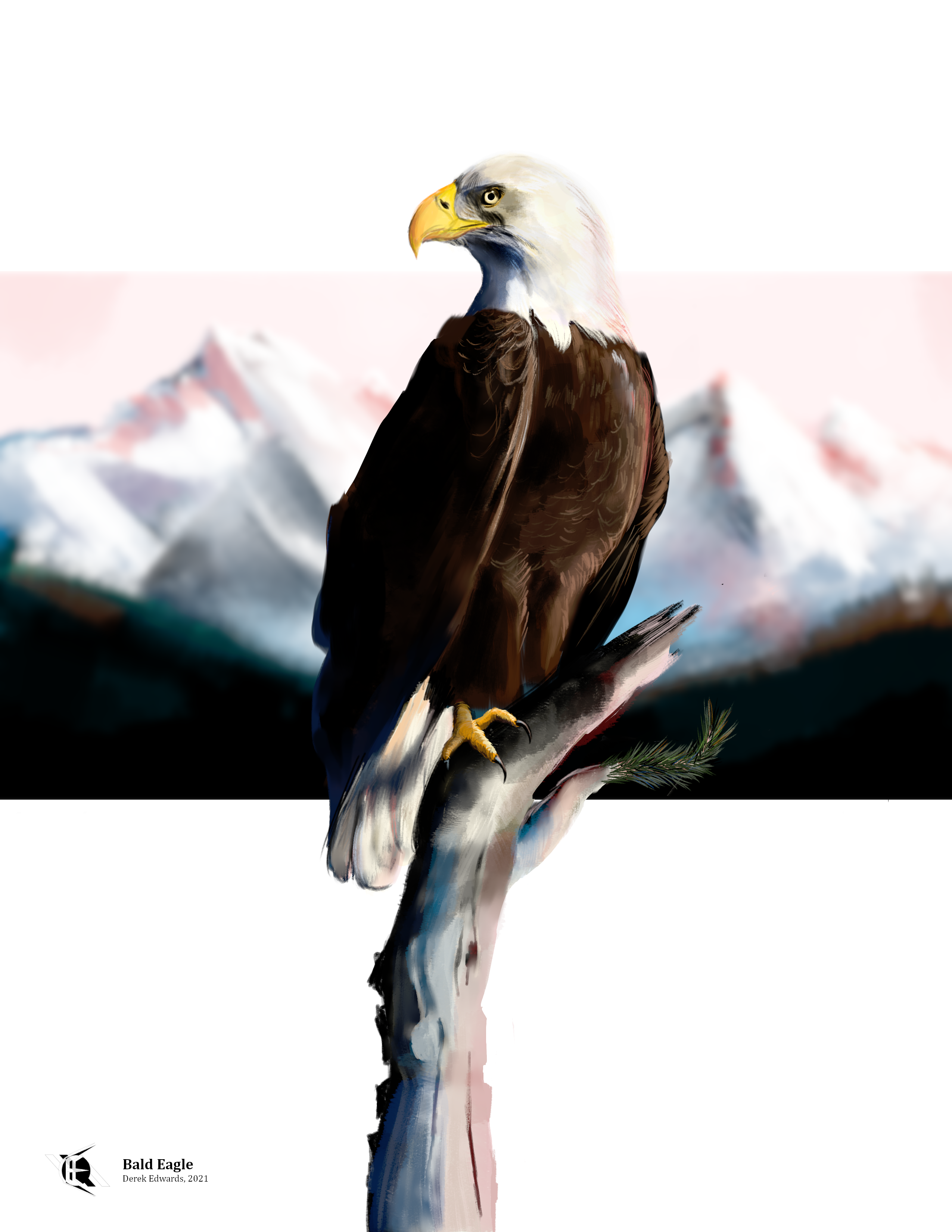
Anyway, we have a special extra-long edition of Bird of the Week to celebrate, featuring the Bald Eagle, which remains one of my favorite drawings I’ve done of a bird. I’ll mention up here that the mountains, which I drew in red-white-and-blue via shadow and alpenglow, are from the Cascades range of Washington, not the US’s most famous range but, I think, the nicest-looking.
Bird of the Week
This week, in honor of the Independence Day holiday and the 250th anniversary of the founding of the United States, we have the Bald Eagle. This large, primarily pescatarian bird of prey is found throughout North America, from Alaska and Canada to northern Mexico. They can be found near large bodies of water in every U.S. state besides Hawaii. They nest in trees; indeed, their nests are the largest found in any tree anywhere in the world, one ton of branches woven into a bowl as wide as 8 feet, large enough for a person to sit in. With their dark chocolate plumage and their white heads and tails, bald eagles are unmistakable at sight. In his seminal field guide, ornithologist and illustrator Roger Tory Peterson described the eagle as "all field mark".1 The African fish eagle, another species in the same genus, is the only bird a mature bald eagle could be mistaken for, but the two's respective ranges do not overlap at all. However, juvenile bald eagles are all-brown and can be easily misidentified, either mistaken for a golden eagle or for some unknown species. Infamously, J.J. Audubon may well have used a juvenile eagle as the model for his "Bird of Washington", a dark, enormous bird featured in his Birds of America.2 Female eagles are notably larger than males.
The bald eagle is the national bird of the United States of America, formally since 2024, but informally since the earliest days of our independence. Like much of the American founding, this is a classical reference. The Roman Republic used a golden eagle as an emblem, and the bald eagle was seen as the distinctly American equivalent. The bird appears in the U.S.'s official seal, on currency, and in branding for many federal agencies. Even many private entities use the bald eagle as a symbol. It has become a mascot not just for the American government, but for the American people. This might be because of Americans' famously hypertrophied sense of aesthetic patriotism, or it might be because eagles are just cool.
At least, everyone but Benjamin Franklin thought so. It’s widely believed that Franklin had advanced the turkey over the bald eagle for the new nation’s national bird. This isn’t actually true, but the kernel of the myth is an interesting thing to have survived the centuries in our collective memories. Franklin was, famously, many things, but chiefly he was a writer, of pamphlets, of almanacs, of newspapers, and of letters. Of note in our case are a particular kind of letter Franklin would address to his daughter. Now, we have a lot of Franklin’s letters to his daughter, most of which are about personal matters, as one would expect in correspondence from one’s father. But there are certain letters in which he would, instead, write unfiltered commentary on current affairs; these letters would often wind up leaked to the press. It would seem Franklin would do so to get away with publicizing ideas without formally publishing them. One such letter never got sent or leaked, but was uncovered after Franklin’s death. This was a writing against the Society of Cincinnati — that is, of Revolutionary war veterans who fancied themselves akin to Cincinnatus, the Roman dictator who humbly returned to civilian life after winning a war, and, thus, another classical reference — which Franklin felt was the first step toward establishing a noble class in the United States, something he was very much against. As part of this tirade Franklin mocked the Society’s emblem, an apparently rather poorly rendered eagle’s head that Franklin thought looked more like a turkey. And that got Franklin going about eagles and turkeys, giving us this quote:
“For my own part I wish the Bald Eagle had not been chosen as the Representative of our Country. He is a Bird of bad moral Character. He does not get his Living honestly. You may have seen him perched on some dead Tree near the River, where, too lazy to fish for himself, he watches the Labour of the Fishing Hawk; and when that diligent Bird has at length taken a Fish, and is bearing it to his Nest for the Support of his Mate and young Ones, the Bald Eagle pursues him and takes it from him.
With all this injustice, he is never in good case but like those among men who live by sharping & robbing he is generally poor and often very lousy. Besides he is a rank coward: The little King Bird not bigger than a Sparrow attacks him boldly and drives him out of the district. He is therefore by no means a proper emblem for the brave and honest Cincinnati of America who have driven all the King birds from our country…
“I am on this account not displeased that the Figure is not known as a Bald Eagle, but looks more like a Turkey. For the Truth the Turkey is in Comparison a much more respectable Bird, and withal a true original Native of America… He is besides, though a little vain & silly, a Bird of Courage, and would not hesitate to attack a Grenadier of the British Guards who should presume to invade his Farm Yard with a red Coat on.”
But the bald eagle wasn’t initially picked as an emblem out of a list of just birds. Franklin was part of the decision-making process that eventually saw the eagle featured on the Great Seal of the United States, but he did not advocate there for the turkey; rather, he wanted a depiction of the Pharoah of Exodus (the stock political bogeyman in the days before Hitler, in this case meant to represent George III) being drowned by Moses (here representing Franklin and other Patriots). Franklin did not get his way and now the eagle, whatever its “bad moral character”, is depicted all over the U.S., including in the branding of the United States Postal Service, which Franklin had been instrumental in establishing.3,4
Despite their exalted status, bald eagles saw their numbers decline significantly during the 20th Century, due to a combination of habitat loss, hunting, and poisoning by pesticides. It was believed (falsely, at least at a scale worth worrying about) that eagles preyed on livestock, and even early conservationists were reluctant to spend energy defending an apex predator who might live to prey on other vulnerable species. Their population in the continental United States dropped to below 1,000 breeding adults. It would have, embarrassingly, become a mainly Canadian bird if not for a strong population holding out in Alaska. The banning of DDT, a pesticide that accumulated up the food chain and caused egg failures in eagles and other birds of prey, was key in the birds coming back Today the bald eagle is seen as a major success story of conservation efforts, numbering in the hundreds of thousands.5,6 Killing an eagle is banned in the United States and Canada, with some exceptions made for traditional use by native peoples, who have similarly revered the birds since well before the U.S. founding.
I personally have seen bald eagles on many occasions and in many places. I wouldn’t say they’re a particularly rare bird, so long as you’re near water with decent-sized fish. But I don’t think I’ll ever not be excited to spot one. They do genuinely have a presence about them that few other birds have.
The name "bald eagle" uses an older form of "bald", short for "piebald", meaning "two-toned". Their binomial is Haliaeetus leucocephalus, from the Greek for "white-headed sea eagle".7 In other languages, they are generally something translating to "white-headed eagle" or "American eagle".
- Peterson, Roger Tory. A Field Guide to the Birds. 1st ed. Boston, United States of America: Houghton Mifflin, 1934. p 68
- Halley, Matthew R. “Audubon’s Bird of Washington: Unravelling the Fraud That Launched the Birds of America.” Bulletin of the British Ornithologists Club 140, no. 2 (June 17, 2020): 110. https://doi.org/10.25226/bboc.v140i2.2020.a3.
- Davis, Jack E. The Bald Eagle: The Improbable Journey of America’s Bird. Liveright Publishing, 2022. pp 19-22, 33
- Stamp, Jimmy. “American Myths: Benjamin Franklin’s Turkey and the Presidential Seal.” Smithsonian Magazine, November 15, 2013. https://www.smithsonianmag.com/arts-culture/american-myths-benjamin-franklins-turkey-and-the-presidential-seal-6623414/.
- American Bird Conservancy. “The Bald Eagle: The Ultimate Endangered Species Act Success Story - American Bird Conservancy,” March 23, 2026. https://abcbirds.org/news/bald-eagle-the-ultimate-endangered-species-act-success-story/.
- “Bald Eagle Decline & Recovery,” American Eagle Foundation n.d. https://eagles.org/what-we-do/educate/learn-about-eagles/bald-eagle-decline-recovery/.
- Jobling, J. A. (editor). The Key to Scientific Names in Birds of the World (S. M. Billerman et al. editors), Cornell Laboratory of Ornithology, Ithaca.
Member Commentary