
Running Commentary 8/25/2026
Hello,
I’ve been sick. Not for the whole time since the last post, but for a while I was sick in bed with bronchitis and for much longer I was pretty exhausted in the evenings and I just haven’t had the time to write this or draw birds until pretty recently. I am feeling much better now, and furthermore we’ve got the new Green Lantern show to watch now! Oh, and since Lanterns comes out evenings on Sundays I’ll be running RC on Tuesdays to give me time to watch and consider new episodes without being a whole week late.
Anyway...
Watching...

Lanterns
HBO’s much-anticipated (? - I was anticipating it anyway) adaptation of Green Lantern is here. It has two episodes out so far, which have set up a sort of murder mystery, alien conspiracy plot set in rural Nebraska. Yeah, that’s a little bit of a different tack for a Green Lantern story to take, but it’s pretty compelling so far. Here are my notes on “Pilot” and “Trust Fall”:
- I thought maybe the first episode’s title might have a double meaning about Hal being a pilot but that doesn’t really factor in so I don’t guess it does.
- The show is not a direct adaptation of any Green Lantern comics, and it is more of a cop show than such an adaptation would be. The odd thing about Green Lantern is that while they’re often described as space police, they often function more like a special forces outfit, lots of fighting alone or in small units, a good bit of search-and-capture of intergalactic fugitives, but not a lot of investigating work. The comics aren’t mystery fiction, and it seems like the show is.
- I will say the two leads are doing pretty well so far. Kyle Chandler’s Hal Jordan is…again, not exactly ripped directly from the pages of the comics but seems essentially true to the character in that if the comic character was ever portrayed a somewhat burnt-out veteran lantern being forced to train a replacement, Chandler’s character would feel ripped from those pages. Aaron Pierre’s John Stewart seems to be leaning pretty heavily on the “former marine sniper” characterization a lot moreso than the “gifted architect” characterization. He doesn’t have a ring yet and so we haven’t seen him make any constructs so far; hopefully when he does that side of him gets to come out.
- Hal interrogating the alien was the standout scene in the opening episode.
- So we see that John has trouble flying (with ex-test-pilot Hal being such a natural at it that he can’t really teach someone else) but is so good at creating a construct that he can make it persist without a ring. He hasn’t mentioned being an architect yet, and maybe never will, but I liked that we’re getting his special skill at constructs anyway. And speaking of flying, Hal taking off has looked really good in this show. My compliments to the special effects team.
- Mysterious manhunter-hunting bald man seeking revenge for the death of his homeworld certainly seems like Atrocitus. Or maybe just Atros, since Atrocitus is a silly name and this isn’t a very silly show. He doesn’t look like a Ryutian but he’s also clearly in disguise.
- Hal’s uniform in this version of things is not a construct of the ring, which I guess explains why he hasn’t been wearing it.
- Hal having a massive SoCal mansion that a grateful billionaire gave him, which he has barely moved into and does not have time to enjoy the luxuries of, is another thing in this show that, while not true of the Hal of the comics, rings incredibly true to the Hal of the comics.
- If the manhunters are at the root of the events in Nebraska, that means this show is sticking to one important rule of GL stories: the real villains are the Guardians. Maybe Hal already knows this, and that’s why he seems so ambivalent about being a Green Lantern.
- Sinestro shows up in the end. I’m not sure how much he’ll be a part of this show, but I expect we’ll get at least an episode focused on him.
- No follow-up in this episode on the shock ending of the previous episode.
Bird of the Week
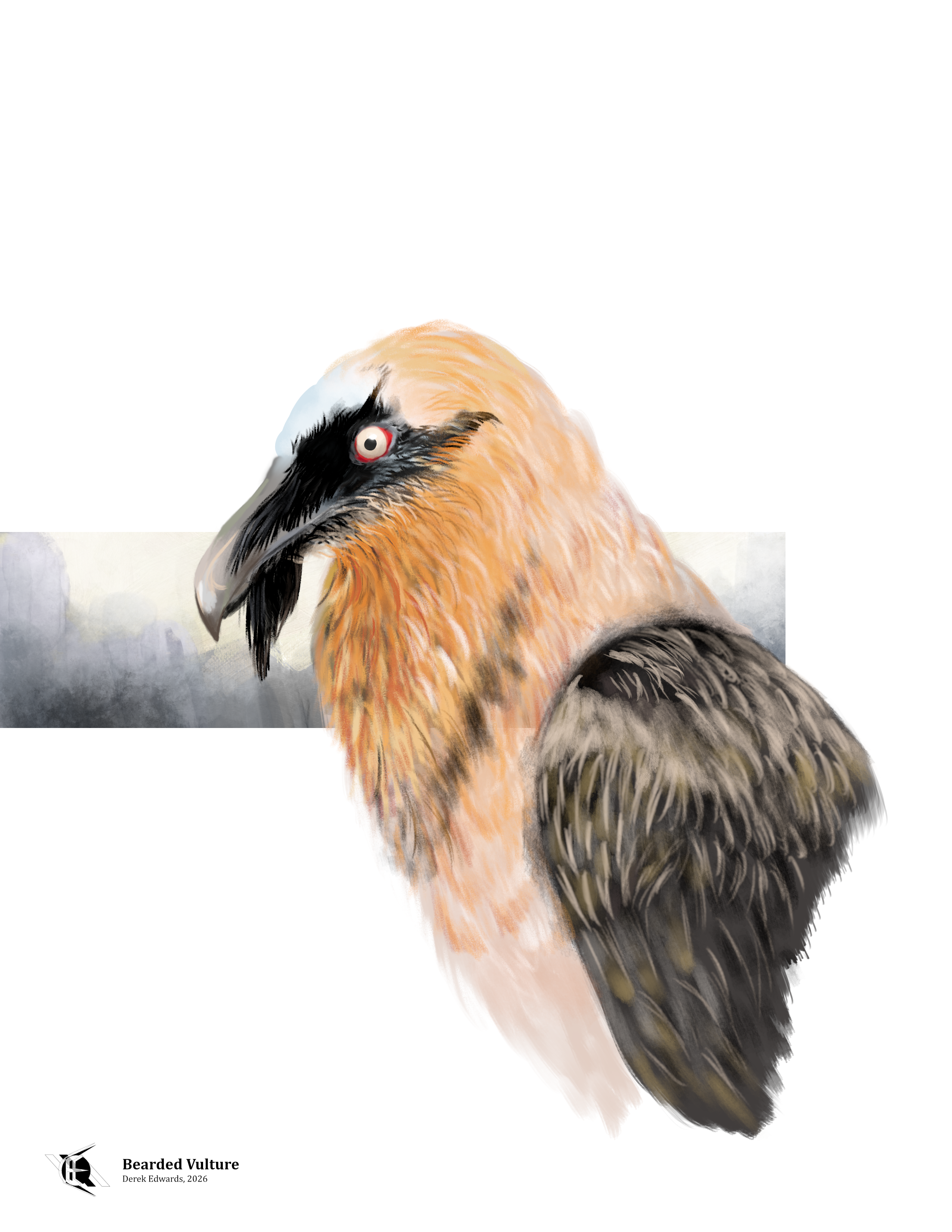
We’ve had a couple vultures before in this space, the king vulture and the turkey vulture; both of these are New World vultures, part of an order of birds behaviorally similar but genetically largely unrelated to the Old World or “true” vultures. Today we have an Old World bird with scavenging habits and “vulture” in the name, but I think it might be overstating it to call this a true vulture: here’s the Bearded Vulture.
The bearded vulture typically lives at high altitudes, nesting in hollows of cliffs. At one point, this bird was a common sight in mountain ranges around the Mediterranean as well as Central Asia and East Africa; today the North African and European populations are much reduced. The species held out in the Pyrenees, which remains a popular place to seek them out, and recent reintroduction efforts have been successful in the Alps, but in much of the bird’s historic western range it is locally extinct.1,2,3 Asian and East African populations have fared better over the years.
They didn’t disappear from Sicily fast enough for poor Aeschylus. The ancient Greek tragedian died there in the fifth century BC,4 and, if we’re to believe Valerius Maximus, a Roman writer who wrote of the matter centuries later, in the day of Caeser Tiberius, he was killed by a large bird dropping a tortoise on his bald head, which the bird mistook for a rock that might break the tortoise open. Now, the actual truth of this claim is dubious but it is certainly true that several large birds of prey will dash tortoises upon rocks from on high to crack them open. Valerius called the bird “aquila”, a word usually translated as “eagle”, and, indeed, golden eagles are known to drop tortoises, but moreso are bearded vultures. If this is, in fact, how the unlucky Aeschylus died, it’s very possible it was at the hand (foot? talon?) of a bearded vulture.5
Tortoises do not make up a particularly large part of the bearded vulture’s diet; like most vultures, they rarely take live prey, instead feasting on the already dead. Which brings us to how they get away with having those beards. The true vultures of the subfamily Aegypiinae and the New World Cathartiformes vultures stand out from most birds as bare-headed. This is for practical reasons, as it allows them to nose through the gore of carcasses without getting blood crusted in their feathers. The head and throat of a bearded vulture is covered in white feathers, and while these are usually seen stained rusty red, that’s not blood but mud, applied deliberately for reasons that remain unclear but seem to be largely cosmetic.6 The bearded vulture need not worry about getting bloody because it does not eat the meat from a carcass; it eats the bones, and not even just from fresh kills; it seems to prefer bones that have dried out a bit, possibly because these are easier to digest. Their gastric juices are very nearly pure hydrochloric acid, capable of dissolving the calcium and phosphorous minerals that give bones their solidity. As much as 90% of a bearded vulture’s diet can be comprised of bone tissue, a fact that makes them unique not only among birds but among all animals.7,8,9
Why eat bones? Low competition seems most likely. I keep a stash of tinned sardines at work to eat for lunch some days (I eat them outside the workspace; I’m not rude). Some of my coworkers keep a stash of chocolates or such. Their stashes get raided a lot more than mine, because few people I work with care for sardines. Similarly, the bearded vulture need not worry about other creatures eating a from a good skeleton, so it doesn’t have to gorge itself. It can take what it wants and come back later. They mainly feed on the bones of mountain sheep, hence the German name for the species: Lämmergeier, or “lamb-vulture”. If a bone is too big for it to eat whole, it will carry it high and drop it onto rocks until it is cracked open — tortoise-dropping is a variation on this more ubiquitous practice — and either swallow the pieces or simply eat the marrow.7 Hence the old Latin-derived name for the bird: ossifrage, that is, bone-breaker. Nestling vultures are fed more traditional carrion until they can handle bones themselves.10
The bearded vulture is one of three vultures in the sub-family Gypaetinae, which are all odd birds in terms of what they eat. The palm-nut vulture is largely a fruit-eater, not odd for a bird but odd for a bird in its family. The Egyptian vulture is an opportunistic omnivore, seemingly willing to eat anything easily had, including, infamously, dung, which apparently provides nutrients supporting the color of its bright yellow face.11 None of these birds are likely to do much to a recently deceased animal. They don’t flock together, they don’t glide soaring through the sky, and all three will occasionally take live prey.12 That’s why I think it would be overstating things to call the bearded vulture a “true vulture”.
To science, the bearded vulture is Gypaeutus barbatus. The species name is Latin for “bearded”,13 deriving from the same root as “barber”.14. The genus name is compounded Greek for “vulture-eagle” which is the kind of noncommittal hyphenated name I suspect the bird would get if it weren’t familiar from antiquity; the Accipitridae is littered with these, harrier-hawks and hawk-eagles and buzzard-eagles. We have, apparently, too few proper names for kinds of raptor.
- Santos‐Cottin, D., B. Arroyo, F. Loercher, A. Brambilla, and J. Terraube. “Assessing the Outcome of Reintroduction Efforts: Trends in Population Size and Drivers of Breeding Success in Alpine Bearded Vultures.” Conservation Science and Practice 7, no. 5 (April 7, 2025). https://doi.org/10.1111/csp2.70027.
- Margalida, Antoni, Sergio Couto, Sergio O. Pinedo, José María Gil‐Sánchez, Lucía Agudo Pérez, and Ana B. Marín‐Arroyo. “The Bearded Vulture as an Accumulator of Historical Remains: Insights for Future Ecological and Biocultural Studies.” Ecology 106, no. 9 (September 1, 2025): e70191. https://doi.org/10.1002/ecy.70191.
- Hardach, Sophie. “One of the Most Successful Wildlife Comeback Stories: The Alps Lost Its Vultures - Then It Got Them Back,” BBC Future. August 10, 2026. https://www.bbc.co.uk/future/article/20260305-how-vultures-returned-from-alpine-extinction.
- Foreman, Robert J. “Greek Tragedian Aeschylus Dies.” EBSCO Research. 2022. https://www.ebsco.com/research-starters/drama-and-theater-arts/greek-tragedian-aeschylus-dies.
- Galassi, Francesco Maria, and Elena Varotto. “Aeschylus’ Legendary Head Trauma: Reflections on Pseudopathology and the Origins of Ancient Mythology.” Journal of Craniofacial Surgery, 2019. doi:10.1097/SCS.0000000000006211.
- Margalida, Antoni, Markus S. Braun, Juan José Negro, Karl Schulze-Hagen, and Michael Wink. “Cosmetic Colouring by Bearded Vultures Gypaetus Barbatus: Still No Evidence for an Antibacterial Function.” PeerJ 7 (May 15, 2019): e6783. https://doi.org/10.7717/peerj.6783.
- Margalida, Antoni. “Presence of Bone Remains in the Ossuaries of Bearded Vultures (Gypaetus Barbatus): Storage or Nutritive Rejection?” The Auk 125, no. 3 (July 1, 2008): 560–64. https://doi.org/10.1525/auk.2008.07124.
- Houston, David C., and Jamieson A. Copsey. “Bone Digestion and Intestinal Morphology of the Bearded Vulture.” Digital Commons @ University of South Florida, n.d. https://digitalcommons.usf.edu/jrr/vol28/iss2/1/.
- Sanz, Montserrat, Joan Daura, Ana Maria Costa, and Ana Cristina Araújo. “The Characterization of Bearded Vulture (Gypaetus Barbatus) Coprolites in the Archaeological Record.” Scientific Reports 13, no. 1 (January 3, 2023): 57. https://doi.org/10.1038/s41598-022-25288-x.
- Margalida, Antoni, Joan Bertran, and Rafael Heredia. “Diet and Food Preferences of the Endangered Bearded Vulture Gypaetus Barbatus: A Basis for Their Conservation.” Ibis 151, no. 2 (January 20, 2009): 235–43. https://doi.org/10.1111/j.1474-919x.2008.00904.x.
- Shouse, Ben. “Beauty Tip for Vultures: Eat Dung.” Science | AAAS, August 11, 2021. https://www.science.org/content/article/beauty-tip-vultures-eat-dung.
- Wink, Michael, Ivan J. Starikov, Karl Schulze-Hagen, Juan José Negro, and Antoni Margalida. “What, if Anything, Is a Vulture? Phylogeny and Trait Evolution in Obligate Avian Scavengers.” Journal Für Ornithologie 167, no. 3 (January 11, 2026): 861–76. https://doi.org/10.1007/s10336-025-02358-1.
- Jobling, J. A. (editor). The Key to Scientific Names in Birds of the World (S. M. Billerman et al. editors), Cornell Laboratory of Ornithology, Ithaca.
- Merriam-Webster.com Dictionary, s.v. “barber,” accessed August 20, 2026, https://www.merriam-webster.com/dictionary/barber.
Curation Links
Dirt, Dirty, Dirt | C. R. Burgess, The Postmodern Dad
Personal essay about life with a robotic vacuum cleaner, and about whether anything can ever truly be clean and if work can ever truly be delegated to a machine.
The Secrets of Ranch Dressing, America's Sauce | Peter Giuliano, Pax Culinaria
“The cream-dressing world and the oil-dressing world were bridged by a French chef in 1756 in Mahon, Spain. Wanting cream fraiche for a recipe but lacking it on the Mediterranean island, the chef emulsified olive oil, egg yolks, and a bit of vinegar, creating a cream-like substance eventually called mayonnaise (after ‘Mahon’). Mayonnaise was an oil-based sauce in the guise of a cream-based sauce, and was a perfect salad dressing. Mayo became the elite choice for salads, while commoners in America, England and Germany ate cream-based dressings (and French and Italian commoners ate oil-and-vinegar.) On the great American frontier, salad dressings made from cream, eggs, sour buttermilk, salt and pepper were common. As mayonnaise became more common, Americans naturally began including it in their dressing recipes, generally as an adjunct for cream, which was exactly what it was intended to do.”
In Memory of My Wife, Elise Cawley (1961–2026), with Thanks for 36 Wonderful Years | Stephen Wolfram
A mathematician eulogizes his recently-departed wife.
The Queen of Spades | Alexander Pushkin, trans. Mrs. Sutherland Edwards
[FICTION] "Tchaplitzki—the one you remember who died in poverty after devouring millions—lost one day, when he was a young man, to Zoritch about three hundred thousand roubles. He was in despair. My grandmother, who had no mercy for the extravagance of young men, made an exception—I do not know why—in favour of Tchaplitzki. She gave him three cards, telling him to play them one after the other, and exacting from him at the same time his word of honour that he would never afterwards touch a card as long as he lived. Accordingly Tchaplitzki went to Zoritch and asked for his revenge. On the first card he staked fifty thousands rubles. He won, doubled the stake, and won again. Continuing his system he ended by gaining more than he had lost.”
See the full archive of curations on Notion





Member Commentary