
Running Commentary 2/24/2026
Hello,
A Running Commentary will be switching to Tuesdays for the next few weeks, since Paradise is back for its second season and new episodes are being released on Mondays.
Anyway...
Watching...

Paradise
Three episodes released as the Season 2 premiere, but I’ve only seen the first. Episodes 2,3,4 will be looked at next week.
- No one from the last season shows up here until the very end, as this seems to be an introduction to a new central character in Annie. As such it’s pretty good, showing us who she is quite effectively.
- Season 1 was about discovering what was really going on inside Paradise; Season 2 promises to be about discovering what’s been going on outside, in the rest of the world. Setting the first episode entirely on the outside fits this but risks giving away too much too quickly. This episode works because, while Annie has been living on the outside and more or less knows what happened to the world more than the people under the mountain did, she’s still had very limited contact with other people since The Day, having herself stayed holed up in a refuge this whole time. So if, as it seems, she’ll be teaming up with Xavier, there will still be a lot that both of them don’t know and will have to discover along the way.
- Last season, Bradford’s affinity for ‘80s music led into the soundtrack featuring lots of ‘80s covers. It seems like this season Annie is the touchpoint for a soundtrack of Elvis covers.

Milan-Cortina Winter Olympic Games
Over the past couple weeks the world got to see another Winter Olympics. This time northern Italy got to host, with the games held dually in Milan and in Cortina (further up in the mountains, where the skiing and such was done.) I’ll stress one thing upfront: this is the prettiest Winter Games I can remember. The Dolomites are just ridiculously scenic and they got to serve as the backdrop for all of the outdoor events. Especially compared to the most recent games, in Beijing, which looked like they were being held in downtown Pontiac a lot of the time, the Milan-Cortina games looked fantastic.
The opening ceremonies were fun. There were kind of a lot of different things going on at onces, but it came together into what felt like a real genuine love-letter to Italy. The country is lucky to have an excuse to just put Andrea Bocelli out to sing opera, that’s rather easy mode.
As for the sports themselves:
- This year there were some camera drones following along behind some of the athletes getting pursuit footage of them. This was especially cool to watch during downhill skiing events, though that also affirmed my own aversion to the idea of skiing myself. Downhill skiing remains my favorite sport to watch in the Winter Olympics.
- Lindsey Vonn had quite a little saga of blowing out her knee, competing in a brace, and immediately crashing for unrelated reasons. She was badly hurt, though that’s happened to her before. Thankfully another American woman — Breezy Johnson — was able to take gold, as part of a pretty impressive showing for the U.S. at the winter games this time.
- I’ve often though ski moguls were a little boring. This year added one-v-one races that did the trick to make moguls watchable. I liked this event quite a bit. In the women’s event the U.S. took silver and bronze, with both those women having taken some rough-looking tumbles but still advancing after their opponents went out-of-bounds.
- Another usual favorite was snow cross. They should have at least as many different events of this as they have for cross-country skiing.
- I watched both ski and snowboard half-pipe. I’m not sure that half-pipe and skis go together. A lot of the skiers got caught up trying to move sideways, perpendicular to their skis. An American won the men’s ski-halfpipe, with silver going to Estonia, the only medal that country got this year. I’d probably have been rooting for Estonia had Americans not been in the competition; I like to see smaller countries win. Another American took a really nasty crash at the end; it had looked like he’d cracked his spine over the lip of the pipe, but in slo-mo you could see his butt had taken most of the initial hit, and he was able to walk away. Still, this was probably the scariest moment I saw in the games.
- We had a new sport added to the winter games this year, the first since snowboarding was added back in ‘98: ski mountaineering, or ski-mo. This involves a lot of uphill climbs and downhill slides. I watched this and I enjoyed it, though it has sort of the cross-country skiing problem of world-class top speed on skis across level or uphill ground just not being very fast. It looked exhausting, which is impressive, but it wasn’t especially exciting. France and Spain did very well in this sport. The U.S. didn’t in the sprints, but we came close to medaling in the mixed relay, and would have had Spain been more harshly penalized for performing a hand-off out-of-zone. They got three seconds added to their time, though, from what I could tell, three seconds in this sport is pretty negligible, as times would differ by about 20 seconds between top teams. No photo finishes in ski-mo. Anyway, the US team had apparently just been assembled last year, and the woman (Anna Gibson) is a cross-country runner who only took up the sport at that time, so I suppose it’s impressive we even came in fourth.
- I didn’t watch hockey but the U.S. took gold in both men’s and women’s, which is an unusually good showing for us. Lots of the hockey players were Michiganders, so I’m doubly excited about these wins I didn’t see.
Bird of the Week
Sometimes it’s quite clear that birds live where they do things out of necessity. Torrent ducks live high in the Andes because they’re specialized for life in rapid streams; you only get those up in the mountains. Canada jays depend on a day‑range in the winter to keep their caches of soft‑shelled seeds edible through the cold months. Kirtland’s warblers need to nest in young jack pines, so they must come to the Upper Great Lakes region in the summer—but they can’t stay during the winter because the little leaf‑clinging insects they eat aren’t available then, so they head to the Bahamas to find food. But some birds make less sense to me, as I was reminded when I got an unexpected chance to see a Crested Caracara.
Typically, the crested caracara lives from the American Southwest down through Latin America, with some also living in Florida and Cuba. They are found in open country wherever there are just enough trees and poles to provide a good vantage point to look for food. As you may guess from their bare faces, caracaras are noted carrion scavengers. But they don’t specialize in carcasses the way vultures do; their diets are more crow‑like—very opportunistic and varied—eating small vertebrates, arthropods, eggs, some fruit,1 and of course larger already‑dead creatures. The one I saw was landing on a whitetail carcass lying in a stubbled cornfield. I’m not sure what brought that bird this far north; vagrancy during non‑migration seasons is sometimes the result of strong winds, but the weather preceding this bird’s arrival in Michigan was all pushing down from the north. Maybe Texas got so cold that the caracara figured it had nothing to lose by checking out Michigan. I dunno. But wondering why we suddenly had a caracara got me thinking: why doesn’t Michigan always have caracaras?
I got that historically, Michigan and the rest of the eastern U.S. were densely forested, and caracaras don’t do dense forests; that’s why they don’t live in the Amazon Basin either, despite living all around it. But as that forest has been cleared, Michigan has gotten all kinds of open‑country birds to move in. And yes, Michigan gets pretty cold, being roughly 45° north of the equator. But so does southern Chile, 45° south, and crested caracaras live there. Certainly caracaras could find food up here—they’ll eat whatever.
I looked into this, and it could well be that crested caracaras are, in fact, moving into the broader U.S. The one I saw was the third reported in Michigan, but recent decades have seen dozens of caracaras appearing well north of their nominal range.2 If that rate of vagrancy continues to increase, who knows—the crested caracara might become, if not resident, at least regular vagrant through much of North America.
So what is a caracara? Essentially they are to falcons what eagles are to hawks—much larger cousins. Unlike eagles, caracaras are strictly New World birds; the name has its origins in the Tupí name for the crested caracara, but in English it is also applied to large falcons of different Latin American genera as well. The crested caracara’s closest cousin, the Guadalupe caracara, was a similar‑looking species that went extinct only a couple of decades after it was first described. It was found only on a single island off the shores of Baja California, where it had fed on seals before human settlement and hunting of seals deprived it of food. It then tried to switch to goats, attacking those introduced creatures with, reportedly, extreme ferocity. Settlers set out to destroy the birds, succeeding in wiping the island endemic out by the turn of the 20th century. People, unable to make much of a go on Guadalupe even without the caracaras attacking their goats, abandoned the island shortly thereafter.3
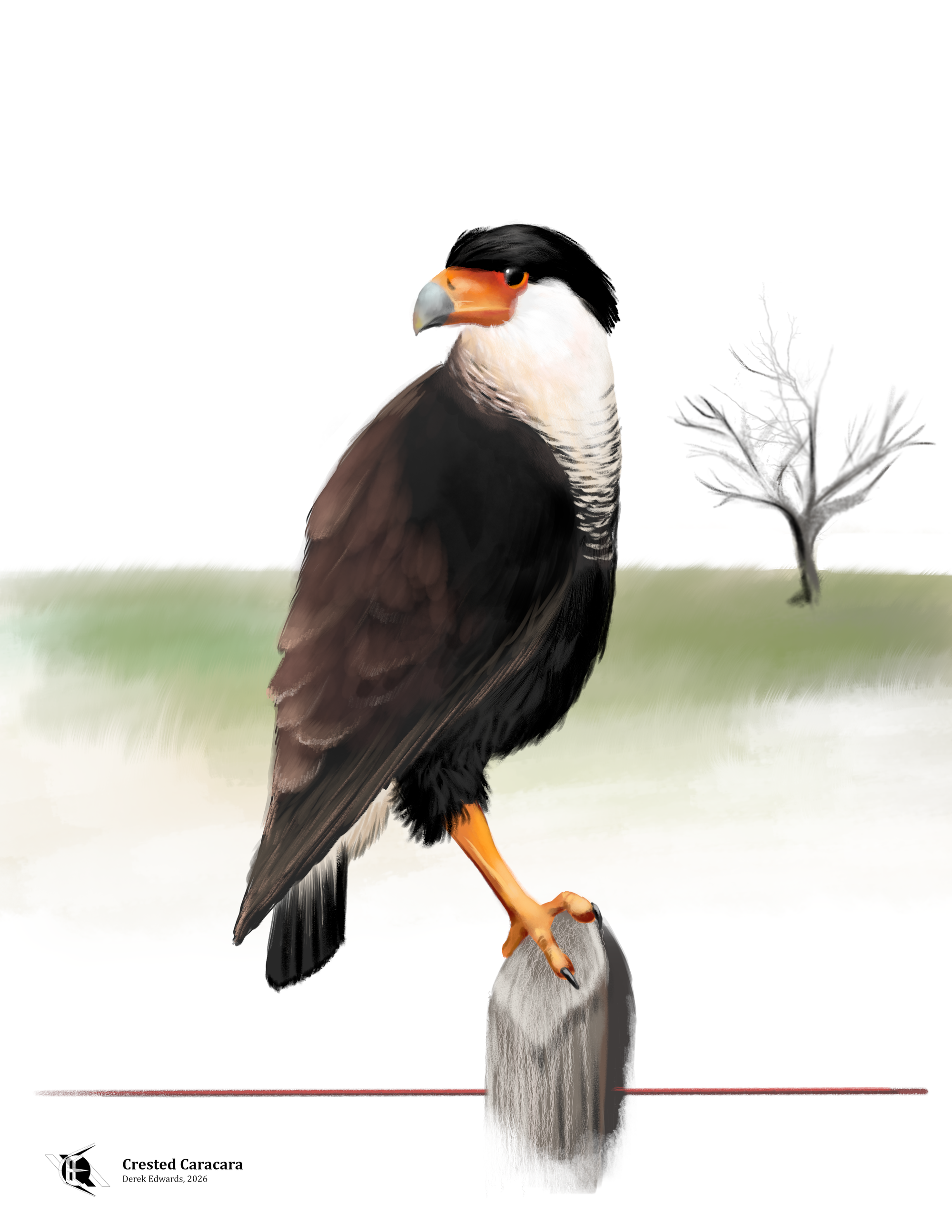
The crested caracara is, I’ve always thought, a smug‑seeming bird. It has, I realized as I drew this one, essentially the visage of a tern mapped onto a raptor’s features: down‑tipped orange beak, white face, a black cap shading into the back, an eye that disappears into the cap’s margin. The caracara has not the eagle’s fierce gaze, nor the peregrine’s swift, seeking attack. The one I and an assembled crowd of eager birders saw came gliding casually into view and went about eating from a pile of carrion without paying us much mind. It seemed unbothered by the snow, which was perhaps some of the first it had ever seen. Its nonchalance stood in contrast to us birders, who had spent an hour on a chilly roadside waiting to see it, and many of whom repositioned to a different roadside when it flew off over a low rise. Reports of that caracara on eBird peaked that day and have dwindled since. I hope this is because the bird finally left to feed back home, but for all I know it’s still there, unnoticed after all those who wanted to see it did.
To science, the crested caracara is Caracara plancus. Originally plancus, a Latin word referring to a type of eagle, was applied to the southern caracara, while the northern caracara was C. cheriway. That species name was the German name for the bird, said to derive from its Carib name. Today the southern and northern caracaras are considered one species, with two subspecies: C. plancus plancus and C. plancus cheriway. “Caracara” is a Tupí word for something that makes a mangled noise, referring to the bird’s odd, rattling voice.4
- Galetti, Mauro, Paulo R. Guimarães Jr. “Seed Dispersal of Attalea Phalerata (Palmae) by Crested Caracaras (Caracara Plancus) in the Pantanal and a Review of Frugivory by Raptors.” Ararajuba. Vol. 12–2, December 1, 2004.
- Nelson, Kristie N. Peter Pyle. “DISTRIBUTION AND MOVEMENT PATTERNS OF INDIVIDUAL CRESTED CARACARAS IN CALIFORNIA.” Western Birds. Vol. 44, 2013.
- Fuller, Errol. Extinct Birds. United Kingdom: Comstock Pub., 2001. p. 58-59
- Jobling, J. A. (editor). The Key to Scientific Names in Birds of the World (S. M. Billerman et al. editors), Cornell Laboratory of Ornithology, Ithaca.
Curation Links
The Man Who Broke Physics | Sally Jenkins, The Atlantic
Ilia Malinin got hyped sky-high leading into the 2026 Winter Olympics — this article was part of that — only to wind up falling during his performance; in fairness he was hardly the only one. Still, at his best he is an incredibly gifted skater, as this article attests. Hopefully he gets to put in a better performance in four years.
The Brood | Ava Kofman, The New Yorker
“For several days, Elliott texted and called Silvia repeatedly. When Silvia finally called her back, she explained that she and Guojun had recently spent four days in jail. She didn’t say why, though she insisted that neither of them was selling their children.”
The Eagle Hunters of Kyrgyzstan | Yam G-Jun, Atavist Magaine
“Kyrgyzstan’s eagle hunters, or burkutchu, carry on a long-standing tradition. For centuries, hunting with an eagle was essential to the region’s nomadic lifestyle: A good hunter could help feed and clothe a village. One family member typically teaches another, and it begins when a hunter finds a nest with multiple eaglets and chooses one to raise. It can take three months to train and raise a fledgling. The hunters spend years with their birds, and the relationship can take on an almost human quality.”
The Unmasking Of Fioha Dubhan | Samuel Chapman, Beneath Ceaseless Skies
[FICTION] “The Fox Festival is a time for liars. For the first three nights of autumn, in the city of Horizon on the island of Craigallian, cheaters prosper, tricksters feast, and glory rarely goes to those who deserve it.”
See the full archive of curations on Notion



Member Commentary