
Running Commentary 12/1/2025
Hello,
We’re past Thanksgiving and into Christmastime. I’ll just give the heads-up that I’ll be taking the 22nd and the 29th off from this newsletter, so there’s just two more RCs this year.
Anyway...
Reading...

Challenger by Andrew Higginbotham
For a book about a single historical event, Challenger is quite long at around 500 pages. I would not say it is padded; rather, it is impressively complete. Higginbotham profiles numerous people: all of the doomed crew, other key NASA officials, and engineers at Morton Thiokol (the contractor who built the faulty booster rockets). On the way to the Challenger disaster, he essentially gives the story of the shuttle program in its entirety, while also recounting earlier tragedies such as Apollo I, in which the first astronauts were lost. There is a lot of complex machinery to explain, a lot of NASA politics to explain, many personal stories to relate, and extensive background on the infamous field joint O-rings. I can’t think of any wasted portions that could have been cut; if anything, some sections could have been expanded. For example, Richard Feynman — who became the public face of the investigation afterward — receives relatively little attention compared to other figures.
The central theme of the book is the tension between the dreams of the shuttle program and its realities. NASA wanted a cheap orbital vehicle that could be operated by less rigorously trained astronauts, could carry ordinary Americans to space, and would recapture the public’s excitement about space exploration. Higginbotham points out how quickly the Apollo missions faded from front pages and national broadcasts, with moonwalks seen less as humanity’s crowning achievement and more as an expensive spectacle. The Shuttle Program was supposed to fix this apathy and reignite enthusiasm for space.
As Feynman noted in his Appendix F, Challenger exploded not only because of specific booster issues but also because NASA’s admirable persistence and belief that nothing was impossible had mutated into a dangerous delusion that failure was impossible. This mindset was forged by increasing public and political pressure to succeed in routine spaceflight while simultaneously trying to outdo previous missions to keep up public praise. Fittingly, the first NASA official introduced in the book is Steve Nesbitt, the public affairs officer who was left speechless on live broadcast when Challenger exploded — a malfunction that shocked the country except for the multiple engineering teams left wondering if the flaw they knew in their systems had finally caused catastrophe.
Higginbotham structures the book quite well. Early chapters are largely discrete episodes, making the book easy to pick up and put down. By the end, however, the threads converge in the lead-up to the launch, shifting into a genuine can’t-put-it-down narrative. I read the first two sections over the course of a month; the third section I finished in about two days. 9/10
Eating...

Pumpkin Pie
Reviewing my Recipe Book, I found that, of my Top 3 pies, I only had #2 and #3 actually listed. That’s fixed now, and the Best Pie, Pumpkin Pie, is now in there too. Mostly I’d just use the recipe on the side of the pumpkin can, but this can vary quite a bit by brand. The one I found this year was a) scaled to make two pies, in what I’m guessing is some scheme to make people buy two cans of pumpkin and b) included flour in the custard, which I think would make it too stiff. This is the recipe from the Libby’s brand can; I don’t particularly endorse their pumpkin over any others, but I do endorse this recipe. One note: when you pull the pie from the oven, the center might jiggle a bit. This is fine, as the custard will set and cook further once you pull it out. Be sure to let the pie cool before cutting it.
Ingredients
- 3/4 cup sugar
- 1 tsp cinnamon
- ½ tsp salt
- ½ tsp gound ginger
- ¼ tsp ground cloves
- 2 eggs
- 15 oz. pureed pumpkin
- 12 oz. evaporated milk
- 1 9-inch pie shell, unbaked in a deep pie pan
Procedure
- Mix sugar, cinnamon, salt, ginger and cloves in small bowl.
- Beat eggs in large bowl.
- Stir in pumpkin and sugar-spice mixture.
- Gradually stir in evaporated milk.
- Pour into pie shell.
- Bake in preheated 425° F oven for 15 minutes.
- Reduce temperature to 350° F; bake for 40 minutes.
- Cool for 2 hours. Serve immediately (with whipped cream) or refrigerate.
Bird of the Week
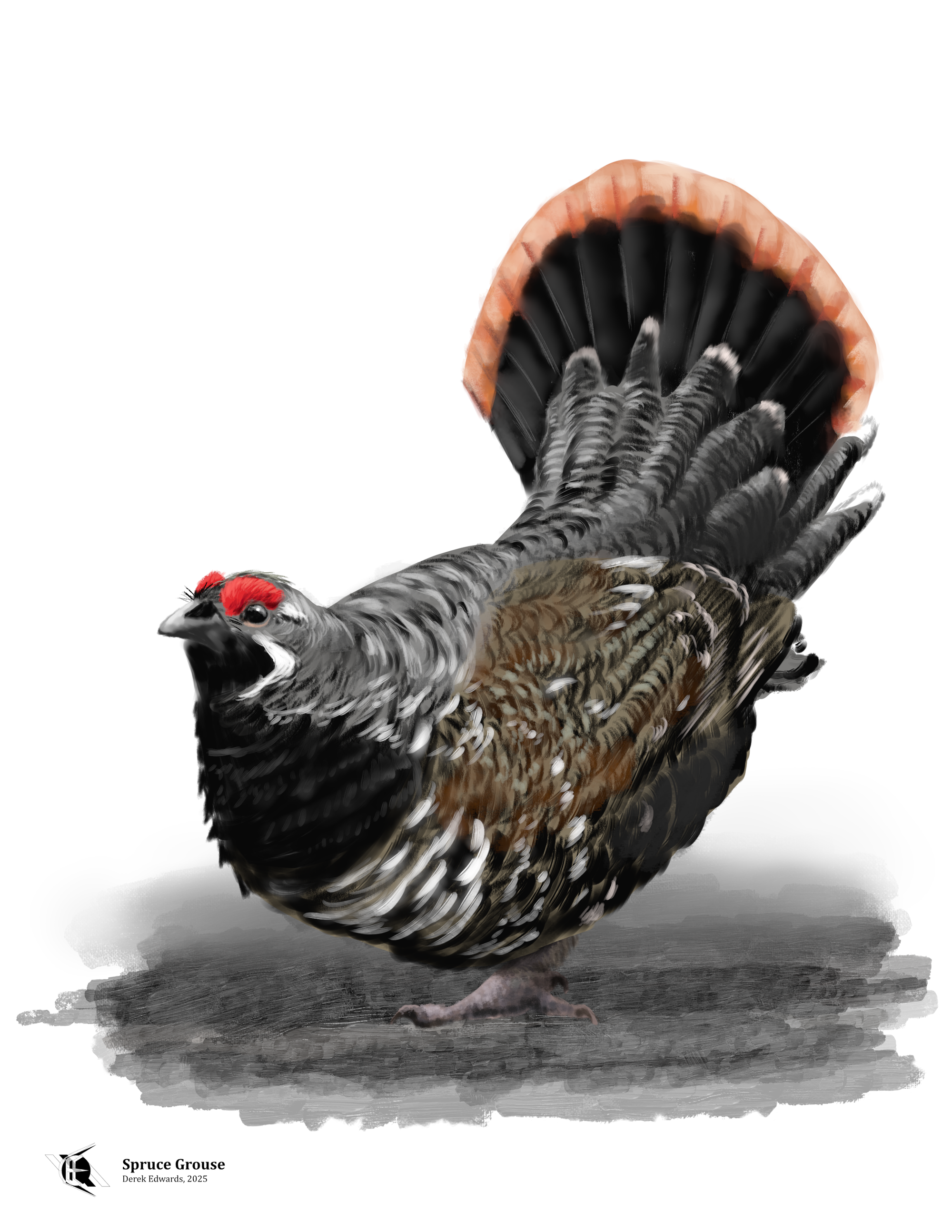
In the years since I drew a turkey for Thanksgiving I’ve spent each holiday drawing a new kind of phasinid each year. This has taken me on a tour of different gamebirds from throughout the world, but this year I’m back home with a bird found in the United States (though mostly in Canada): the Spruce Grouse.
This species is found in the or “boreal forest” of North America, which is the western portion of what in Eurasia is called the “taiga”. This discontiguous expanse of conifer woods, which stretches around the northern lands of the world between southern bounds below which a wider variety of broadleaf trees will grow and northern bounds above which no trees will grown, is the breeding home of many bird species. In the U.S. and Canada the boreal forest is mainly composed of spruce trees, after which this grouse is named; indeed, in the winter months, the spruce trees are what keep the spruce grouse alive. With most fruit gone and most insects having either left or gone to hide out the snows in whatever way their kind does, conifer needles become the staple of the grouse’s diet. Grouse are not exclusive leaf-eaters (there is only one such bird, a very strange one that I’ll discuss when I finally get around to drawing it) but they do find about four-fifths of their winter calories in pine and spruce needles. These make for pretty poor eating, but there’s such an overabundant supply in the boreal forests that the grouse have little need to move south to find food; they just keep eating needles.1
The spruce grouse thus not only breeds in the boreal forest, but stays resident there. That said, some spruce grouse have been observed to travel seasonally, though not as a population north-to-south-to-north as true migrant species will. Rather, some grouse in a breeding area will “disperse” in the winter to within ten miles of their starting point, in any cardinal direction.2 This movement is certainly more than their regular, non-seasonal movements, but it is a pretty small compared to most studied seasonal movements in a bird. No spruce grouse has ever traveled far enough for me to get a look at it; they’re known in Michigan, but pretty rare.3 Where they can be found, though, they’re apparently relatively easy to spot, for grouse. They’re known colloquially as “fool hens” because they will allow people to get within a few feet of them before they flush away.4
To science, the spruce grouse is Canachites canadensis; the species name means “Canadian”, as the type specimens were taken near Hudson Bay; the genus name means “grouse-resembling” (the spruce grouse is the only member of this genus) by logic of Canace (grouse) + ites (resembling). Canace comes from the Greek for “noisy”, as grouse tend to be, making “drumming” noises with their wings. However, the genus Canace had already been given to another group of noisy-winged creatures: beach flies.5 So Canachites comes to mean not grouse-like but fly-like, which, with that squat gray body and big red brows giving them a bug-eyed look, I can actually kind of see.
- Pendergast, B. A., and D. A. Boag. “Nutritional Aspects of the Diet of Spruce Grouse in Central Alberta.” Ornithological Applications 73, no. 4 (December 1, 1971): 437–43. https://doi.org/10.2307/1366665.
- Herzog, Patrick W., and Daniel M. Keppie. “Migration in a Local Population of Spruce Grouse.” Ornithological Applications 82, no. 4 (November 1, 1980): 366. https://doi.org/10.2307/1367557.
- “Canachites Canadensis (Spruce Grouse)” Michigan Natural Features Inventory. n.d. https://mnfi.anr.msu.edu/species/description/10957/Canachites-canadensis.
- Department of Environmental Conservation. “Spruce Grouse,” n.d. https://dec.ny.gov/nature/animals-fish-plants/spruce-grouse.
- Jobling, J. A. (editor). The Key to Scientific Names in Birds of the World (S. M. Billerman et al. editors), Cornell Laboratory of Ornithology, Ithaca.
Curation Links
Sharks Show How Animals Scale Like Geometric Objects | Joanna Thompson, Nautilus
“It’s a universal fact that as any 3-D object, from a Platonic sphere to a cell to an elephant, grows outward in all directions, its total surface area will increase more slowly than the space it occupies (its volume). If the object’s geometry and shape remain the same as it gets bigger, then its surface area will increase roughly as fast as its volume to the two-thirds power. For centuries, biologists have wondered if life forms, too, follow this two-thirds scaling law, even though they come in a stunning variety of shapes and sizes. If so, it would suggest that there are underlying constraints fundamental to evolution that might influence how life interacts with the world around it.”
Overcoming Your Demons | Morgan Housel, Collaborative Fund
An investor’s account of living with and managing a stutter, in a career that calls for lots of talking and appearing unruffled and dependable.
In the Glow of the Candle | Charlotte Mullins, Aeon
“Today, A Philosopher Giving that Lecture on the Orrery, in which a Lamp is Put in the Place of the Sun (1766)by Joseph Wright of Derby (1734-97) is rightly considered a masterpiece… So why, then, was he overlooked when the Royal Academy of Arts was founded by George III just two years later? When Wright had been lauded as a ‘genius’ at that same year’s Society of Artists exhibition? Why was he not a founder member of the new august institution?”
Five Views of the Planet Tartarus | Rachael K. Jones, Lightspeed Magazine
[FICTION] “Planetside, they hold a farce of a trial in the Sibylline Court, a decaying mansion of rotten marble. All traitors to the Sibyllines go to Tartarus to receive the only punishment for rebellion: eternal life."
See the full archive of curations on Notion


Member Commentary