
Running Commentary 1/6/2026
Hello,
I hope you all had good holidays. I was able to spend some time with family, to spend some time birding, and even to spend some time birding with family, when I persuaded some to come with me to walk along a snowy riverbank in search of some northern pintails that had been reported to eBird. We didn’t find the pintails but we did find some hooded mergansers, which are honestly a cooler thing to see if you haven’t seen them well before.
Anyway...
Reading...
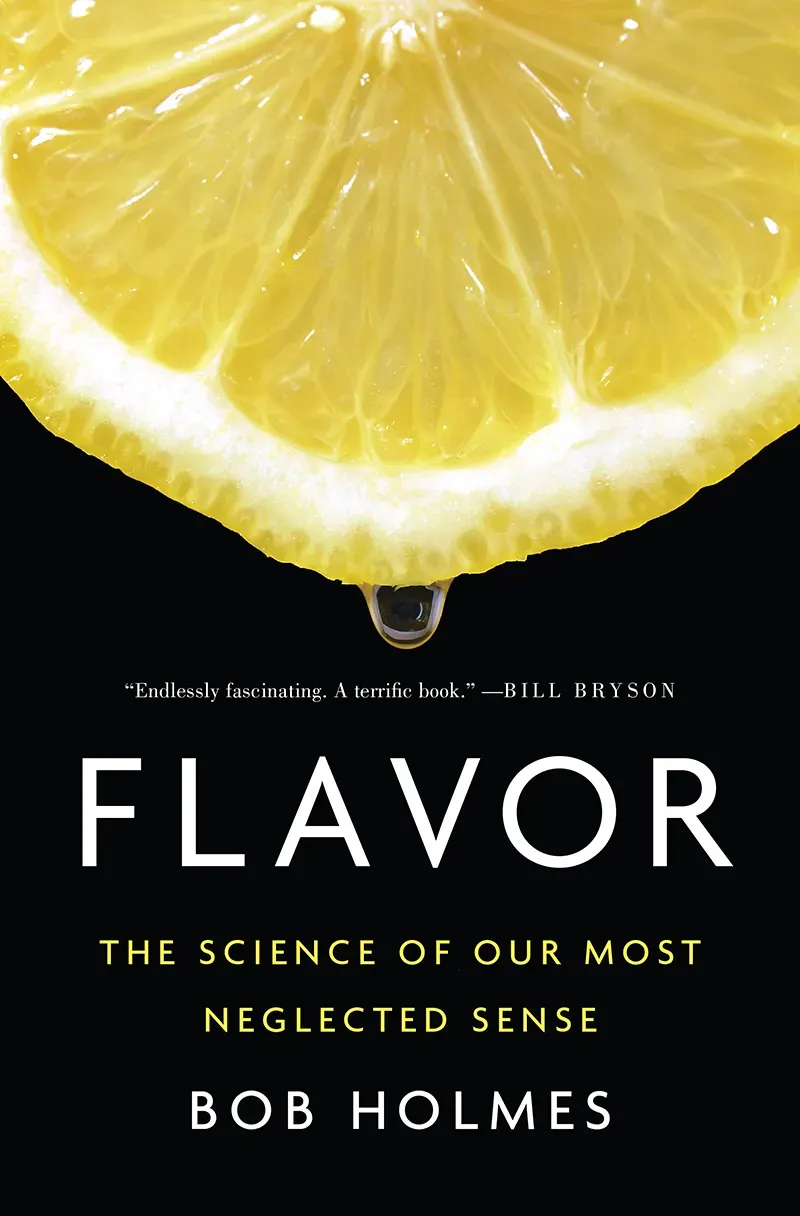
Flavor by Bob Holmes
This book breaks down by topic into fairly discreet chapters. The first two are about the basic mechanics of taste and smell; these are interesting but a little dense and dry; they’re about the fundamentals of flavor, so it makes sense for these chapters to come first, but they could be considered a lot to get through compared to the rest of the book, which is less medical and more culinary in its focus.
One interesting thing in the early chapters is an explanation of the difference between taste and smell; beyond smell being done with the nose and taste with the tongue, I always figured they were the same thing essentially. Here I learned that they are actually entirely separate ways of perceiving chemicals: taste is analytic; smell is synthetic.
But counting up odor receptors doesn’t tell the whole story of smell, because there’s another whole layer to the way we perceive odors that isn’t there for taste. Our sense of taste is what sensory scientists call analytic—that is, we easily break it down into its component parts. Sweet and sour pork is, well, sweet and sour. Soy sauce is salty and umami. Ketchup is sweet, sour, salty, and umami. Our sense of smell doesn’t work that way. Instead, it’s a synthetic sense: Our brains assemble the component parts into a single, unified perception, and we can’t easily pick out the parts separately. That’s easiest to understand if you think about another synthetic sense: vision. When I gaze fondly at my wife, I don’t see lines, curves, and edges, even though that’s what my brain is actually detecting and processing. I just see her face, the synthetic object of my perception. Similarly, the individual odor molecules sensed by our nose can combine in our brain to create a new perception that’s entirely different from its components. If you combine ethyl isobutyrate (a fruity odor), ethyl maltol (caramel-like), and allyl alpha-ionone (violetlike) in the proper proportions, for example, what you smell is not caramel-coated fruit on a bed of violets, but pineapple. Similarly, one part geraniumy 1,5-octadien-3-one to one hundred parts baked-potatoey methional smells fishy—something neither ingredient shows the least hint of alone. Neuroscientists like to refer to these new, higher-level perceptions as “odor objects.” Each one is, in effect, a unique pattern of activation involving a subset of the four hundred or so different kinds of odor receptors in your nose. In essence, these odor objects define reality in our olfactory worlds, just like my wife’s face is a visual object that seems more real to me than its component lines and curves.
Holmes opens with the thesis that people don’t understand flavor as a sense very well, and can’t even put the sensation of something they eat into proper words, the way they can the sensation of something they see or hear. This is a fair enough observation, but it seems that even among sensory scientists and the culinary industry struggles with this as well. Holmes met with many experts in flavor (a term he uses pretty broadly to encompass all sensations of eating, which come together in the brain to form a synthetic perception) and all of them seem to be actively developing a language around and an understanding of flavor. We hear a lot about lab studies and recent papers that indicate certain things about how we perceive flavor, things that bear further investigation. Each one has some lexicon for categorizing flavors as we do images by color, but there’s no unified standards as yet. There are definitely five things that we taste, but probably more that are harder to isolate from food. We can smell tens of thousands of different substances, and the way we perceive smells gives a huge number of possible combinations, so cataloguing smells isn’t as empirical. Spice and minty freshness also have to fit in somewhere, so does mouthfeel. Altogether there’s a lot of different things coming together at once when we eat that forms the food’s flavor, more things than we could consciously comprehend and more things than we can easily study.
Would reading this book make you a better cook? I don’t think that’s quite what this is for. It’s more likely to make the reader a better eater, if anything, by being more informed how foods, particularly processed foods, are flavored — here Holmes stresses that processed foods aren’t unhealthy due to the chemicals used to flavor them, which are usually simply the same chemicals naturally found in flavorful foods, and indeed only the big important ones, without the thousands of trace compounds, but because the actual foods being flavored (corn chips, lumps of cooked sugar, etc) are low-nutrition foods being made more enticing through being given the flavors of high-nutrition foods. Holmes touches little on home cooking, or even regular restaurant cooking or proper cuisine, instead focusing on molecular gastronomy, the cutting-edge, very science-minded practice among some chefs of developing foods using the kinds of flavor science discussed in this book. Ultimately after his experiences with them, Holmes concludes that for most people a chemical or psychological or linguistic approach to cooking is probably more trouble than its worth, given that one needn’t understand the science of or be able to articulately describe their food in order to enjoy it. That might seem to undercut this book’s importance, but as an engineer I must endorse this general “do things, then do the science behind things (optional)” ethos. In the end, this book is worth reading for the reason any number of popsci books are, to get a look at the world underpinning our world, mainly for curiosity’s sake.
One good, practical thing to remember from this book: past the first few bites, one ceases to really experience a dish, due to the way the brain works pushing flavor sensations to the background of consciousness once they’re no longer a change in immediate experience. I’ve long held that it’s somewhat wasteful to eat more than a small amount of ice cream, due, I believed, to the cold food’s numbing effect making it less tasty. Apparently, though, it’s wasteful, from a flavor experience perspective, to eat too much of anything, as the neurons that perceive flavor do so less and less as they fire over and over in a short span.
Playing...
Warframe
The Old Peace
For the first time, I actually remembered to record myself playing a new quest. It took me about an hour-and-a-half to play through, so it’s quite a bit shorter than some recent quests, certainly. Give this a watch if you haven’t played it yourself:
“The Old Peace” gives us our first actual taste of the Tau System, which we should be getting more of in this coming year. I suppose that explains why this quest feels so much like a prologue. Unlike other prologue quests, this has a full set of missions to play, not just an interactive cutscene, but everything we get here, story-wise, is opening questions, not resolving anything. There was peace between the sentients and the Orokin for a while? Margulis helped cover the Orokin’s betrayal up? All the Tenno once heard the Man in the Wall, and Margulis put us to sleep so we’d be separated from him? Lot’s of interesting stuff is brought up here, but it’s all just brought up. That said, I’m really intrigued now, moreso than I had been to go to Tau the more the Sentients showed up in the Origin System.
I will say, from a storytelling perspective, the Murmer’s encroachment on the Dark Refractory really didn’t feel like a genuine way to build tension. I don’t think we needed to take a minute to fight them in the middle of everything, we could have just played through our memories, and it would have been fine.
The quest’s boss fights were a bit tedious, mostly due to the underpowered weapons you’re given in the quest. Going back and fighting them with my real gear, I’m hoping that our fighting them on a small rock arena in an empty skybox is only a temporary measure before we get back to Tau. It reminds me of the Nihil boss arena, which I also don’t much like. As boss fights otherwise, they’re okay, not great — Warframe has few actually great boss fights — but not bad or annoying.
Uriel
The new warframe comes with a new protoframe which DE seems to be positioning as somewhat central to the story going forward. I’m still in the middle of talking with the new protoframes, so I’ll talk about Roathe later on when I cover them. For now, let’s just talk about Uriel as a ‘frame:
- Uriel’s name is that of an angel associated with holy fire and judgment; his visual design is stereotypically devilish. Both of these things play into Roathe’s story. His powerset, though, how he plays, is not really what I’d picture as a devil ‘frame. There’s no possession power, nothing really trickery based or built around subverting his enemies or anything. He plays, I guess, as more of a “lord of hosts”, very much the military commander that Roathe was. Uriel is optimized for a battlefield. He’s weak against bosses or other strong enemies, but very strong against crowds, very mobile, with good survivability.
- His passive is, essentially, an additional three unmoddable companions: one chains enemies together such that they are slowed and share damage taken, one attacks strong enemies (this is the only single target attack Uriel has), and one drops a gun buff that adds fire rate and heat damage to whatever ranged weapon you have equipped. All three of these imps draw enemy attention. None of them can be directly controlled by the player, which makes them a little hard to test out, but this is just a passive, and it’s a decent one.
- Uriel’s first ability puts him in a temporary but decently long-lasting state of being on fire, which damages enemies that come into contact with him. It also allows him to start flying if you dodge while you’re jumped up into the air. While flying, you always move forward, but you can change direction as normal. It works most similar to Wukong’s Cloud Walker ability, as far as flight abilities go, although you come out of it if you run into something. The energy cost is pretty cheap, and the flight is good for both map traversal and escaping a dogpile of enemies.
- His second ability heals both Uriel and his minions. It’s not a complete heal if you’re almost dead but its a solid, quickly-castable save, and helps power…
- His third ability spends some of his minion’s health to deal damage to the enemies in front of him. This is his spammable attack. It’s fine, as a damaging attack, but it’s really for charging up…
- His fourth ability charges up as his minions kill enemies and as he attacks with his 3. Once it’s charged, casting 4 will light the room on fire, dealing a really impressive, growing amount of heat damage to every enemy in the area twice a second until a brief timer runs out, at which point you’ll need to start charging it again. This attack is very strong but timing it out with the charge can be tricky; essentially you have to fight one room to charge up, then go to a different room that still has enemies to use it (or, in stationary missions, charge in one wave, use it the next). The way it charges up keeps it from being a Saryn or pre-rework Ember -style room nuke, but it’s still very strong if used judiciously.
Uriel doesn’t do a whole lot that some ‘frame or another can’t, but he’s a well-designed ‘frame that I can see myself coming back to, especially if I’m playing in a big open area where his flight can be used fully.
Bird of the Week
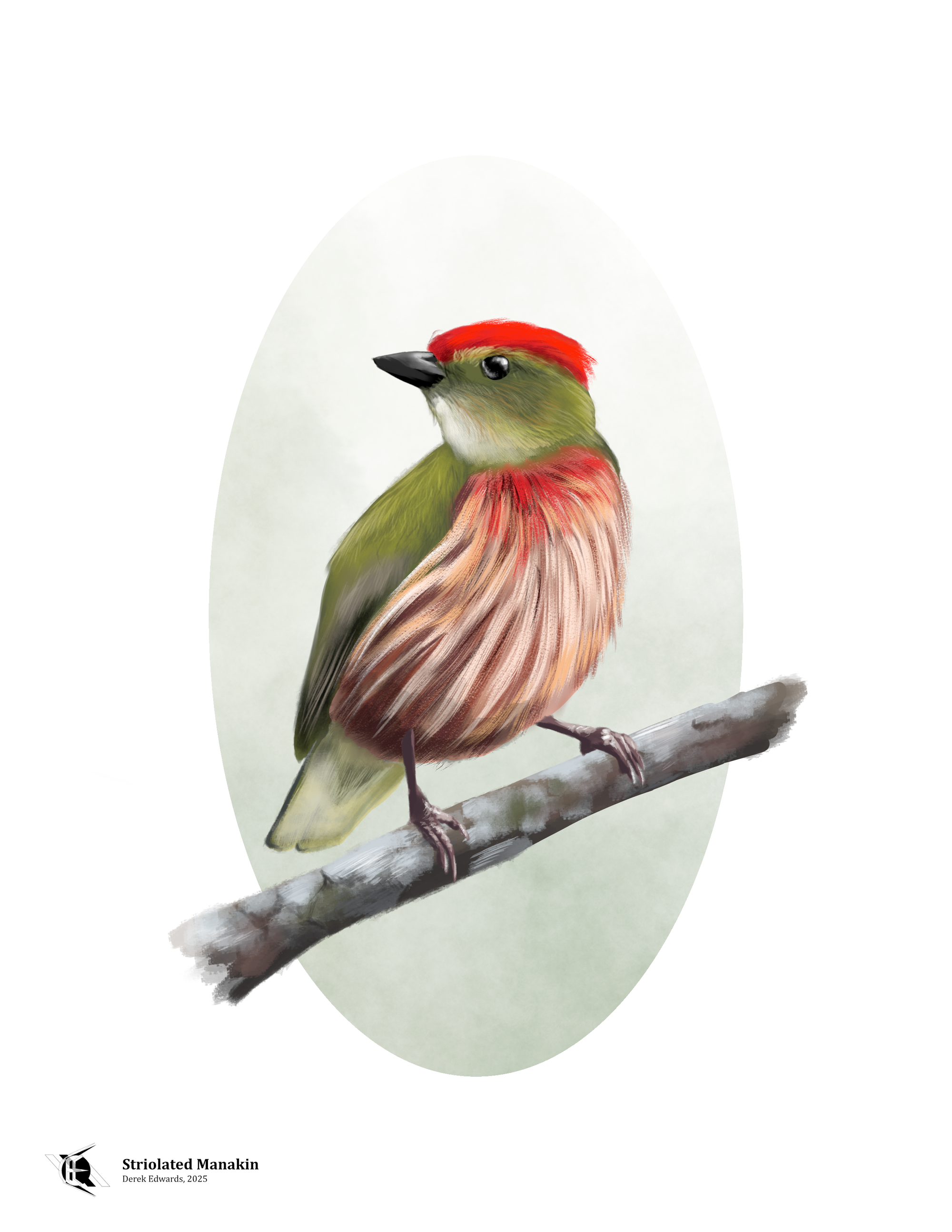
Every year, I draw a bird for Christmas that shows the Christmas colors of red and green. This past Christmas I did one better by drawing a bird with candy-cane striping, the Striolated Manakin.
Found in the inland rainforests of northeastern South America, the striolated manakin is one of the several dozen species in the family Pipridae. I’ve featured one other of these birds before: the Araripe manakin, which remains the rarest bird I’ve drawn. As someone who likes to uncover how birds got their names, Pipridae is a frustrating family: their formal Latin name derives from the type genus Pipra, which takes its name from an unknown bird so named by Aristotle, certainly not any of these South American species, to whom the name was applied arbitrarily;1 their vernacular name, manakin, derives from the Dutch term for “little man”, the same as the miniature wooden figures used by artists to form reference poses.2 That etymology is quite certain, but I’m left with the question of why these birds were given the Dutch name “little men”. Presumably this comes from Dutch colonists in Suriname, but what struck these people to call the birds “little men”? Could it be that the “caps” of most species in Pipridae gives the impression of a human head of hair? That was my speculation, but it’s pure speculation. German ornithologist Helmut Sick, who wrote a book on the birds of Brazil, posited another theory: that the birds were given a name sounding like “manakin” by a native people,3 which is plausible but, again, speculation. I cannot give a clear origin of this word, as it seems to have become part of the Suriname vernacular before birds there were formally studied and named.
But let’s not let the birds’ name overshadow the birds themselves. Manakins are gorgeous little birds, and, unlike the figurines with whom they share a name, they cannot really be appreciated from a still image. Manakins are dancers, known for their courtship displays, which vary by species. The striolated manakin males will reportedly hop up and down while producing a insect-like buzzing with their wings. I’m afraid I couldn’t find any footage of this posted anywhere online, but I was able to find some of the courtship display of a close cousin, the club-winged manakin, which can make its wings hum a loud note:
To science, the striolated manakin is Machaeropterus striolatus; the species name and the common name refer to the stripes down the male’s front, deriving from “stria”, a Latin word for furrows; the genus name is Greek for “dagger-winged”, a reference to the genus’s modified wing-feathers that they use to produce those odd sounds.1
- Jobling, J. A. (editor). The Key to Scientific Names in Birds of the World (S. M. Billerman et al. editors), Cornell Laboratory of Ornithology, Ithaca.
- Merriam-Webster.com Dictionary, s.v. “manakin,” accessed January 6, 2026, https://www.merriam-webster.com/dictionary/manakin.
- Sick, Helmut. Birds in Brazil: a Natural HIstory. 1993. Princeton University Press. p 492
Curation Links
Looks That Quill | Noelle Mateer, WIRED
An exploration of the world of Instagram-famous hedgehogs. “I became obsessed with the idea that this wasn’t just a subset of photogenic pets but rather an entire species exploding in popularity. I wanted to learn about the hogs behind the display names, to peek past their veneer of tiny top hats and GIF-able snuggle sessions. One question was running on an exercise wheel in my mind: When a species goes viral, what happens to the animals?”
Lines of Light: How Analog Television Works | Technology Connections
[VIDEO] Before the age of flatscreens, TVs worked using small electron accelerators to light the pixels of their screens, one-at-a-time, very rapidly. This video goes into how that was accomplished in an era before digital signal. (17 minutes)
Being short is a curse | Ruth Michaelson, The Guardian
“It looks like medieval torture, from the metal rods inserted into sawn bones to the months of agonising recovery. But to some, travelling to Turkey to gain a few inches is a (very high) price worth paying”
First Light | Andrew Palmer, JOYLAND
That was the job title Charlie and I shared. Charlie, a retired elementary school teacher, had earned it over sixteen seasons. In my case it masked a near-total ignorance of the subject we were charged to interpret. Luckily the migration was running late this year, which kept the crowds away and gave me time to read up on the four species of fish that journeyed up the river each spring: sea lamprey, eels, Atlantic salmon and—by far the most numerous—shad.”
See the full archive of curations on Notion




Member Commentary