
Running Commentary 1/12/2026
Hello,
A warm spell has seen a lot of thawing happen where I live, which has been bad for duckspotting. Ice cover of ponds and lakes helps corral ducks into rivers, especially in certain places I know where industry keeps the waters warm. I went checking one of these places this past week and found nothing, not even mallards. The only sign of avian life was the calls of a woodpecker, and even that I didn’t see.
Anyway...
Reading...
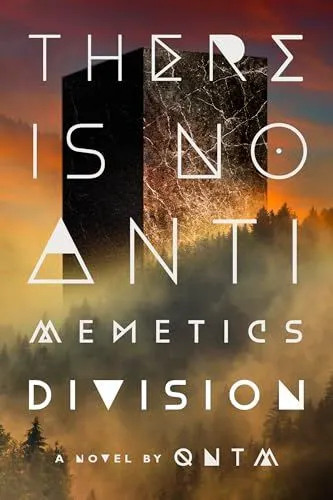
There Is No Antimemetics Division by qntm (Sam Hughes)
This book was originally a series of short fiction works published on the SCP Wiki — a collaborative fiction project written in the form of procedures and reports made by a bureaucratic organization devoted to securing and containing “anomalous” things (mysterious, physics‑defying, or otherwise supernatural items and people) in order to protect the modern world from being subjugated or destroyed by such things, or even from knowing about them. SCP Wiki entries are published under a Creative Commons license, and as such, proprietary names and terms used in the original stories have been changed in the published novel (which has also been revised and professionally edited). Someone familiar with SCP will be able to see what specific terms have been scrubbed out; readers unfamiliar with SCP won’t be missing anything needed to appreciate these stories. Indeed, the repeated use of the number five throughout the book would probably throw an SCP fan off, making them speculate about a connection to the in‑universe Scientology analog the Fifthist Church. (This connection is present in broader SCP lore but doesn’t factor into either this book or the original stories it derives from.)
The cover of this book refers to it as “a novel,” but I wouldn’t call it that myself. It’s a story cycle, similar to Bradbury’s Martian Chronicles in its structure. The component stories have a definite oneness and tell a larger story when read in order, which makes this more than just a collection — but they are component stories, not chapters of a longer work, at least not until the end.
The core of the book is Marie Quinn, a senior researcher into “antimemes”, things which possess an anomalous quality of being hard to notice, remember, or think about, sort of how the old pulp hero The Shadow was “invisible” through hypnotizing others into not seeing him. Quinn uncovers, in a roundabout way, that there is an entity, called వ (A Telegu letter that serves as that languages word for “word”, though the book never tells us this), an extra-real idea that gains power the more people know of it but which kills all who directly observe it. qntm does well writing around a villain that is, by its nature, difficult to comprehend: the writing is tightly focused on character perspectives. Even though the book is written in third person, we get no omniscient viewpoint, and we don’t see or hear anything the viewpoint characters don’t see or hear. The only advantage the reader has in comprehending the story is that we can remember what we’ve read while the characters often forget what they’ve done. This tight perspective both enables the twists and, later, allows us to be struck by the incomprehensibility of వ along with the characters. It works better to have the characters unable to understand something than the narrator.
Overall, this book works well independent of the SCP universe that it spawned from. Everything the reader needs to understand the world for the sake of the story is present. The story is a good one, strong worldbuilding aside. The story we get of Marie and her husband Adam comes in as background for Marie but becomes central to the last section of the book, when Adam becomes a major character. You can kind of tell that the final section was written a bit after the rest of the book, as a wrap‑up — but it’s a good wrap‑up, something that elevates the work from a collection of intriguing ideas to an emotionally impactful narrative.
This isn’t the greatest book I’ve ever read, but it is incredibly recommendable, if that makes sense. That’s why it has taken off as well as it has by word of mouth. It has some really neat, chilling ideas at its core; it’s short and snappy; it has a strong core of horror without being gory. It’s easily worth a read for anyone at all interested in the premise.

Bird of the Week
The United States used to have parrots. This was long before my time, and they weren’t ever found in Michigan. The Carolina parakeet lived in the southeastern states, and it was already declining in the 1800s due to unrestricted hunting and the loss of dense forest habitat; the last of them died sometime between the World Wars. It’s strange to think of early Americans knowing parrots as part of their world of Washington or Lincoln or Douglass or Franklin seeing such a bird out their windows. To us, the Americans of the 21st Century, parrots are birds of zoos and pet shops, the quintessential exotic birds. I know that there are cities in the world where parrots do live, mostly in the tropics; I envy such places. To me, a world of parrots feels almost Edenic, fuller of life and color than the world I live in. But then, this isn’t the most grounded view of things. Parrots are more common than they might seem, and they’re not always the easiest of neighbors. Both truths are embodied by the Monk Parakeet.
Native to a region of South America stretching from central Argentina up into southern Brazil, monk parakeets are among the most widely kept pet parrots. Naturally, they live in the Chaco savannah, stretches of grassland scattered with trees. But they’re also exceptionally capable of living in urban areas. Escaped pets have established breeding populations in numerous major world cities. One such population is found in Greenwood Cemetery, a large expanse of lawns, trees, and tombstones along Brooklyn’s Fifth Avenue — which, I should note, is a different street from Manhattan’s Fifth Avenue, the one with the Empire State Building and Central Park along it. Greenwood was once a Revolutionary War battlefield, became a cemetery in the 1830s, and gradually turned into a refuge for birds as the surrounding land was built upon and paved over. In the 1960s, it became home to a crate‑full of monk parakeets when said crate broke open at a nearby airport, and their descendants live there to this day, delighting Brooklynites and attracting birders eager to add a species to their life list without having to cross the equator.1,2
Other American cities also host colonies of monk parakeets: Chicago’s Hyde Park neighborhood once had a flock of hundreds, though they’ve declined and scattered in recent years;3 there’s a population in Austin, Texas;4 many of the semi‑tropical cities of Florida are home to monk parakeets alongside other introduced parrot species.5 In most cases, these birds find a glad welcome. After all, they’re the kind of animal people invite into their homes — so surely they can invite themselves into a yard or park.
But there comes a point when guests become invaders. In Spain, cities are also home to monk parakeets — not charming dozens, but devastating thousands.6 In large enough numbers, monk parakeets can have a real impact on fruit crops. In Europe especially they can outcompete local birds. But most problematic is their nesting. Monk parakeets, and their close relatives the cliff parakeets, are unusual among parrots in that they construct their own nests rather than using existing cavities. And the nests are not tiny, single‑household affairs, either, but massive multi‑family complexes with numerous openings, which can weigh hundreds of pounds. These provide shelter through the winters of these northern cities, allowing monk parakeets to survive where many other parrots would not. In Greenwood Cemetery, these huge nests get built in the spires of the front gate; in most other urban settings, they get built on the tops of electrical poles, amid wires and transformers not designed to operate with a giant bundle of sticks packed into them. Parakeet nests have been implicated in hundreds of power outages.7 Spain and several other jurisdictions have banned the sale and/or keeping of monk parakeets.8
To science, the monk parakeet is Myiopsitta monachus. The genus name means “mouse‑parrot,” apparently a reference to the pale gray color of the face and underparts; the species name comes from the Greek word for “alone,” meaning “one who lives alone,” derived from monos, a Greek root for “single” or “one” that appears in many English words.9 Now, as to why they are called “monk”, I’ve seen some suggest that the gray face and otherwise green body give the birds a hooded appearance, like a monk. Why they are sometimes also called “Quaker parakeets” is less clear: either because their pale fronts recall the bibs worn by members of the Christian sect of the same name, or because they literally tremble.10 In any case, “one who lives alone” is certainly not a fitting name for this flock‑nesting bird. They live with each other, and they live with us, whether we’re happy about it or not. The United States used to have parrots — and I find now that, in certain corners, it still does.
- NYC Bird Alliance. “Green-Wood Cemetery,” n.d. https://www.nycbirdalliance.org/events-birding/birding-resources/birding-in-nyc/birding-in-brooklyn/green-wood-cemetery.
- Saha, Purbita. “My Journey Into the Heart of Brooklyn Parrot Country.” Audubon, April 22, 2025. https://www.audubon.org/magazine/my-journey-heart-brooklyn-parrot-country.
- Gersony, Laura. “The Quiet Victory of Chicago’s Monk Parakeets.” Chicago Maroon, January 20, 2023. https://chicagomaroon.com/28830/grey-city/quiet-protest-chicagos-monk-parakeets/.
- West, Abby. “Bird of the Week: Monk Parakeet.” Travis Audubon https://travisaudubon.org/murmurations/bird-of-the-week-monk-parakeet-2.
- Connor. “Parrots in Florida.” Worldwide Birder (blog), December 12, 2024. https://worldwidebirder.com/parrots-in-florida-the-complete-guide-to-wild-parakeets-in-florida/.
- Planelles, Manuel, Manuel Planelles, and Manuel Planelles. “Monk Parakeets Now Seen as a Plague in Major Spanish Cities.” EL PAÍS English, November 12, 2015. https://english.elpais.com/elpais/2015/11/11/inenglish/1447256002_327689.html.
- Foran, Sheila. “Beating Monk Parakeets at Their Own Game.” UConn Today, October 3, 2014. https://today.uconn.edu/2014/09/beating-monk-parakeets-at-their-own-game/.
- Souviron-Priego, Lucrecia. “Legal Imports and Feral Parakeets in Spain.” British Ornithologists’ Union, March 5, 2021. https://bou.org.uk/blog-souviron-priego-et-al-trade-ias-parakeets-spain/.
- Jobling, J. A. (editor). The Key to Scientific Names in Birds of the World (S. M. Billerman et al. editors), Cornell Laboratory of Ornithology, Ithaca.
- Kalhagen, Alyson. “7 Fascinating Insights Into Quaker Parrots: What Makes Them Unique.” The Spruce Pets, June 7, 2025. https://www.thesprucepets.com/facts-about-quaker-parrots-390854.
Curation Links
The Body Trade | John Shiffman, Reade Levinson, & Brian Grow, Reuters
“When Americans leave their bodies to science, they are also donating to commerce: Cadavers and body parts, especially those of the poor, are sold in a thriving and largely unregulated market. Grisly abuses abound.” A fascinating series of investigative journalism, though I think at points it tries to make villains out of people who are more idiosyncratically opportunistic than evil. Not in every case, though.
The 2025 Audubon Photography Awards: The Top 100 | Audubon
The best bird photos of the past year, as I always add to the curation leaks as they are published.
Rethinking How the Egyptians Built the Pyramids | Ben McGrath, National Geographic
If you look at a map of where the major pyramids of Egypt were built, you’ll notice that they run along a line beside, and several miles west of, the Nile River. Well, archaeologists now believe, based on geological data and surviving documentation of the pyramids’ construction, that a since-dried branch of the Nile once ran right past them, or rather, they were built conveniently on the bank of this stream, not out in the desert wastes as they stand today.
Jump Cut | James Martin Morrison, DUST
[FICTION] [VIDEO] "When a struggling actor accepts the lead role in a mysterious experimental film, her grasp on reality begins to unravel." (17 minutes)
See the full archive of curations on Notion




Member Commentary