
Running Commentary 4/1/2026
Hello,
It’s April Fools Day, but I have no joke this year. Last year I had a whole fake bird that I thought was pretty funny but no-one caught on that it was fake or why it was funny, so it didn't really work as a joke.
Anyway...
Watching...

Paradise
The Final Countdown
- I like how they wrapped things up with Gary. I think it did a lot to show that Teri’s seen a lot of death in the last few years, and really would rather not see any more, even if someone might be said to deserve it. It was a really strong scene when she saved Bean and Gary both.
- Jane’s dead, then.
- You know, I just don’t find the conflict between Jeremy and Agent Robinson at all compelling. I could have written that earlier, but it really did feel like there was nothing to do with these characters at this point in the story so the writers tried to force something. I don’t care.
- We’re certainly left on a cliffhanger here. I can see either of two things happening: either the people under the mountain manage to stop the meltdown, but in such a way that they can no longer keep the outsiders out, or the reactors melt down, everyone inside dies, and Season 3 is about using Sinatra’s time machine to prevent the meltdown and save Xavier and Teri’s kids.
- This episode has perhaps the best depiction of hacking in any modern TV show, with Presley using social engineering to gain access to Sinatra’s system privileges and not really hacking anything.
- So Link is, apparently, Sinatra’s son. Or at least that’s heavily implied, and I’m not sure why they’d bring this up if it wasn’t the case.
- I know I mentioned maybe the scientist had faked his wife’s death, but the particular way this episode ends, with the orange glow in Sinatra’s face, makes me think “Alex” is the name of the time machine he invented.
Exodus
- Well, I was correct, broadly about what Alex was. I did not anticipate that it was acting independent of Sinatra, but it is, indeed, a computer able to act across time. We don’t get a lot more than that here, but it appears Alex will be central to the final season’s story.
- I was kind of correct about how the season would end, in that I made two guesses and got close with one: the actions to save the people under the mountain did indeed render it impossible to keep them apart from the outsiders, it’s just that everyone wound up outside rather than inside.
- I’d completely forgotten that Link and his crew had come together to shut down nuclear plants before they melted down. Nice to see that brought back around here.
- Jane’s not dead, then?
Overall Season 2 was still pretty good TV, but I don’t think it was as good as the first season, mainly because that had the whole high-concept murder mystery at its core, while this season didn’t have that and didn’t have anything as good to replace it. The Alex mystery is more just withheld information and teasing, and even in the finale there are a lot of details left for the future. I’m looking forward to Season 3.
Playing...
Warframe
Warframe’s latest update brings the 64th frame, Follie, along with a new mission type, one that launched to the worst reception of any update since “Scarlet Spear”. I didn’t get to play the mission as it was released; I didn’t have time until the weekend, and by then DE had already pushed a patch addressing many of the major complaints. I watched some release‑day streams to see what it looked like originally, and while the mission isn’t wildly different now, it’s been tweaked in a few ways that make the farm more consistent. Either that fix was a bigger improvement than it seems, or a lot of people simply didn’t understand the mission. That said, it’s still not exactly a good mission. Now that I’ve finished the farm, I don’t think I’ll be playing Follie’s Hunt again for fun.
Up until this update, most Warframe gameplay revolved around killing enemies (directly or indirectly) or, less commonly but still often enough, stealthing around unseen. If you try either approach in Follie’s hunt, you’re going to have a very bad time. Enemies won’t die easily, and trying to go unseen will just get you killed by environmental hazards. The key to this mission is simple: stay alive and keep moving. Hop around, sprint from room to room. If you see a balloon, shoot it. If you see a swirling plume of paint, run through it and dodge‑roll to the nearest canvas. Ignore enemies in most cases. I’d recommend bringing a ‘frame with strong mobility and survivability; I’m a Kullervo guy anyway, and I found him a great fit here.
Story‑wise, the mission follows an aspiring Aribiter of Hexis trying to decipher notes left by his mentor, who was killed when a Balor Formorian destroyed the Vesper Relay over Venus. This leads the player to farm atramentem, the new mission resource. I was able to get the required 1200 in just a couple sessions, maybe three hours of playtime. By that point, I had every blueprint for Follie and all but one for her gun, plus some duplicates. That’s all luck; it’s theoretically possible to never see a blueprint drop. But I’m confident most players who complete the story requirement will be basically done with the game mode if they want to be.
If your goal is atramentem, I’d recommend Steel Path. If your goal is blueprints, Normal is fine. I played about half‑and‑half, and both felt similar since you’re ignoring enemies most of the time. Steel Path gives double atramentem, but Normal gives more blueprint chances per atramentum. So I’d say: play Normal until you get the blueprints you want or hit 1200 Atramentem, then switch to Steel Path if you need extra for purchases. Then you’re done.
Is It the Worst Mission? Honestly, no. I don’t think this is the worst farm mission in the game. Yareli’s farm, at least on release, was astonishingly drawn‑out, and Hildryn’s are still ridiculously time‑and effort‑intensive. I’d probably remember that farm more negatively if I hadn’t gotten all the blueprints in just three runs. I’d still rather play Follie’s Hunt than Defection or the Corpus Kahl mission.
But I’m not going to play it again for fun. It’s high‑stress — not because it’s difficult, but because you constantly, constantly, constantly need to be moving. And I have other small complaints: when I first played, “Find paint” was not a helpful prompt, since everything in the tileset is covered in paint, and it took me most of the mission to stumble across what I was actually supposed to be looking for.
Now that Warframe is out on Android, it’s worth noting that playing as Drifter/Operator on touchscreen controls seems to lack a way to dodge‑roll, which makes this mission borderline unplayable on mobile. Overall, mobility controls on mobile have a few gaps in their functional capability compared to PC — directional weapon slams, for example, are possible but impractical. Maybe DE assumes mobile players are using Bluetooth controllers, but I don’t, and I don’t think it would be impossible to achieve full movement functionality on mobile. I avoid playing jump‑heavy missions on my phone, and I’d probably do the same for Follie’s hunt. If you’re a mobile‑only player, I’d honestly just buy Follie with platinum instead.
As for Follie Herself, I have her built, but I’ll talk about how she plays after I’ve actually spent some time running her, probably in the next newsletter.
Bird of the Week
One thing you begin to notice when you get into birding is that certain kinds of birds are overwhelmingly common compared to others of their general sort. Mallards are the classic example. They’re found in practically every inland body of water in the Northern Hemisphere. Duck‑spotting thus becomes less a matter of spotting ducks and more a matter of spotting other ducks besides mallards. Or take thrushes; I can find bluebirds if I know where to go, and if I’m lucky I might come across a hermit thrush or a Swainson’s thrush or a veery — someday, I hope to conclusively find that last one — but I see a robin pretty much every time I go outside, at least in the warmer months. Well, there’s one of those for North American shorebirds: the Killdeer.
We’ve encountered plovers before in this space, back when we looked at the northern lapwing. “Lapwing,” “dotterel,” and “plover” are all terms for members of the family Charadriidae, and “plover” usually refers to the smaller, plainer members of this group, though there’s no strict rule. There’s also some disagreement about how to pronounce “plover”: does it rhyme with clover or hover? I rhyme it with clover, and the dictionary says either is correct. The root of the word is the Latin pluvia, meaning “rain.”1 Plovers are known to show up in flooded fields after storms, especially in spring as they make their way north to their breeding grounds.
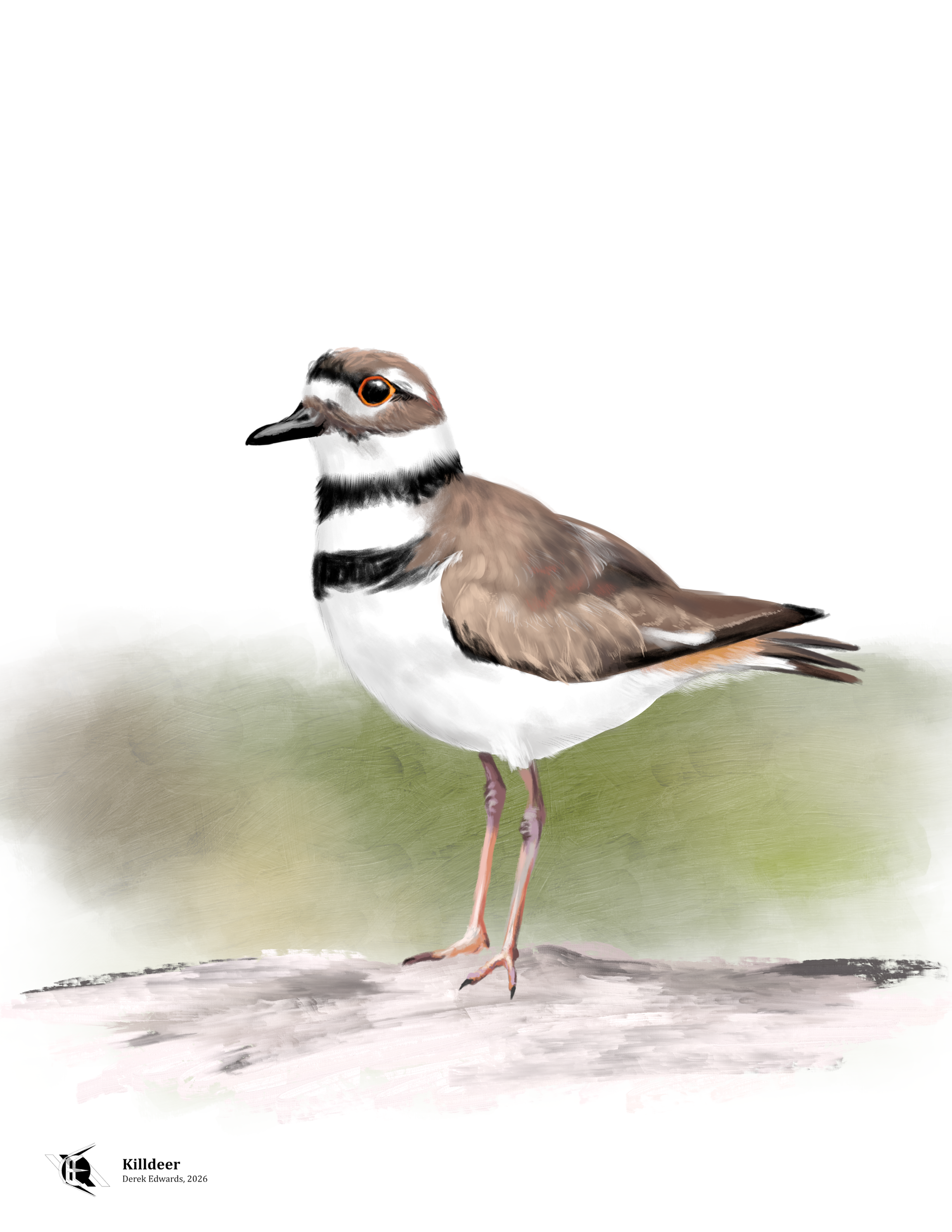
Killdeer are plovers, even if they’re not called that in their common name. They’re one of those birds that manage to name themselves through sheer insistence. They are, by far, the most vocal of all the shorebirds I’ve encountered. If you find even a small group of killdeer, you’ll likely hear them before you see them, shouting “kill-dee! kill-dee!” over and over to each other. They aren’t literally always calling, but it can certainly seem that way. You’ll find them farther from water than many shorebirds, in various wide‑open short‑grass fields, including large urban green spaces and airfields, along with the usual marshy habitat plovers are known to love. Because they’re widespread, conspicuously noisy, and relatively content to live in human landscapes, killdeer are the plovers most North Americans would be familiar with, even if they don’t realize it’s a plover.
Like many plovers, killdeer are particularly vulnerable while nesting. They lay their eggs in shallow scrapes in the ground, leaving them exposed to danger from predators and from large, oblivious things that might crush the nest unnoticed. For this reason, killdeer do what they can to prevent their nests from being approached. If a person comes too close, killdeer exhibit a remarkable capacity for conscious deceit, holding out one wing as if broken and limping away from the nest before suddenly abandoning the ruse and flying off.2 If you encounter a killdeer acting in this manner, go ahead and play along; it’s guiding you away from its eggs. If you don’t, keep an eye on where you’re stepping. Killdeer eggs are heavily speckled and blend into the ground. Both parents attend the nest.
If you have reason to doubt that the plover you’re seeing is a killdeer — maybe you’re far from people, close to water, and your bird isn’t making any noise — there are a couple of field marks to look for. In front, the Killdeer has two black bands across its neck and chest. Other similar North American plovers have, at most, one band. In back, the killdeer has a rufous rump, especially visible in flight.
To science, the killdeer is Charadrius vociferus. The species name means “noisy, talkative” in Latin, which is perfectly appropriate.3 The genus name is the root of that of both the plover family, Charadriidae, and the shorebird order, Charadriiformes. It’s another bird name with an unclear, ancient origin, only this time, rather than coming from the writings of Aristotle or Pliny the Elder, this name comes from the Bible. Specifically, it comes from a passage in Leviticus enumerating which birds the ancient Hebrews were to avoid eating. The King James Version renders it thus:4
“And the stork, the heron after her kind, and the lapwing, and the bat.”
So, no eating storks, herons, lapwings, or bats (which aren’t birds at all in the modern understanding, but that’s beside this point). But that word “lapwing” is perhaps not the most accurate translation. The original Hebrew word was דּוּכִיפַת — dukhiphat — which might instead refer to a hoopoe or a grouse.5 The Septuagint—a Greek translation of the Hebrew Bible, traditionally said to have been produced by seventy (or seventy‑two) translators during the rule of Alexander’s successors over Judea, rendered the word as χαραδριός — kharadriòs.6 By the time of the Septuagint’s compilation, the book of Leviticus was as old to them as Pliny would be to us, so it’s unclear whether this was meant as a confident direct translation or a best guess. The Greek word literally refers to a bird of river valleys, perhaps the stone‑curlew.3 The Septuagint served as the basis for the Latin Vulgate, long used by the Roman Church, where the bird’s name was rendered charadrius. That name passed into scientific usage for Linnaeus’s original plover genus, though its translation in the KJV as “lapwing” suggests it was understood to mean a plover‑like bird before then.
- Merriam-Webster.com Dictionary, s.v. “plover,” accessed April 1, 2026, https://www.merriam-webster.com/dictionary/plover.
- Deane, C. Douglas. “The Broken-Wing Behavior of the Killdeer.” The Auk 61, no. 2 (1944): 243–47. https://doi.org/10.2307/4079369
- Jobling, J. A. (editor). The Key to Scientific Names in Birds of the World (S. M. Billerman et al. editors), Cornell Laboratory of Ornithology, Ithaca.
- Leviticus 11:19 (KJV)
- James Strong, et al. “H1744 Strong’s Dictionary”. Strong’s Dictionary | Official Authoritative Original Text Repository, n.d. https://strongsdictionary.org/strongs-dictionary/H1744.
- Leviticus 11:19 (LXX)
Curation Links
American Hindenburg | Robert Weintraub, The Atavist
“In the early days of flight, airships were hailed as the future of war. Then disaster struck the USS Akron.”
E.B. Whiter than White | Henry Oliver, The Common Reader
“Everyone loves Charlotte’s Web and rightly so—it’s a children’s book of the highest order—but the man of the essays, the temperate voice of the mid-century New Yorker, whose whole persona has a keen nostalgia value today, has the sort of insistent, supercilious gentleness that soon drives me to ungenerous thoughts. Page after page, White recounts the little events of his life, activities with Fred the dachshund, the books and profiles he keeps in bed with him when he is ill, the fattening and then grieving of a pig who died from an unknown illness. O who can object to such moderate stuff? Isn’t it mere grouchery to complain of a friendly tone that never ever snaps?“
The Weather Equation | Dan Harris & Brady Haran, Numberphile
[VIDEO] A meteorologist explains, at length, the mathematical formula used to model the up-down wind activity of a weather system. I can’t say I completely grasped it all but I certainly gained a sense of how much work goes into atmospheric modelling, at least. (45 minutes)
A Fishy Story | Jerome K. Jerome
[FICTION] Excerpted from Jerome’s Three Men in a Boat. An amusing story about travelers learning the story behind an enormous trout mounted on a plaque in a pub.
See the full archive of curations on Notion





Member Commentary