
Running Commentary 3/18/2026
Hello,
I got to collect two classic bird behavior observations recently: I followed reports to find some woodcocks calling and doing their skydance, and later in a field near where I work I saw a kestrel flying into the wind to hang in midair and look for food, as they’re known to do. I’ve seen both of these species before, but I’ve never seen them doing what they were doing before. Sometimes seeing birds doing something neat for the first time is just as exciting as seeing them for the first time overall.
Anyway...
Watching...

Paradise
“The Mailman”
- We finally get to see what Teri was up to this whole time.
- As with Annie in the first episode, this episode does a great job establishing who Gary is in showing how he dealt with The Day: he’s a guy who was kind of hoping for the apocalypse. Not that he wanted all the death, but he didn’t seem like he was really loving life before the end of the world as much as he was loving the fantasy of life afterwards. A lot of post-apocalypse shows might have a prepper be a homesteading militiaman, which makes sense but who is a bit of a played-out stock character at this point. Gary instead is a more ordinary guy, a hobbyist who got into doomsday prepping out of an odd sense that he’d have more in life after the apocalypse than before it.
- Gary’s crisis as a character comes from how he doesn’t quite get the life he dreamed of at the end of the world, since he doesn’t find love. The episode’s final shots make for a good twist.
“Jane”
- Another short episode, and honestly not a very good one. Season 2 so far has had some really cool moments but it really does feel like a middle of something at this point. In the two episodes we have left I expect we’ll see Xavier and Teri make it back to Colorado and the reveal of what’s going on with Sinatra’s secret project and anything else will be reserved for Season 3.
- Why would a sauna have an exterior lock?
- Jane Driscoll is not a character that I had a lot of questions about, but this episode did let us know two important things about her: She grew up unloved, and seems to try to get ersatz maternal approval from both her trainer and now from Sinatra. She has herself positioned as Sinatra’s right hand now, which I think is where she wants to be; I don’t think she has much plans beyond that. And she may be genuinely psychotic. I say maybe because I think there’s a chance that the voices she’s hearing are in fact messages through time.
- There definitely are messages through time, as we see in the beginning when Circuit City guy starts getting AIM chats from “AlexQ” about Jane. This really makes me quite certain that there is no conventional time machine, only information transfer, since you wouldn’t need to recruit some rando in the past to do things if you could just send an agent back.
BattleBots
This set of fights saw the return of Rusty, everyone’s favorite bad bot. I mean, we all love Rusty, we Dave Eaton building and fielding a bot all by himself, but Rusty’s never really expected to win. That’s part of its charm, really. Here, Rusty was up against three newer bots: Hellfire, Manta, and Traves T.
- HELLFIRE v TRAVES T. — Hellfire is very reminiscent of Valkyrie — a sort of triangular undercutter. It seems to be an alright bot. This was its first fight here, against Travis T., which is… unfinished, would be my take on it. Kurt Krueger has been iterating on his bot for a while now, and the version shown here seemed like a partly assembled test configuration, with all the innards exposed. It lost every fight it fought, including the one it won, and I’m confused why it was allowed to enter fights people paid to see in the state it was in.
- MANTA vs. RUSTY — Manta is a bot from a young team, and it was the best bot fielded in Face‑Offs 5. My only issue with it is that it’s an incredibly meta‑following design. The sport does not need another compact vertical eggbeater drum spinner with little forks in front, but that’s apparently what it’s gonna keep getting.
- MANTA vs. HELLFIRE — This was the fight between the two, y’know, actually good bots, so unsurprisingly this was the highlight of the bunch. Hellfire was doing pretty well up until it hit Manta too hard and broke something important within itself.
- RUSTY vs. TRAVES T. — Rusty ought to have at least won this one, but tragedy struck as it often does in the form of the kill saw slots. Traves T. took the win but also managed to completely break its systems apart trying to knock Rusty loose, so it actually took the most crippling damage despite winning by knockout.
- MANTA vs. TRAVES T. — I mean, yeah — Manta won in the first bit, against a bot that was already all but destroyed. Don’t have bots compete without a chassis.
- HELLFIRE vs. RUSTY — Hellfire never recovered from the fight against Manta. They tried to give Rusty a proper win, not just a forfeit. And good sportsmanship paid off in a win, since Rusty seems to also have been not quite ready for a fight. I’ve gotta say though, watching two bots without weapons function or any meaningful speed nudge each other for two minutes until one of them burns out for unrelated reasons is not entertaining.
This was kind of a failure of an exhibition, I’m sorry to say. Not for lack of trying, but I don’t think there was a single really exciting fight, and a lot of the bouts were just tough to watch considering that the bots simply weren’t capable.
Bird of the Week
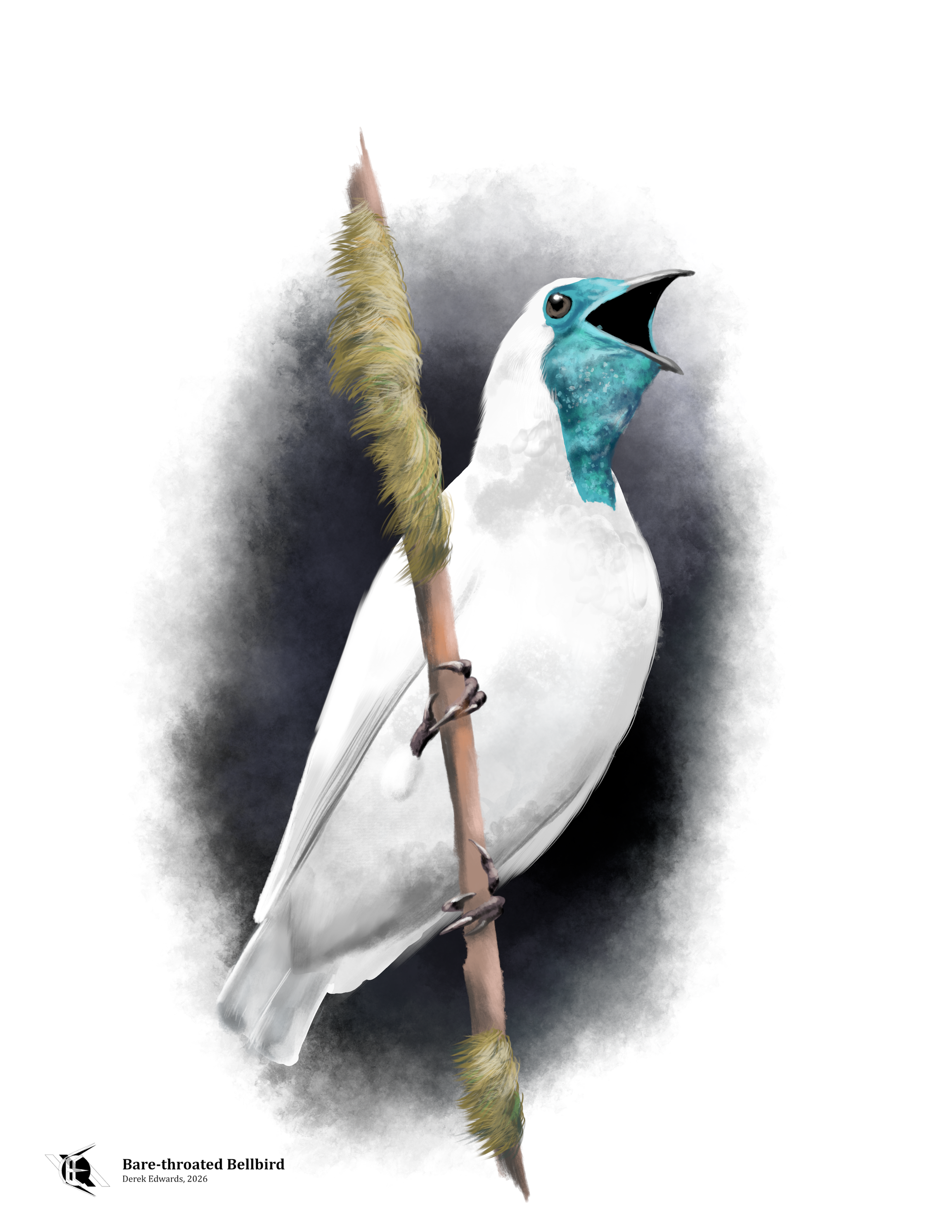
If you’re in a forest in South America, you’re going to be hearing a lot of birds. The continent is home to thousands of species, all competing for attention. Many do so by being vividly colored, trying to stand out through the visual noise of the jungle. But some instead try to cut through the actual noise with loud, ringing calls. These are the bellbirds of the genus Procnias, four species including today’s bird, the Bare‑Throated Bellbird.
There is another group of “bellbirds” besides Procnias: the family Oreoicidae of Australasia, but these are unrelated and, from what I can tell from briefly coming across them in my research, not as aptly named. The Procnias species are all found in the Atlantic forests of Latin America, from the Three‑Wattled Bellbird in Central America down to the Bare‑Throated Bellbird of southeastern Brazil. These bellbirds are a subtype of the cotingas, a very diverse family of mostly fruit‑eating birds of the tropical New World forests. Many cotingas are richly colored — such as the deep magenta pompadour cotinga — but the bellbirds are not among these. Female bellbirds are olive‑green and streaked, and the males are either white or white‑and‑brown depending on the species. The male Bare‑Throated Bellbird’s eponymous feature is the most vibrant coloration shown by any of the bellbird contingent, its skin being blue-green. These birds aren’t without their beauty, but the main thing people notice about them is their songs.
Speakers of the Tupí language called the birds gwira’ponga, from which derives the Portuguese araponga. Brazilians also sometimes call it ferreiro—“the blacksmith”—because that harsh, pinging call sounds like a hammer striking an anvil.1
Spanish speakers in the parts of Paraguay and Argentina where the Bare‑Throated Bellbird is also found call it el pájaro campana, for which “bellbird” is a direct English translation. Campana is the feminine form of campanus, the Latin word for a person from Campania, a region of Italy around Naples from which the alloy used in bells once came.2 (“Bell,” the English word, derives from an Old English word for “resound,” from which we also get “bellow.”)3 In 2012, Paraguay declared el pájaro campana their national bird, an effort intended to prompt protection for a species already beloved by Paraguayans but threatened in the country by habitat loss. The bellbird’s loud call inspired the opening measures of a folk standard for the Paraguayan harp (or two).4
In Brazil, araponga is also slang for a spy,1 evidently because of a Brazilian television show of the same name. From what little is available about the show on IMDb, it seems this was the Brazilian equivalent of Get Smart. That would probably make the title character’s codename a joke, as a bellbird would make a lousy spy.
To science, the bird is Procnias nudicollis; the species name simply means “bare‑throated” in Latin, combining the roots of the English words “nude” and “collar.” The genus name recalls Procne, the Theban princess of myth who was turned into a bird, usually claimed to be a swallow. Someday I’ll draw a purple mountain someday and say more about that when I talk about the genus Procne; for now, just know that “bellbirds” were once thought to have mouths resembling those of swallows.5
- SA, Priberam Informática. “Araponga.” Dicionário Priberam Da Língua Portuguesa, n.d. https://dicionario.priberam.org/araponga.
- “Campana” El Castellano - Todo Sobre El Idioma Español: Gramática, Dudas, Etimolgía Y Diccionario. n.d. https://www.elcastellano.org/palabra/campana.
- Merriam-Webster.com Dictionary, s.v. “bell,” accessed March 17, 2026, https://www.merriam-webster.com/dictionary/bell.
- Fornera, Genesis. “Meet Pájaro Campana: Paraguay’S National Bird and Its Legendary Call.” The Asunción Times, September 27, 2025. https://asunciontimes.com/lifestyle/exploring-paraguay/pajaro-campana-paraguays-national-bird-and-its-legendary-call/.
- Jobling, J. A. (editor). The Key to Scientific Names in Birds of the World (S. M. Billerman et al. editors), Cornell Laboratory of Ornithology, Ithaca.
Curation Links
Words Without Borders | Matthew Battles, Lapham’s Quarterly
Excerpted from Palimpsest: A History of the Written Word, a brief history of European writing from Classical Greece to Charlemagne’s court.
Lab Cultures | Anonymous Biologist, LOGIC(S)
“In the last decade or so, advances in gene-editing techniques have allowed scientists to modify genetic code with an unprecedented level of precision and speed, and at a fraction of the cost. This has been game-changing for biological research. Scientists can now make and test changes to genetic code in ways never before possible, with far-reaching ramifications. The scientific discoveries that get buzz in the popular press and what scientists themselves are excited about are often pretty different, however. So we were curious to learn more about how scientists see these developments. Even more fundamentally, we wanted to know about the nuts and bolts of research: how do labs operate? Who works in them, what is the hierarchy like, and where does the money come from? How do conversations about ethics in scientific research differ from those in the tech world? What job prospects outside of academia are out there for someone with a PhD in biology? Over drinks at our kitchen table, we sat down with a current PhD student in cell biology to learn more.”
Your cheap furniture has a secret | Rex Krueger
[VIDEO] What is budget furniture made of? Steel wire and fiberboard, maybe, but if it’s solid wood, it’s probably rubberwood, a byproduct of the natural latex industry. Woodworker Rex Krueger gives a history of rubberwood as well as his expert opinion of the wood itself. (12 minutes)
Drift | Kevin B, Necessary Fiction
[FICTION] “There was a spot of blood on the dog’s right ear. Scout, Sheila’s pride and joy, was so unnerved by her erratic driving that his little body flitted about only long enough for her to notice the red dot in her rearview mirror, but not long enough for her to snatch him up and examine where the blood could be coming from or whether or not it belonged to her. Her hand was still bandaged and gripping the steering wheel tightly brought about a slow throb that exacerbated her already heavy breathing. She told herself that if anything happened to her, she won’t meet it with fear, but she couldn’t bear it if something happened to the twelve-year-old terrier whimpering in the backseat of her beat-up Buick Century.”
See the full archive of curations on Notion





Member Commentary