
Running Commentary 12/8/2025
Hello,
I got to go on a sleigh ride this past Saturday. Actually, it was less of a sleigh and more of an old cargo sledge, but it was a trip through the woods sliding behind some horses so it counts. There was a red-tailed hawk that flew along ahead of us for a bit, that gave a nice cry as it flew overhead.
Anyway...
Watching...

The Fantastic Four: First Steps
- A lot of work went into making this film look like the world of the original Stan Lee/Jack Kirby comics of the 1960s. Beyond that, the storytelling feels very much like the Christopher Reeve Superman films of the 1970s, very earnest heroism, planet-ending stakes, uncomplicated cooperation with world governments. In pretty much every way, this film hearkens back to mid-latter 20th Century superhero storytelling, with the only major modern touch being the quality of visual effects. This works well for the Fantastic Four, who occupy an odd space — like Superman — too inherently fanciful to work as gritty realism, but also too iconic and beloved to work as comedy. The retrofuturistic production design helps to keep the sincere, straight-played story from feeling bland.
- The film wisely has the team go into space and confront Galactus as he consumes another planet. It gives the film a much-needed action scene in the first half, it shows Galactus as a real threat, but it’s low-stakes enough, to the audience, that it leaves steam for the climax. This film is well-paced.
- My one complaint is that the film seems to presume the audience is already quite familiar with the characters. We are told the Four’s origins in a sort of newsreel flashback, but that’s just the facts of how they got their abilities. This is not about the Fantastic Four’s first steps into heroism; they’re already well-established in this role by the events of the film. They have tendencies and catchphrases and a team dynamic that matches their comic counterparts — and if the viewer is aware of these, the characters here play well. But if not, I’m not so sure. I, myself, have read Hickman’s Fantastic Four and FF comics and am generally familiar with the characters, but I’m not a dedicated fan. I found that I was able to follow the story well enough, but I don’t think I felt for the characters at really any point. They were a bit too much just people doing things here.
- I think a lot could be done with this setting, which I’m hoping doesn’t get completely abandoned once the Fantastic Four get pulled into the main MCU. As much as I understand producers can be worried that audiences won’t be able to keep several universes straight, I think the X-Men should absolutely have their own reality and I think, at that point, they should let the Fantastic Four keep theirs.
- I’m adding Ebon Moss-Bachrach to The List, since between this and The Bear he now counts as a celebrity outside of Star Wars with a small role in Star Wars.
Bird of the Week
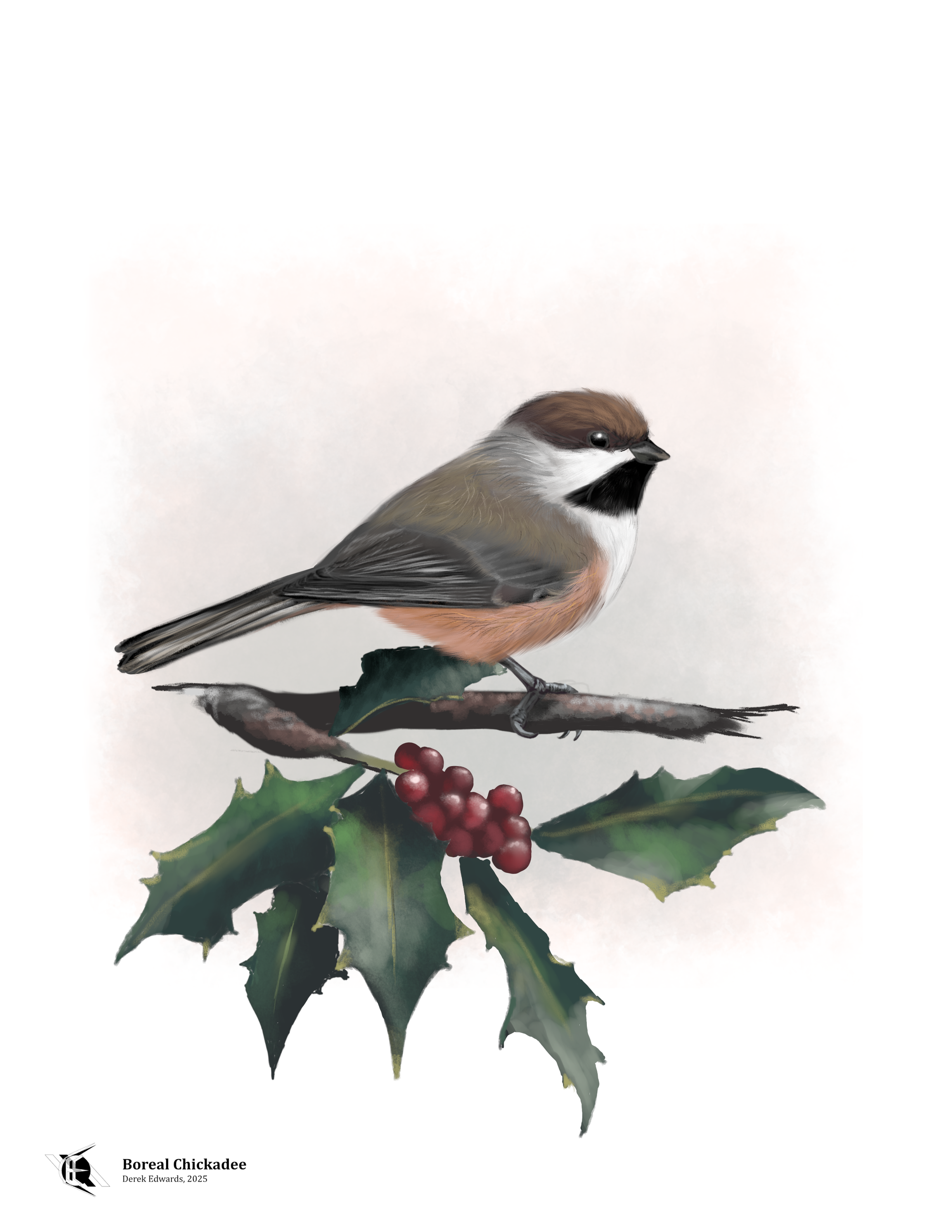
I see for the second week in a row we have a bird of North America’s boreal forest. Last time’s was a Thanksgiving bird, and this drawing is Christmas-y, so I couldn’t really move them apart much, as I typically would.
There are seven species of chickadee — that is to say, seven species of parid called “chickadee” rather than “tit” or “titmouse”. The predominant sort in my home region is the black-capped chickadee, which has a true but somewhat unhelpful name, because five of the chickadees have black caps. This week, we’re looking at one of the other two, the Boreal Chickadee.
This is mainly a Canadian bird, found throughout the vast conifer forest stretching from coast to coast of that country, as well as in interior Alaska. In the contiguous United States it is largely confined to regions still very close to the Canadian border, especially the upper Great Lakes and Maine; in this way the boreal chickadee is an almost perfect inverse of North America’s human population, which is overwhelmingly found in the United States, with most Canadians living close to the border and most Alaskans living near the coasts.*
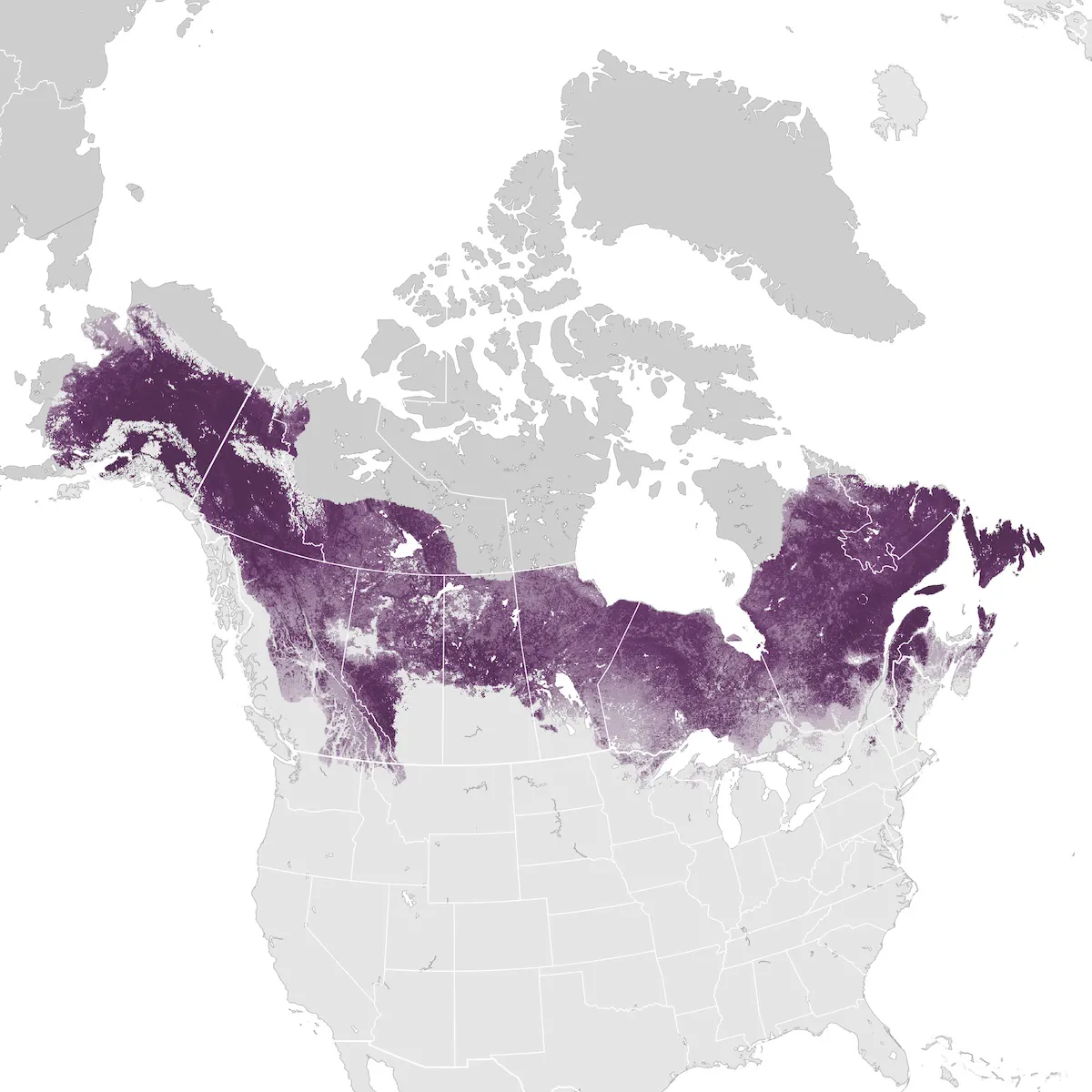
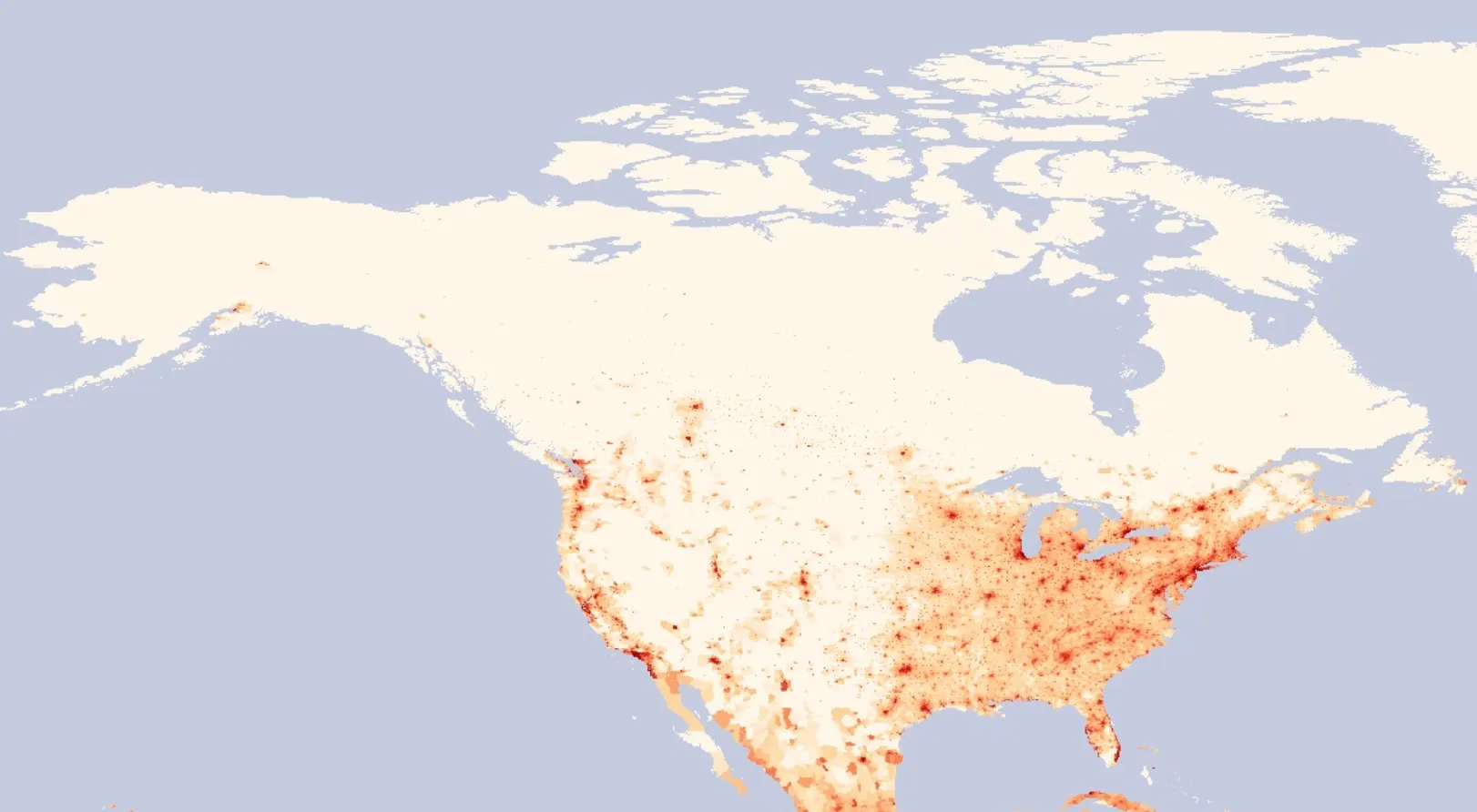
Population densities for the boreal chickadee (left)1 and for people (right)2
The boreal chickadee is thus not an especially widely-known bird, though where it and people are both found, the bird is not particularly shy; like the black-capped and Carolina chickadees to the south, the boreal chickadee is a common backyard bird, which is my defense for drawing this one perched on a holly branch. Holly — at least the recognizable Christmas holly — is not native to North America, though it is grown as an ornamental plant in gardens there. European holly is an evergreen plant, surviving into the winter, when its red berries ripen; while toxic to people, holly berries are an important food source for birds in a time of year when most fruit is gone. Holly has been associated with Christmas for as long as Christmas has been celebrated, dating back to the days of the Roman empire. Roman pagans considered holly to be sacred to their god of time, Saturn, as holly was living and fruiting around the New Year. They decorated with holly branches for Saturnalia, a week-long festival worshiping Saturn that occurred in late December.3 By the Third Century, Christians had begun to commemorate Christ’s birth at around the same time. While accounts of the Nativity mention shepherds watching their flocks in the evening, indicating a vernal date, Jewish tradition had long held that great prophets died on the anniversary of their conception. It was held that the Crucifixion took place on either March 25th or April 6th on the Roman calendar, and while Good Friday would wind up floating around in the year based on the shifting date of Easter, the feast of Annunciation (commemorating the appearance of Gabriel to Mary announcing the virgin conception) was pinned to April 6th in the Greek-speaking East and March 25th in the Latin-speaking West. And, add the 9-month average pregnancy to those dates and you get the dates for Christmas used by the eastern and western churches; for the church in Rome, that was December 25th, which is the date passed on to the United States. This was also the legal date of the Winter Solstice (which by modern reckoning is now placed a few days before), which took on symbolic importance as the day both literal and spiritual light returned to the world.4,5,6 And, since there was holly pinned up for Saturnalia already at this time, the plant and, more broadly, its green-and-red colors came to be adopted by Christmas.
To science, the boreal chickadee is Poecile hudsonicus. Linnaeus had called it Parus hudsonicus, meaning “tit of Hudson Bay”; later the chickadees and some of the Old World tits were moved from Parus to Poecile by the German naturalist Johann Jakob Kaup, who was usually more interested in extinct creatures; he bought the mastodon skeleton unearthed by Charles Wilson Peale in New York when Peale’s museum went bust, moving that most famous American fossil to Darmstadt, where it remains to this day,7 uncovered a mammoth of his own in Germany,8 and gave the pterosaurs their name.9 The name he gave to the marsh tit and its cousins derives from the Greek poikilos, which means “varied in color”;10 while I wouldn’t exactly call the chickadees “colorful” — the boreal is, along with the chestnut-sided, probably the most colorful of them, by virtue of being brown rather than gray — I suppose their high-contrast head pattens count as varied.
I have an additional Christmas gift to you all: it’s been a while since I recorded myself drawing a bird. I’ve done so while drawing this one, which I think was a pretty representative example of how I draw lately. Here you can watch the footage, sped up 3x:
*I use “North America” in an ecological sense, as it is typically used in reference to birds; that is, not including Mexico, which of course is also home to many people.
- Fink, D., T. Auer, A. Johnston, M. Strimas-Mackey, S. Ligocki, O. Robinson, W. Hochachka, L. Jaromczyk, C. Crowley, K. Dunham, A. Stillman, C. Davis, M. Stokowski, P. Sharma, V. Pantoja, D. Burgin, P. Crowe, M. Bell, S. Ray, I. Davies, V. Ruiz-Gutierrez, C. Wood, A. Rodewald. 2024. eBird Status and Trends, Data Version: 2023; Released: 2025. Cornell Lab of Ornithology, Ithaca, New York. https://doi.org/10.2173/WZTW8903
- NASA Earth Observations (NEO). “Population Density | NASA.” Population Density | NASA, n.d. https://neo.gsfc.nasa.gov/view.php?datasetId=SEDAC_POP.
- Dixie Sandborn, Michigan State University Extension. “Holly: A Christmas Tradition.” MSU Extension, December 22, 2016. https://www.canr.msu.edu/news/holly_a_christmas_tradition.
- Seta, Martinus. “Celebrating Christmas on December 25 began as early as 2 century CE, history shows.” The Conversation, December 12, 2023. Accessed December 7, 2025. https://doi.org/10.64628/aan.ynacs7wc5.
- Hughes, Alexander. “Why We Celebrate Christmas on December 25th: A Historian‘s Perspective.” History Tools, May 26, 2024. https://www.historytools.org/stories/why-we-celebrate-christmas-on-december-25th-a-historians-perspective.
- Burger, John. “The Roundabout Way Early Christians Determined the Date of Christmas.” Aleteia, December 17, 2020. https://aleteia.org/2020/12/17/the-roundabout-way-early-christians-determined-the-date-of-christmas/.
- Simpson, George Gaylord, and H. Tobien. “The Rediscovery of Peale’s Mastodon.” Proceedings of the American Philosophical Society 98, no. 4 (1954): 279–81. https://www.jstor.org/stable/3143882.
- The Linda Hall Library. “Johann Jakob Kaup - Linda Hall Library,” March 15, 2022. https://www.lindahall.org/about/news/scientist-of-the-day/johann-jakob-kaup/.
- Pterosauria Kaup, 1834 in Döring M (2022). Checklist dataset https://doi.org/10.15468/c3kkgh accessed via GBIF.org on 2025-12-08.
- Jobling, J. A. (editor). The Key to Scientific Names in Birds of the World (S. M. Billerman et al. editors), Cornell Laboratory of Ornithology, Ithaca.
Curation Links
The race to make the greatest Christmas ad | Stuart McGurk, The Financial Times
"The Christmas ad season is often described as the UK equivalent of the Super Bowl, America’s premier advertising event. For this year’s Super Bowl, some £500mn was spent to target 335mn Americans. This Christmas, UK advertisers will spend £1.4bn to reach a population one-fifth of that size, admittedly over a number of weeks rather than all in one day. 'Napoleon derided us as a nation of shopkeepers...I think we’re actually a nation of shoppers. Retail brands feel like public property. They belong to us.'”
How to paint with sound | Craig Ogden, Aeon
A classical guitarist explains the methods used to produce the music of “a small orchestra”, an instrument able to play multiple music lines at once in multiple ways. Short video clips interspersed throughout demonstrate the methods described.
The ghosts of dead stars | Kovi Rose, Cosmos
“Stars are endlessly collapsing under gravity. This immense pressure drives a fusion reaction, where hydrogen particles join together into heavier elements. The energy produced by this fusion reaction pushes outwards, stopping the star from collapsing in on itself. However, when a star starts to run out of fuel for its fusion engine, the balance breaks down and things get interesting.”
The White Vault (Seasons 1,2) | K.A. Statz, Fool and Scholar Productions
[AUDIO] [FICTION] A repair team becomes stranded within an underground compound on Svalbard, a remote Arctic island, when a serious storm arrives. Waiting out the storm, they make strange discoveries within the caves. (Story told across 20 episodes, each about 20 minutes.)
See the full archive of curations on Notion


Member Commentary