
Running Commentary 12/15/2025
Hello,
This will be the last edition of A Running Commentary for 2025; I’ll be taking the next two weeks off to celebrate Christmas/New Year’s. So, a Merry Christmas and a Happy New Year to you all.
Anyway...
Watching...
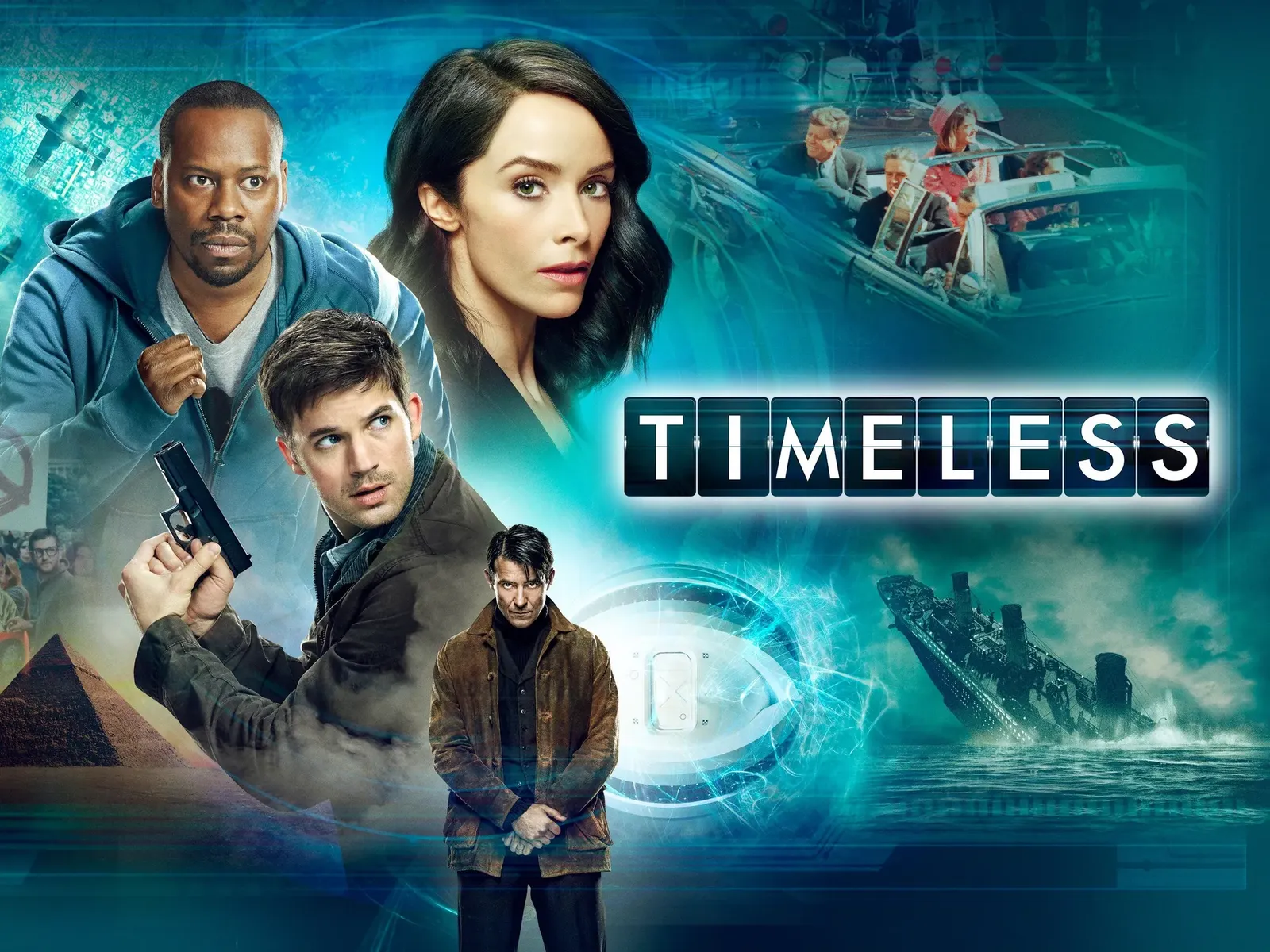
Timeless
I have finished watching both seasons of Timeless — actually I finished it a few weeks ago, but had other things for the newsletter until now — having started it back in the beginning of October. I liked this show, though, if I’m being honest, I wish one or two things had been done a bit better. Here are my futher notes on the full series:
- The series would have mainly ended after just the first season. I liked the second season fine, and think the series overall was strong, but I don't think the show would have sustained a many-season run. It would be tough to sustain stakes while still progressing for that long.
- The episode “Karma Chameleon” somewhat broke the logic of the show. Up until that point, I understood that the lifeboat could only go back to the time when the mothership went; that was why the heroes didn’t just travel back to right before then and lay a trap for the villains. But in this episode, they go back to the early ‘80s to break up Wyatt’s wife’s killer’s parents. After that, the show goes back to the lifeboat only going where the mothership went, for the most part. So maybe it’s just an error in the writing of this particular episode. Especially in Season 2, it would seem using the lifeboat to seek out Rittenhouse sleeper agents before their respective activation days would be a more viable strategy, or even going back to assassinate their pilot while she was stranded in the 1800s.
- That overlookable lapse in storytelling logic aside, I will say that I ended up a bit disappointed in Rittenhouse as villains by the end. Maybe this is because the show was cut short, but I don’t think we ever got any real understanding of what their grand plan was. They served as an effective threat throughout, but I feel like they remained too vague and mysterious right up until the end. What they’re supposed to be seems to shift from episode to episode. In their origins, they seem to be a proto-eugenicist group, but in modern-day this no longer seems to be the case. Somehow they’re both tied to the Confederacy and to Ulysses Grant. They want to change history—but to what end? One gets the general sense of this being a kind of Henry Ford-ist American techno-fascism, but the show is unwilling to fully commit to showing this in any unequivocal way. Lucy’s father, particularly, doesn’t seem to have any goals beyond the advancement of his family’s…wealth? Rittenhouse doesn’t come off as particularly authentic without a clear agenda.
- The other thing that didn’t really get fleshed out was the thing in the first couple of episodes where some people in the past landed just like fugitives in the present. When Season 2 introduced the Rittenhouse sleeper agents, I thought that might tie in, but I guess it was just a dropped thread.
- Over the course of the show, the various different characters do get a chance to shine—not just Rufus and Lucy, who got most of the attention early on. The heroes are what make the series work: all were drawn distinctly, all contributed meaningfully to the story, and all were portrayed competently.
- Overall, I wouldn’t rank Timeless among the top echelon of American network sci-fi, but it’s better than solid and well worth the watch. Its short length means it didn’t have much time to fall off in quality and wasn’t stretched out beyond what the creator’s intended, and it means a viewer can get through it quickly. The story it tells is exciting and well-paced, with some creative twist coming in each episode. It hits a great balance, having a larger story told across the series that moves forward in an intriguing way each episode, while still telling a contained story in every episode. I really enjoyed this series. 7/10
Bird of the Week
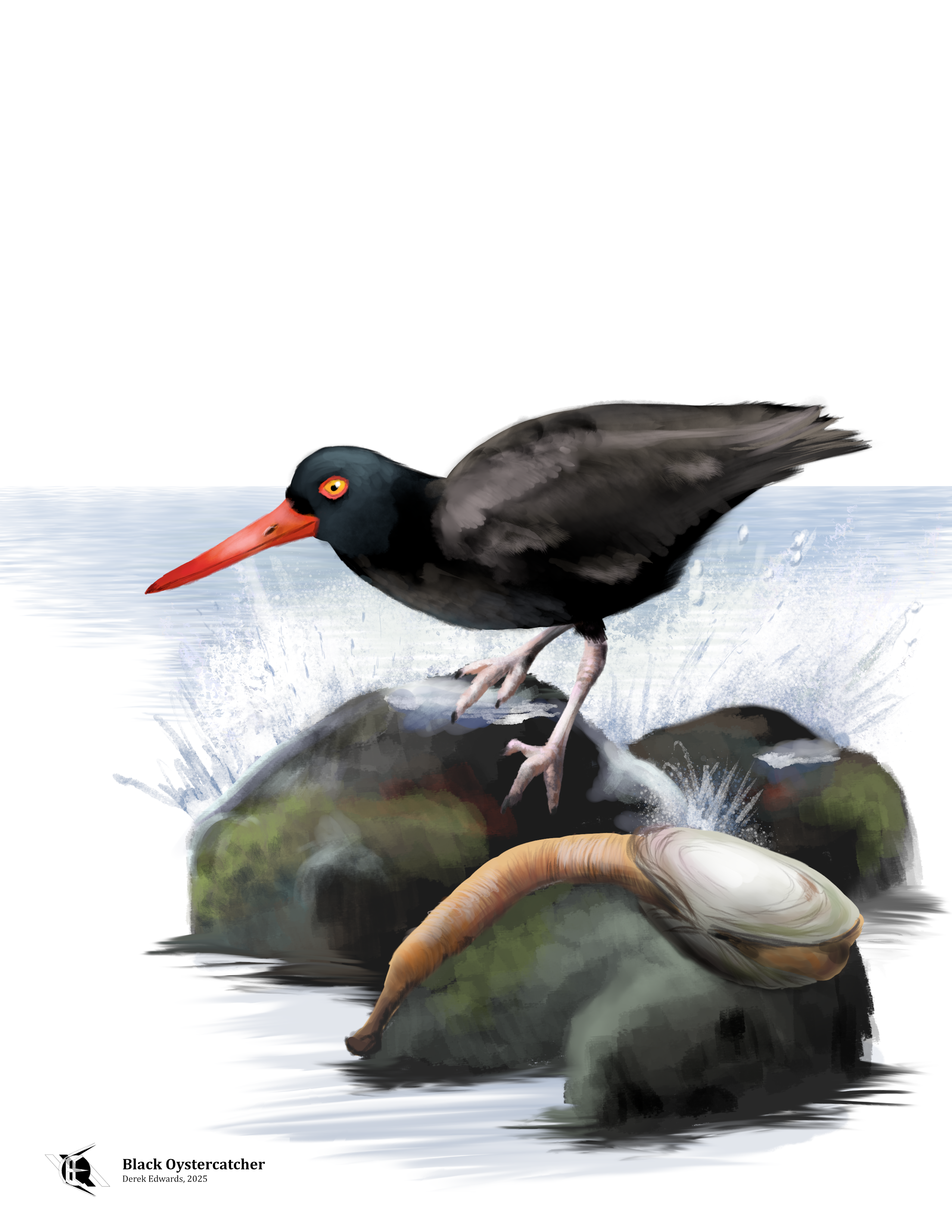
Go to almost any ocean shore, to the slimy zones of the world that vacillate between being “the land” and “the sea” with the tides, where animals, plantlike, cling to the rocks or root themselves into the mud, and you’ll likely find an oystercatcher. Fitting their ambiguous homes, oystercatchers are creatures of duality. While there are eleven extant species in the world, oystercatchers essentially come in two sorts: pied and dark; the pied oystercatchers are two-toned, black above and white below, and they typically live on sandy beaches and muddy expanses; the dark oystercatchers are uniformly blackish-brown and also scrabble over rocks and through intertidal pools. There are five pied species, five dark species, and the “variable oystercatcher” of New Zealand among which some individuals are black-bellied and some white-bellied. All oystercatchers share pink feet and a carrot-orange shucking blade of a bill. The dark-bodied species of North America’s Pacific coasts is the one formally called the Black Oystercatcher, though that term sometimes is informally applied to other dark species.
Found from the shores of Alaska down to the Gulf of California, the black oystercatcher is, like its cousins, more of a musselcatcher. Their bill is flattened, with sharp edges, and when a perusing oystercatcher comes upon a mussel with its shell held open, a quick strike with that bill will sever the mussel’s adductor and allow the bird to eat the rest of the flesh. If all the mussels it finds are sensibly shut already, the oystercatcher’s bill is able to dislodge an entire shellfish and, once it’s placed it somewhere suitably secure, to break through the thinner points of its shell. By this method oystercatchers also eat limpets. Buried prey like razor clams and marine worms are often dug out of sand and mud, particularly by the pied species more prone to living on such shores.1
While the black oystercatcher stays close to rocky shorelines at all times, some other species will move to fields just inland, either to nest or to find food in the winter; these birds typically feed on earthworms while away from the water.2 When oystercatchers are forced to change their feeding habits, the shape of their bills will slightly change, with worm-eating, field-wintering oystercatchers having long, pointed bills, where mussel-cracking summer birds have shorter chisel-tipped bills. It seems that the physical actions of feeding effect the wear of the bills; diet forms the bill, rather than the reverse.3
The particular shellfish I’ve drawn here with my black oystercatcher is a Pacific geoduck — pronounced “gooey-duck”, deriving from the name given to the mollusks by the Lushootseed, people who lived in the Puget Sound region, the modern-day greater Seattle area4 — the largest species of burrowing clam. Geoducks reach their full size, about 2 pounds on average (though some are many times larger), over the course of fifteen years, and can live for more than a century beyond this age. They have the shell of a much smaller clam, bulging rather ludicrously even when still young and small, with a long “neck” extending from one end, used to siphon up nutrient-bearing water. The pacific geoduck and the black oystercatcher have nearly identical geographic ranges, but the clams are too large for the birds to eat. People, on the other hand, eat geoducks frequently enough to support an aquaculture industry and export market, mostly selling across the Pacific to China or to local restaurants where the clams are better-known and thus less off-puttingly strange.5 Washington’s Evergreen State College features “Speedy the Geoduck” as their official mascot.6
To science, the black oystercatcher is Haematopus bachmani. The genus name for the oystercatchers means “bloody-foot” in Greek; despite the bird’s habits of walking across sharp, mussel-encrusted rocks, the name is figurative, referencing the pink blush of their feet and legs. The species name was given by J. J. Audubon in honor of the Rev. Dr. John Bachman, a friend of his from Charleston, South Carolina.7 Bachman had little to do with this first description of the bird, which Audubon described from specimens sent to him by the scientist and explorer John Kirk Townsend. Audubon attempted to honor Townsend in the bird’s name, but, as it happens, Audubon considered the black oystercatcher collected at the mouth of the Columbia river (what he called “Bachman’s Oyster-Catcher”, H. bachmani) and the black oystercatcher collected on the coast of California (”Townsend’s Oyster-Catcher”, H. townsendi) to be two separate species. As he listed Bachman’s first, H. bachmani is the name given precedent for what was, in fact, a single species.8 Bachman was the one to collect the type specimen for the Bachman’s warbler, though this bird is, unfortunately, now extinct; noted birder Kenn Kaufmann has speculated that the Bachman’s warbler was a nesting specialist in wild river cane, and that, much as the Kirkland’s warbler was nearly driven to extinction with the wholesale logging of jack pines in the upper Great Lakes, the Bachman’s warbler was driven extinct by the clearing of canebrakes to be converted to farmland.9
To science, the Pacific geoduck is Panopea generosa; the genus name seems to be taken from Greek mythology, the name of one of the Nereid nymphs, associated with the sight of land by sailors; otherwise the name literally means “all-seeing”,10 an odd name, in its literal sense, to give to a sightless creature that lives buried in mud. The species name refers to the overflowing nature of the clam’s shell.
- “Food Habits.” American Oystercatcher Working Group, January 22, 2022. https://amoywg.org/american-oystercatcher/food-habits/.
- Heppleston, P. B. “The Feeding Ecology of Oystercatchers (Haematopus Ostralegus L.) in Winter in Northern Scotland.” Journal of Animal Ecology 40, no. 3 (October 1, 1971): 651. https://doi.org/10.2307/3443.
- Swennen, C., L.L.M. De Bruijn, P. Duiven, M.F. Leopold, and E.C.L. Marteijn. “Differences in Bill Form of the Oystercatcher Haematopus Ostralegus; a Dynamic Adaptation to Specific Foraging Techniques.” Netherlands Journal of Sea Research 17, no. 1 (October 1, 1983): 57–83. https://doi.org/10.1016/0077-7579(83)90006-6.
- Merriam-Webster.com Dictionary, s.v. “geoduck,” accessed December 15, 2025, https://www.merriam-webster.com/dictionary/geoduck.
- Tomky, Naomi. “All About Geoduck: The Life of a (Delicious) Oversized Mollusk.” Serious Eats, August 10, 2018. https://www.seriouseats.com/what-is-a-geoduck-clam-seattle-pacific-northwest-how-geoduck-are-farmed.
- The Evergreen State College. “Our Mascot,” n.d. https://www.evergreen.edu/student-life/our-mascot.
- Jobling, J. A. (editor). The Key to Scientific Names in Birds of the World (S. M. Billerman et al. editors), Cornell Laboratory of Ornithology, Ithaca.
- Audubon, John James. “Bachman’s Oyster-Catcher, Haematopus Bachmani, Aud. [Pl. 325].” The Birds of America : From Drawings Made in the United States and Their Territories 5 (1842): 243--244. https://doi.org/10.5962/p.319438.
- Kenn Kaufman, The Birds That Audubon Missed: Discovery and Desire in the American Wilderness (Simon and Schuster, 2024), p. 190.
- Atsma, Aaron J. “Panopeia”, Theoi Project. https://www.theoi.com/Pontios/NereisPanopeia.html
Curation Links
For this last RC of 2025, here are my favorites among links curated in this year’s newsletters
Asleep at the Wheel in the Headlight Brightness Wars | Nate Rogers, The Ringer
“There appear to be two types of drivers in North America these days: those who think about headlights only when one of theirs goes out, and those who fixate on them every time they drive at night. If you’re in the first camp, consider yourself lucky. Those in the second camp—aggravated by the excess glare produced in this new era of light-emitting diode headlights—are riled up enough that the National Highway Traffic Safety Administration receives more consumer complaints about headlights than any other topic”
Long Before Pantone, This Bird-Based System for Describing Color Was a Hit | Alice Sun, Audubon Magazine
“In the early 20th century, ornithologist Robert Ridgway published a massive dictionary to categorize birds’ hues, from Peacock Blue to Duck Green. His work still resonates for artists and designers today.”
Revolution in the air | Mark Miodownik, The Guardian
Excerpt from Midiownik’s It's a Gas, a history of anesthetic vapor, from nitrous oxide to ether to chloroform to nitrous oxide again.
Death of an Accent | Mo Rocca, John McWhorter, & Jessica Drake, Mobituaries
[AUDIO] A look at what’s sometimes called the “Midatlantic” or “Transatlantic” accent, the New York-to-Boston, semi-British sounding manner of speaking that became the standard for proper speech in the beginning of the 20th Century before falling completely out of favor (save for Frasier) by the beginning of the 21st.
Everything I Thought I Knew About Nasal Congestion Is Wrong | Sarah Zhang, The Atlantic
“Nasal congestion, I’ve learned in all this, is far weirder than I ever thought. For starters, the nose is actually two noses, which work in an alternating cycle that is somehow connected to our armpits.”
The Eggshell's Outer Shell | Ernie Smith, Tedium
A history of the egg carton. These make the mass-commercial sale of eggs possible, so it should come as no surprise that a lot of different inventors contributed to the forms they take today.
A Brief History of Valentine's Cards | Hannah Kingwell & Holly Hyams, Aeon Videos
[VIDEO] “In this video from the Victoria and Albert Museum in London, the curator of prints Zorian Clayton provides a brief history of the origins of Valentine’s Day before digging into some treasured Valentine’s cards in the museum’s collection. Starting with an example from 1780 and ending with some notable designs from contemporary artists, Clayton traverses mechanically animated, ornately designed and even some quite mean-spirited examples. Through these objects, he demonstrates that, while fashions and formats have changed, the motifs and messages used to convey romantic love across the Anglos world have remained quite steady over the past several centuries.” (16 minutes)
The Comet Panic of 1910, Revisited | Sam Kean, Distillations
Halley's Comet passes within sight of the Earth every 76 years, never really without incident, but not often inspiring as much dread as it did in 1910, when the new science of spectroscopy revealed cyanogen and hydrogen in the comet's tail, leading to wild claims that it might poison the whole planet or else turn our sky to water, drowning and asphyxiating us all at once. (We made it unharmed.)
How a Stuffed Animal Named Billy Possum Tried—and Failed—to Replace the Teddy Bear as America's National Toy | Howard Dorre, Smithsonian
When something new happens surrounding a new president, it can be hard to tell whether it’s a one-off thing or a new American tradition. When Theodore Roosevelt’s refusal to shoot a captive bear led to the teddy bear craze, that was something new; there hadn’t been toy crazes attached to previous presidents (Lincoln Logs didn’t come along until the nineteen-teens). But would there be toy crazes attached to presidents from then on? The William H. Taft supporting creator of the Billy Possum sure hoped there would be. (There would not be.)
Hooked on Big Bass | Ryan Krogh, Texas Monthly
"When it was created, Valley Lake, with a maximum depth of roughly 35 feet, was stocked with catfish, crappie, freshwater drum, and largemouth bass, but it has rarely been open to the public. Apart from the occasional TXU executive (or local sneaking in), firsthand accounts were rare. It was the equivalent of Area 51 for anglers, whispered about at local barbecue joints and bait shops.”
The Impact Sprinkler - more clever than it seems! | Technology Connections
[VIDEO] A look at the intricate, elegant design of a common sort of lawn sprinkler, familiar to many but which, unless you have one yourself and examine it while it’s running, you probably don’t quite understand. Why does it sput-sput-sput, what makes it spin, and why does it sweep in one direction faster than in the other? The answers are all in this video. (10 minutes)
The Father of Modern Metal | Jonathan Waldman, Nautilus
Excerpt from Waldman’s Rust: The Longest War, which is a book worth reading in full, telling of Harry Brearley’s invention of stainless steel, which was not the first invention of the material but was the one that led to the industry. “The stuff he cast from the electric furnace at Firth’s on Aug. 20, 1913, was nothing new. At least 10 others had created it, or something like it, before; at least half a dozen had described it; and one guy even explained it, and explained it well. Others had patented it, and commercialized it. Before Brearley got around to it, at least two dozen scientists in England, France, Germany, Poland, Sweden, and the United States were studying alloys of steel by varying the amounts of chromium, nickel, and carbon in it. Faraday had tried as much nearly a century earlier. It’s not like Brearley was exploring unknown territory. That he is credited with discovering stainless steel is due mostly to luck; that he is credited with fathering it is due mostly to his resolve.”
Jambusters | Joshua Rothman, The New Yorker
Reporting on the engineering team at Xerox tasked with preventing paper jams in everything from office copiers to massive publishing presses. A lot happens to a sheet of paper as it passes through a printer, following a specially prepared “paper path” through rollers, belts, and vacuum pumps as ink or toner is applied and bonded to its surfaces. The jambusters must account for space constraints, the delicateness of partially-performed printing, and, in those office copiers especially, for inexpert users’ ability to clear jams when they do occur. Its a puzzling, cross-disciplinary job, but those who have it love it.
Revenge of the Earthworms | Moira Donovan, The Walrus
Earthworms are greatly beneficial to garden soil, so many people have come to believe they are a positive good wherever they can be found. But they are not native to the boreal forests of Canada, where they have been introduced and where they have commenced reshaping the ecosystem in massive ways belying their small size. Now, a second, more active species spreading up through Ontario might raise awareness of this squirmy ecological threat.
Portrait of a Worm on Fire | Claire L. Evans, WIRED
“One of the simplest, most over-studied organisms in the world is the C. elegans nematode. For 13 years, a project called OpenWorm has tried—and utterly failed—to simulate it.”
A-Ha - "Take On Me" | Paul Waaktaar-Savoy & Hrishikesh Hirway, Song Exploder
[AUDIO] Interview with the writer of Norway's biggest pop hit, which went through several iterations between when Waaktaar-Savoy first came up with the hook as a teenager and when it finally became a big hit in 1985. (35 minutes)
Court Sketcher | Hatty Nestor, Granta
“Trials do not consist of a single person in a courtroom. The accused may also be accompanied by barristers, jurors, prosecutors, and members of the public watching from the viewing gallery. As such, most of the courtroom sketches I’ve encountered depict more than one person. In the absence of a camera, the artist’s purpose is to capture the moment and the mood, to produce a freeze frame of the central cast.”
The Price is Wrong | Sharon Su, Van Magazine
After decades of obscurity, the works of composer Florence Price have finally gotten a wide release from a major music publisher. Only, as many performers have found, these manuscripts are often riddled with errors having apparently been inherited from the various earlier editions and not caught during an inattentive review process.
Light Speed is Not a Speed | Andy Dudak, Clarkesworld
[FICTION] “‘Picture a man on a camel loping along at fifty miles an hour. The mounted piece fires a gunstone at a hundred miles per hour. How fast is the gunstone moving when it strikes you? You’re stationary. You’re standing there like a dolt.’ Lig snorts. ‘Hundred and fifty miles per hour?’ ‘Right.’ ‘I’d become a fine mince. You could sell me in pies.’ ‘And if you were running toward the gunstone at ten miles per hour, because you’re just that foolish?’ ‘One-sixty. So . . . ’ ‘Light is different, they say. Always moving at light speed.’ ‘You lost me, El.’ ‘If it’s true, it means . . . ’ He can’t put into words what he’s thinking, but he pictures light moving, independent of reference frames. ‘If it’s true, then light speed is not a speed. I could fly like a bullet toward a star, or a torch, and the light hitting me would still be moving at light speed. It doesn’t add up.’ ‘What doesn’t?’ ‘Light!’ Lig clutches his stomach. He heads for the stinking, buzzing necessary down the lane—three-bit per use. El gives up trying to explain himself. His thoughts race, approaching light speed, never quite getting there. If light speed is not a speed, what is it?
A context, he thinks. But for what?
For everything.”
The Murderer | Eve Morgan, JOYLAND
[FICTION] “This one woman, Rebecca, on this one July evening, did something she never did before. She fell asleep on her sofa, with a lamp on. The day had been long, and her last unspooling thought was simply how happy she was to have made it this far. A smile of fresh air cradled her, and she slept for her favorite amount of time: eleven hours. When she woke up it was with a jump, moon-eyed, choking on the thick pulse in her throat, hoping she had imagined the knocks at her door. A woman she didn’t recognize, with pitch black hair and a pitch blacker jacket, stared back at her through the peephole. Rebecca was relieved to see a woman. She opened the door. ’I’m very sorry,’ the murderer said. And she knocked Rebecca out cold.”
Tie A Yellow Ribbon | Harry Turtledove, Reactor
[FICTION] From the master of alternative history, we have the story of an American diplomat in 1980 returning home from captivity in Tehren, home to the land of his people, the sasquatches.
Tictocq; the Great French Detective, in Austin | O. Henry
[FICTION] O. Henry’s parody of detective stories, most likely of the Arsene Lupin stories by Poe. Quite funny.
See the full archive of curations on Notion



Member Commentary