
Running Commentary 1/26/2026
Hello,
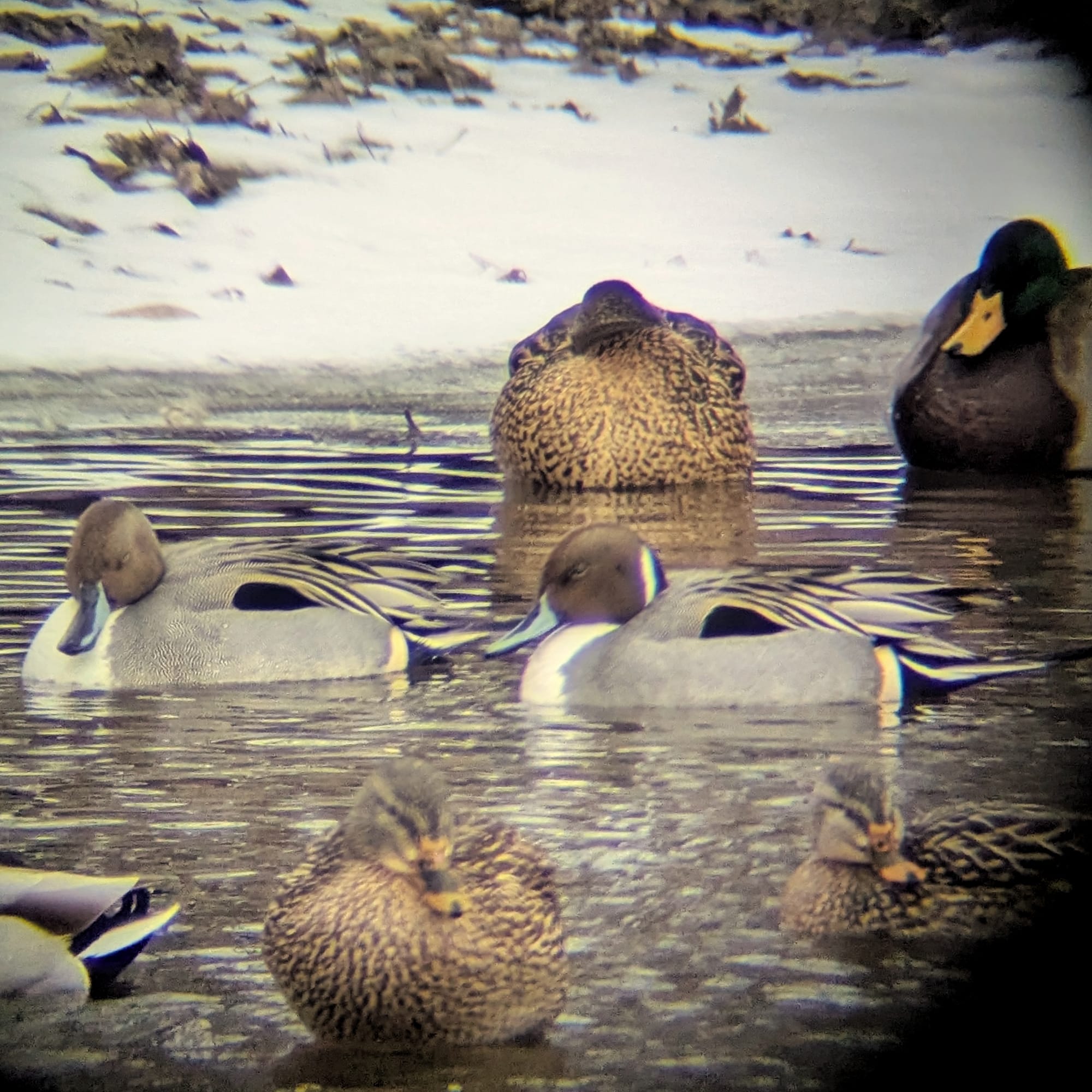
I finally got a good look at northern pintails! Long-time readers will know that the northern pintail was a birding nemesis of mine, the last inland duck commonly seen in Michigan that I saw, a bird that I made several attempts to find before I finally saw a pair, at a great distance and through reeds. Since then they’ve been on my life list but also still on my list of birds that I hoped to see again, more clearly. Recent readers will remember a couple newsletters ago when I mentioned going to look for these and not finding them. Well, other birders kept reporting them and the third time was the charm for me to find two males among a large flock of mallards (and a few black ducks). Here’s a photo I took through my spotting scope:
I got to see these right before an absolutely brutal cold snap, which has frozen the rivers in town and that I’m sure has driven these ducks further south where they’re supposed to be in January.
Anyway...
Watching...
Listers
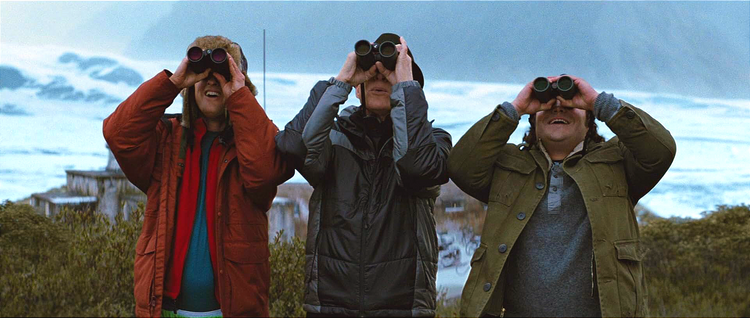
- Listers is a documentary about birding that came out last year to a pretty warm reception among birders. It follows the experiences of two non‑birder brothers who learn about how some people will go on a “Big Year” and try to see as many birds as they can in the United States in a single year. They decide to jump into birding by doing a Big Year of their own. They don’t exactly set out to win (and they don’t, though they place respectably), but to do a Big Year for the experience of it and to get a crash course in birding.
- As a look at the hobby, Listers is a decent summation, though it tends to focus on the more extreme end of birding. If you only knew the brothers’ story, you’d get the impression that birders spend all their time and money chasing birds to add to their lists. That certainly describes some birders, but most people don’t do that, and a non‑birder might get turned off by how intensely birding is portrayed—thinking they’ll be expected to see 400+ birds in their first year or to submit a list to eBird every day.
- The film does make the point, in one section, that most people are at least arguably birders, even if they don’t identify themselves that way. But the people in between the vaguely nature‑conscious and the obsessive world‑listing road‑trippers—people like myself, frankly—are a bit left out of Listers.
- One thing Listers does well is show that there are birds to be found everywhere. The brothers show birds they find at gas stations, in parking lots, and in other places that aren’t official wildlife refuges. That’s something a lot of people don’t understand, and once you realize that there’s good birding to be found in many places near you, you have a clear path into the hobby.
- Toward the end of their year, the brothers start to burn out on birding. Quentin says he thinks he’ll always remain a birdwatcher, but that competitive listing isn’t really something he enjoys by the end. While the documentary shows a lot of love for birds, it’s a more mixed look at the culture of birding in the 2020s. Comparing this account of a Big Year to Kaufman’s Kingbird Highway or Obmascik’s The Big Year, one notices that the Reiser brothers are a lot more dependent on technology—particularly Cornell’s eBird and Merlin—than birders of the 20th century. There’s a point at which they lose access to these tools, and it throws them off quite a bit. Furthermore, you see quite often how a birder’s social‑media status‑seeking has encouraged competitiveness in the hobby. It’s a different world for birders now compared to days past.
Eating...

Michigan is not without some good Mexican food but it’s not a hotspot for the cuisine either. Growing up I generally held that I didn’t like Mexican food but that mainly meant that I didn’t like Taco Bell (which still stands). When I’ve had better Mexican food, I’ve generally liked it fine. This year, I’ve decided to try to learn a few recipes and see if I have a taste for any of them. First up was chile verde con cerdo, or “green chili with pork” in English. This is a New Mexican dish, so technically American but still part of the same culinary tradition. I didn’t change the recipe (which was from America’s Test Kitchen) much beyond omitting the cilantro — I’m not sure if I don’t like cilantro because I’m genetically disposed to think it tastes of soap or if I don’t like it because I think it tastes bad, same as I think sage tastes bad. I don’t eat enough soap to recognize the taste in other things. I will also say that clearing the charred skin from the roasted chiles isn’t super important to do completely; it all gets blended up.
Ingredients
- 1 (3½- to 4-pound) boneless pork butt roast, trimmed and cut into 1½-inch pieces, trimmings reserved
- 1 TBSP + 1 tsp kosher salt, divided
- 1 cup water
- 1½ pounds tomatillos, husks and stems removed, rinsed well and dried
- 5 poblano chiles, stemmed, halved, and seeded
- 1 jalapeño chile, stemmed and halved
- 1 onion, peeled, cut into 8 wedges
- 5 cloves garlic, unpeeled
- 1 TBSP vegetable oil
- 1 tsp dried oregano
- 1 tsp ground cumin
- ⅛ tsp ground cinnamon
- 1 pinch ground cloves
- 2 bay leaves
- 2 tsp sugar
- 1 tsp pepper
- Lime wedges
Procedure
- Toss pork pieces with 1 TBSP salt in large bowl. Cover and refrigerate for 1 hour.
- Chop pork trimmings coarse and simmer with water in a Dutch oven over high heat, cooking until all liquid has evaporated (~12 minutes, begin stirring at this point) and a dark fond has developed and the trimmings have crisped (~6 minutes further). Discard trimmings and retain rendered fat in the pot.
- Arrange tomatillos, chiles, onion, and garlic skin-side up on a foil-lined rimmed baking sheet, drizzle with oil, and broil 6 inches from the element for 6 minutes. Rotate sheet and broil for a further 6 minutes.
- Turn off broiler and set oven to 325 °F
- Allow vegetables to cool, then remove skins from garlic and as much blackened pepper skin as will easily come away.
- Roughly puree all vegetables in a food processor.
- Heat rendered fat in Dutch oven over medium heat until shimmering.
- Add oregano and spices and cook until fragrant.
- Add vegetable puree, bay leaves, sugar, 1 tsp salt and cook, scraping up any browned bits on the bottom of the pot.
- Add pork and bring to a simmer.
- Cover and cook in oven for 1½ hours; stir halfway through to make sure all pork pieces spend time braising in the puree.
- Allow to rest covered for 10 minutes before serving with lime wedges.
Bird of the Week
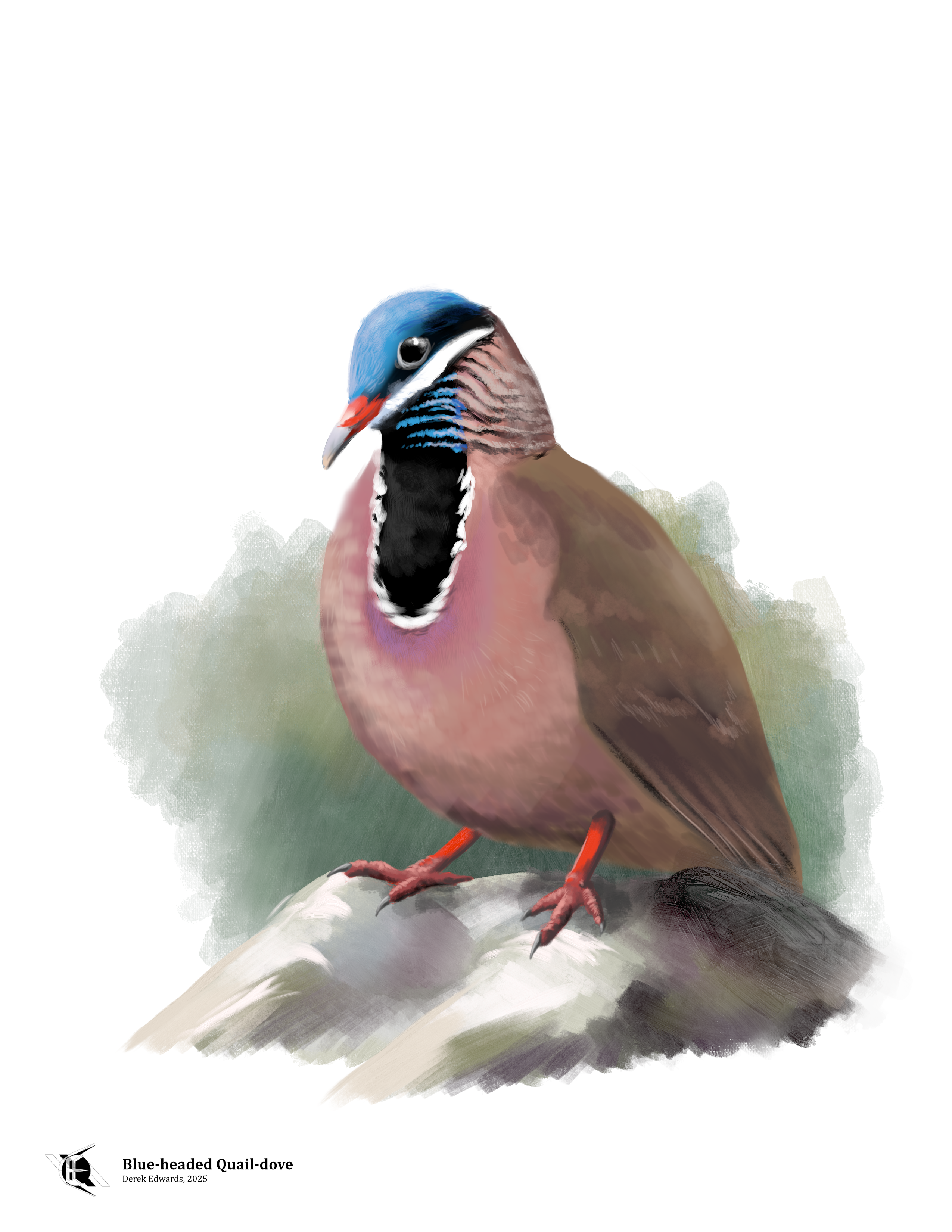
I don’t do enough Caribbean birds. I’ve done a few warblers that winter in the Caribbean, and some widespread birds that occur there along with many other places. But I believe the only true Caribbean endemic I’ve drawn so far has been the Cuban tody. That’s too bad, because the region has a lot of beautiful birds found nowhere else, such as this week’s another Cuban species, the Blue‑headed Quail‑dove.
J. J. Audubon claimed that, in his day, these birds would regularly visit the Florida Keys in the springtime1, but those days seem to be past; eBird shows no reports of the species away from Cuba. Cuba is an interesting case for nature lovers: it’s an island, which always makes for unusual flora and fauna, and compared to other large Caribbean islands, Cuba is relatively undeveloped. The country’s history as a Soviet satellite didn’t leave its ecology untouched, but it did render large portions of the island a kind of de facto nature preserve — not counting the actual preserves and parkland — due to a weak economy and an embargo blocking investment from the wealthy land on the other side of the Straits of Florida. I don’t want to dismiss the hardships faced by the Cuban people, but it can’t be denied that Cuba’s isolation has been a boon for Cuban birds.2
Even still, some birds in Cuba are struggling to survive, the blue‑headed quail‑dove sadly very much included. Only about a thousand of these birds live today, and these are threatened by habitat loss due to logging and by hunting, both by hungry people and hungry cats.3 If this situation is not reversed in the coming years, the blue‑headed quail‑dove will become the latest Caribbean species to be lost.
In this case the loss would be especially tragic, as the blue‑headed quail‑dove is an unusually distinctive species. Latin America is home to nineteen species of quail‑doves, which are doves, not quail, and so called because they are brownish‑bodied and tend to stay near the ground. Eighteen of these belong to the same subfamily, and the three other quail‑doves found in Cuba are either also found on the mainland or are closely related to mainland species. The blue‑headed quail‑dove is not closely related to these or to any other dove species; it is placed in its own subfamily within the Columbidae. Physically it most closely resembles the doves of Australasia, but this is apparently not due to a genetic link with those birds. The blue‑headed quail‑dove is the only member of its lineage among the doves and pigeons, extinct or extant, making it, from a genetic standpoint, an even stranger bird than the dodo, another island columbid to which it is often compared.4,5
Ecologists sometimes romanticize the limited industrialization of Cuba and the way it has left much land relatively wild, but it wasn’t wealthy industrialized societies who destroyed the dodo in Mauritius or the passenger pigeon on the North American mainland; it was people clearing land for a basic extractive economy and hunting for food, much like the people of Cuba today.
To science, the blue‑headed quail‑dove is Starnoenas cyanocephala, which is nearly the same as its English name in meaning. Linnaeus named it Columba cyanocephala, Greek for “blue‑headed pigeon,” which was its common name in the 18th and 19th centuries. Charles Lucien Bonaparte was the first to place this odd bird in its own genus, which he actually gave an Italian, not Latin, name, a portmanteau translating to “partridge-dove.”6 Partridges and quail are different birds, but either is appropriate to describe the ground‑dwelling habits of this third kind of bird.
- Audubon, J. J. Birds of America Vol V, Plate 284 “Blue-headed Pigeon, or Ground Dove”
- Linden, Eugene. “The Nature of Cuba.” Smithsonian Magazine, November 17, 2013. https://www.smithsonianmag.com/travel/the-nature-of-cuba-81691555/.
- IUCN. “Blue-headed Quail-dove Starnoenas cyanocephala.” IUCN Red List. August 26,2020. https://www.iucnredlist.org/species/22690970/178419260
- Oswald, Jessica A., Bret M. Boyd, Avery R. Szewczak, Michelle J. LeFebvre, Brian J. Stucky, Robert P. Guralnick, Kevin P. Johnson, Julie M. Allen, and David W. Steadman. “Genomic Data Reveal That the Cuban Blue-headed Quail-dove ( Starnoenas Cyanocephala ) Is a Biogeographic Relict.” Biology Letters 21, no. 1 (January 1, 2025): 20240464. https://doi.org/10.1098/rsbl.2024.0464.
- Pinson, Jerald. “Unique Dove Species Is the Dodo of the Caribbean and in Similar Danger of Dying Out.” Florida Museum Research News, March 17, 2025. https://www.floridamuseum.ufl.edu/science/unique-dove-species-is-the-dodo-of-the-caribbean-and-in-similar-danger-of-dying-out/.
- Jobling, J. A. (editor). The Key to Scientific Names in Birds of the World (S. M. Billerman et al. editors), Cornell Laboratory of Ornithology, Ithaca.
Curation Links
The Ghosts in the Machine | Liz Pelly, Harper's Magazine
Excerpted from Pelly's Mood Machine, an examination of Spotify’s increasing featuring of low-royalty stock music in mood-based playlists.
Is Fleur de Sel Worth Its Salt? The World Says Oui (and Sí and Shì) | Cathy Erway, TASTE
A look at three nations’ traditions of producing very high-end sea salt in seaside marshes.
What Is a Manifold? | Paulina Rowińska, Quanta Magazine
“Standing in the middle of a field, we can easily forget that we live on a round planet. We’re so small in comparison to the Earth that from our point of view, it looks flat. The world is full of such shapes — ones that look flat to an ant living on them, even though they might have a more complicated global structure. Mathematicians call these shapes manifolds. Introduced by Bernhard Riemann in the mid-19th century, manifolds transformed how mathematicians think about space. It was no longer just a physical setting for other mathematical objects, but rather an abstract, well-defined object worth studying in its own right.”
The Hound of the Baskervilles | Sherlock & Co.
[AUDIO] [FICTION] Really, I recommend this entire audio drama series, which re-imagines the Sherlock Holmes stories in the form of a true crime podcast hosted by Dr. John Watson, but any Sherlock adaptation might best be judged on how they tackle the big one. A note if you jump in here: Mariana Ametxazurra is this show’s version Mrs. Hudson, with Hudson being the properties company she works for when she first meets Holmes and Watson. (ten episodes, roughly 7 hours total)
See the full archive of curations on Notion
Member Commentary